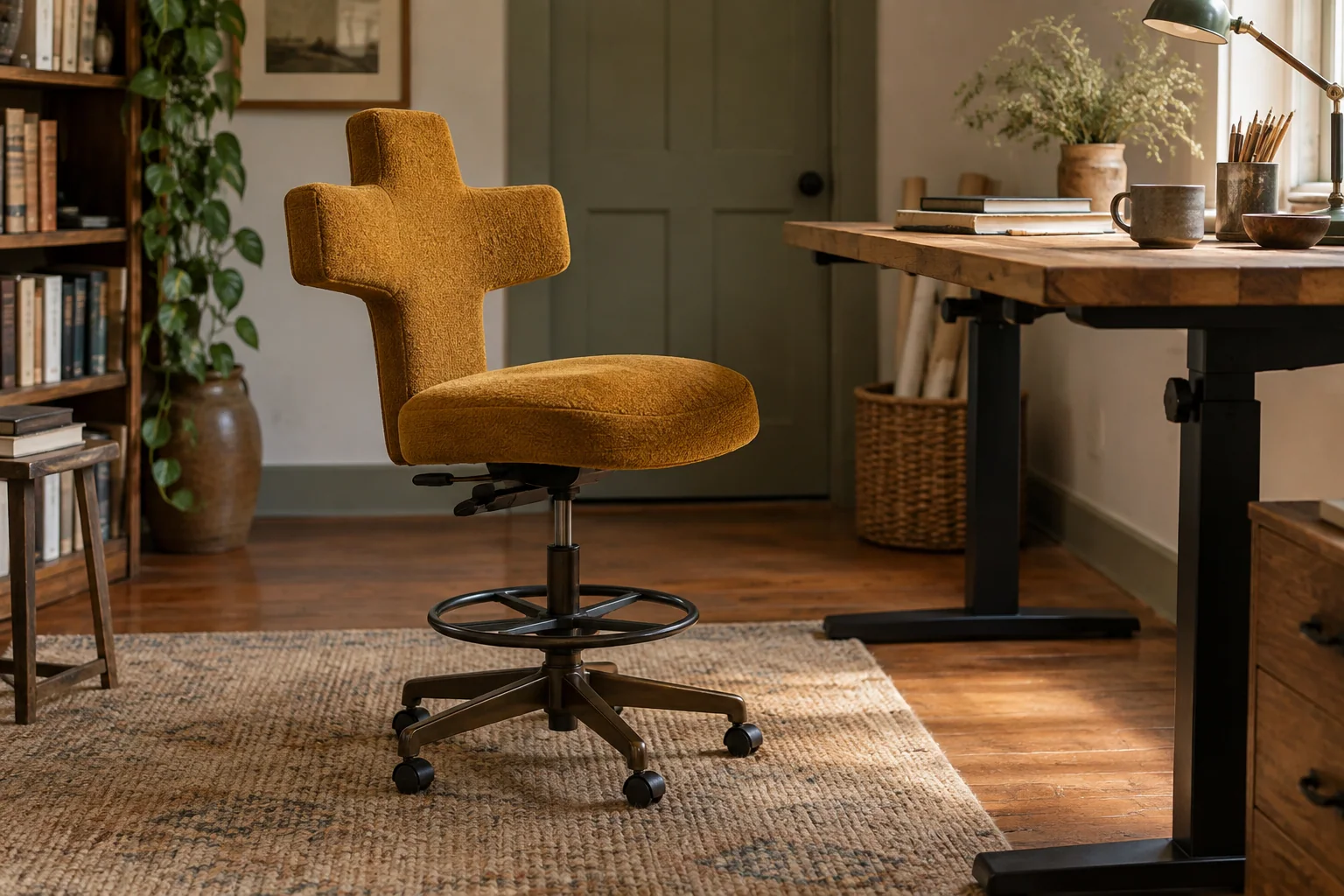
Similar-looking chairs can serve different desk heights
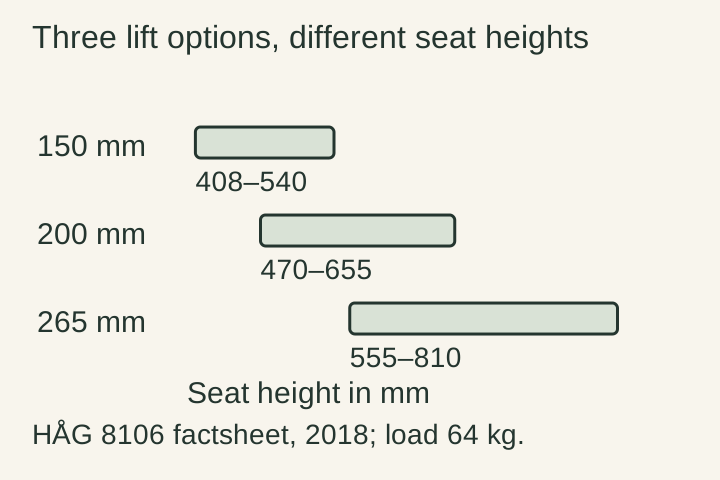
The upholstered Capisco 8106 is documented with several lift options. Flokk’s 2018 factsheet gives distinct seat-height ranges for 150, 200 and 265 mm lifts, measured under its stated test conditions. Those figures are a useful comparison reference; they are not measurements of the old chair in an advertisement.[1]
| Lift option | Published seat-height range |
|---|---|
| 150 mm | 408–540 mm |
| 200 mm | 470–655 mm |
| 265 mm | 555–810 mm |
The practical difference is substantial. A chair whose lowest position is around the upper end of your usual sitting height may be unsuitable for a fixed low desk. Do not buy first and assume every cylinder can simply be exchanged: have the complete configuration and compatible replacement confirmed.
Try the saddle, not just the adjustments
Sit in the intended forward position and adjust the chair using the instructions for that version. Notice how the saddle shape supports you and whether the front contour feels comfortable. Give it several minutes; an unusual seat can feel novel before you know whether it suits your work.
If you expect to change position, try only the positions permitted for that model and do so at your actual working height. The goal is a comfortable way to reach your work, not proving that you can imitate every pose in a product photograph. Avoid treating a different sitting style as a promise to solve a health problem.
Measure your desk surface and the clear space beneath it. Then check where your hands and forearms settle when you work. A height-adjustable desk can offer more options, but its minimum and maximum settings still need to match the chair and your preferred position.
Foot support belongs in the purchase
Flokk’s product information distinguishes lift choices and foot-support options. Ask whether the actual chair includes the appropriate base, castors and any foot ring for its configuration. A ring seen in a photograph should be identified along with its attachment and compatibility, not treated as a universal accessory.[2]
Try reaching the intended support with your feet in the positions you will use. If you are constantly searching for somewhere to rest them, the arrangement is not yet resolved. Check the floor surface too: the selected castors should suit both the chair and the floor, rather than merely fitting into a socket.
Look for damage or unexplained movement in the base, support ring and attachment areas. Do not climb on the chair or use a ring as a step to test it. Have uncertain parts assessed before normal sitting.
Separate the age of the design from the age of the chair
Ask for identification details and any purchase or service records supporting the seller’s date. This guide concerns older examples; the existence of an older design does not turn a recent chair into vintage furniture. A replacement seat cover can also obscure the history without changing the age of the other components.
Check height retention and the fitted adjustments in normal use. If the chair sinks or a control fails, have the fault diagnosed and the compatible assembly priced. Cylinder work belongs with a competent service provider; do not attempt to open a pressurised lift.
Send this before ordering parts
Here are the label, base, lift and control photographs, plus the measured occupied seat-height range. My desk is ___ mm high. Please confirm the model and compatible configuration before quoting any lift, foot-support or upholstery work.
A Capisco can be an interesting older tool for a home studio when the configuration fits the task. The bargain is the complete arrangement you can use, not a distinctive saddle waiting for several incompatible upgrades.