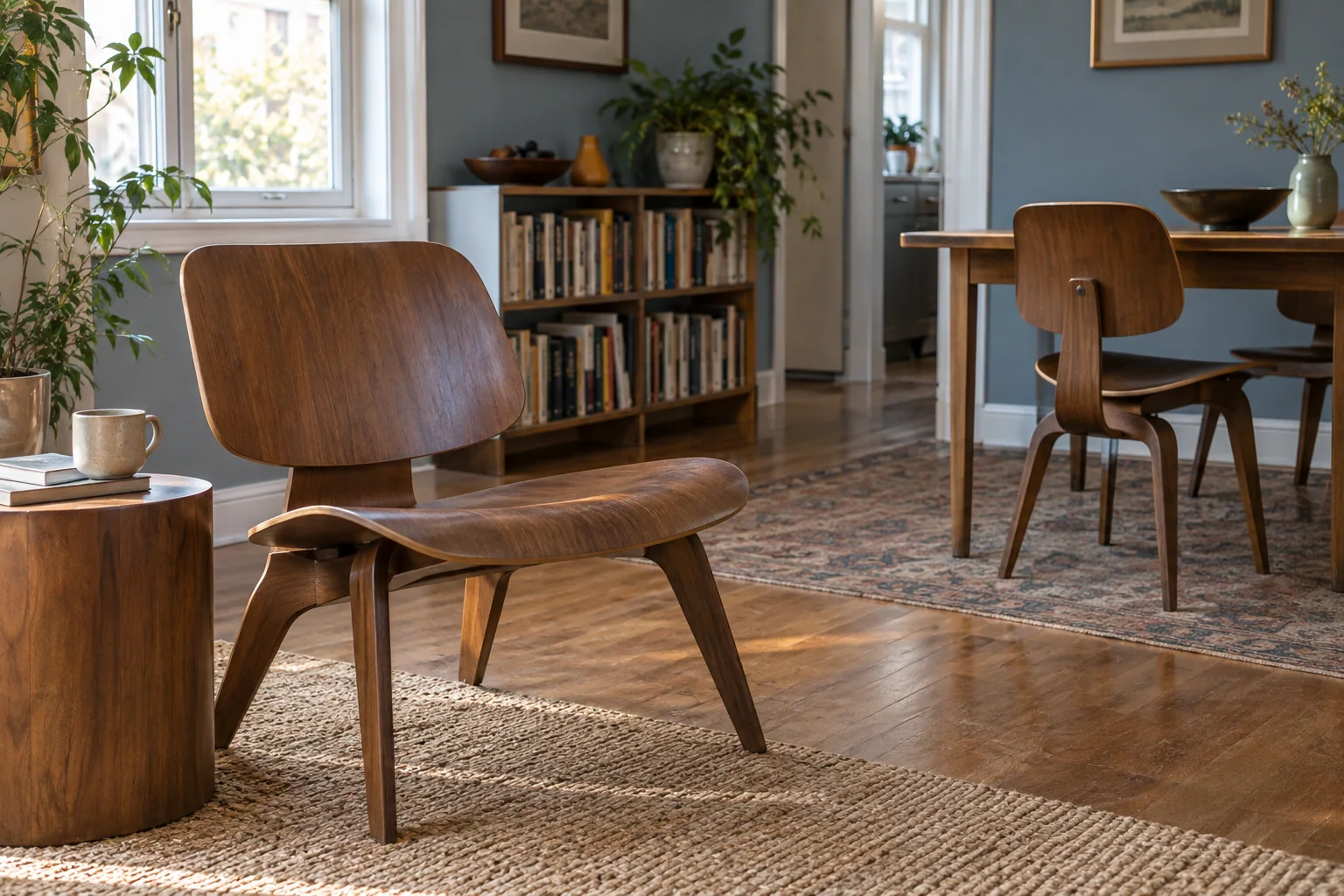
LCW and DCW solve different sitting problems
The Eames Foundation records both designs entering public view in 1946. Their separate moulded seats and backs grew from experiments in shaping plywood around the body. The family resemblance is strong, but the intended sitting positions differ. Use the model name to narrow your search, then let the actual chair and your body settle the choice.[1]
| Your use | What to try |
|---|---|
| Dinner or writing at a table | Start with the DCW. Check occupied seat height, thigh room and whether you can reach the table comfortably. |
| Reading beside a low table | Start with the LCW. Try its lower lounge posture, the reach to a drink and getting up again. |
| One chair for both jobs | Test both activities in the same example. Small overall dimensions do not guarantee a useful compromise. |
A thick added pad changes where you sit relative to the back and table. If the listing has one, ask to try the chair both ways when its condition permits. Measure the object being sold; current catalogue dimensions are references for the specified edition, not proof of an older chair’s identity.[2]
Follow the connection, not just the screw
Vitra describes the plywood seat and back attaching through shock mounts: bonded rubber and metal connectors. That distinction matters because tightening an accessible screw does not necessarily repair a failing bond between a mount and the plywood.[3]
Ask for photographs of every attachment area with enough surrounding wood to understand its location. Look for a lifting edge, a mount sitting differently from its counterpart, unfamiliar metal plates, extra holes or adhesive spread beyond the attachment. These are observations for a repair specialist, not a remote diagnosis of the adhesive or its remaining strength.
A seller may reasonably report that a mount was replaced. Ask who did it, when, which component was used and whether the plywood underneath needed repair. A dated invoice can answer more than a close-up of clean black rubber. Avoid deliberately flexing an uncertain back or pulling on a mount to “test” it.
A through-bolt changes the next repair
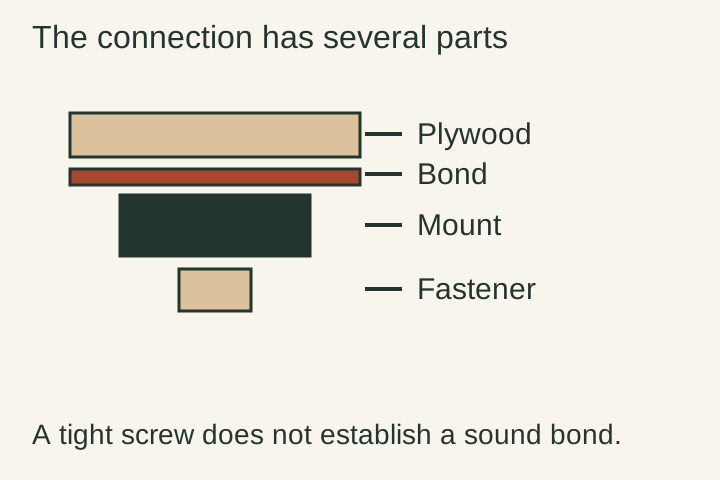
Imagine two otherwise similar chairs. One has a detached mount but apparently intact plywood. The other has been drilled through the visible back and bolted together. Both need assessment, but the second has an additional material and appearance problem: removing the bolt will not remove the hole. Quote the condition you have, not the condition you hope to find under the hardware.
| Area | Useful observation |
|---|---|
| Face veneer | Colour variation, losses and earlier refinishing; these concern the visible surface. |
| Plywood layers and edges | Splitting or separation, especially near a stressed attachment. |
| Mount and bond | Position, detachment, replacement history and compatibility. |
| Added fasteners | Through-holes, plates or screws absent from the relevant documented construction. |
An attractive shell does not identify the whole chair
The Eames Foundation names Herman Miller and Vitra as authorised manufacturers. Compare the complete chair, label, construction and any ownership paperwork with the appropriate maker’s records. Do not use a current label as a universal checklist for decades of production, or infer that every chair carrying an Eames name has its original components.[1]
If the evidence is incomplete, a description such as “attributed to, with mount repairs recorded” is more useful than inventing a precise year. Keep purchase confidence and readiness for sitting as separate decisions: convincing provenance does not strengthen a failing bond.
Take one short brief to the viewing
Message to adapt
Please confirm whether this is an LCW or DCW and send the overall dimensions, underside, rear attachments and any label. Have mounts, plywood or fasteners been replaced or repaired? If a connection is loose, I would like the repair scope confirmed before arranging a sitting trial.
When the role fits and the repairs are understood, these can be wonderfully economical chairs in a room: little visual bulk, a distinctive silhouette and no enormous upholstery project. The small hidden connections are what deserve your attention before the chair becomes part of everyday life.