
Start with the footprint, then sit down
A Wassily can make a room feel less crowded because you see through its sides. That makes it tempting beside a sofa or in the corner left over after arranging a bookcase. Before committing, mark out the width of the complete frame and check the route past its arms.
Knoll’s current US model 50L is 31 inches wide and 27 inches deep, with a seat height of 16.5 inches. Rounded to centimetres, that is about 79 × 69 cm with a 42 cm seat. These are reference dimensions for that model; the offered chair needs its own measurements.[1]
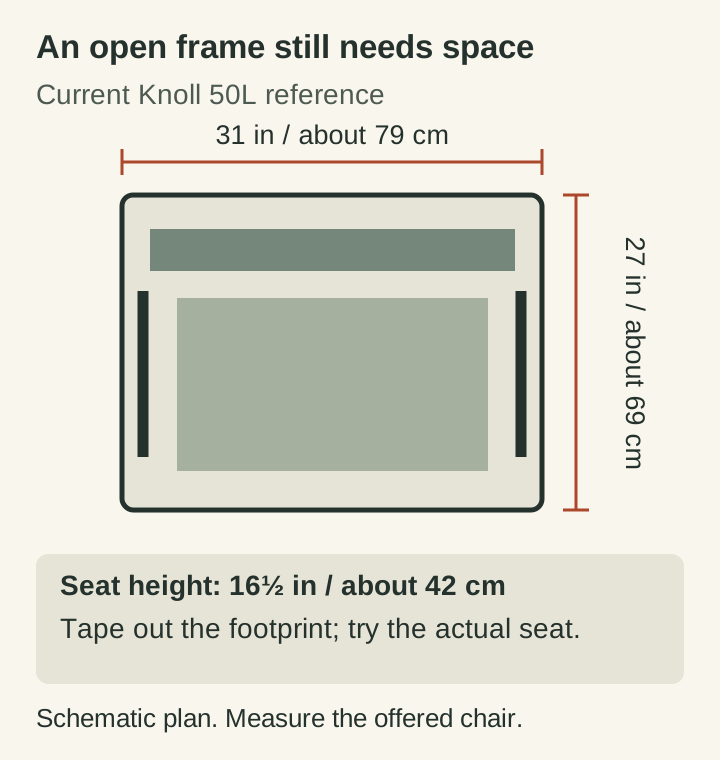
A low seat measurement tells you little about how this suspended seat feels. During an ordinary sitting trial on a chair whose condition permits use, notice where your weight settles and whether the back and arm slings support you comfortably. Try standing up in your normal way. Avoid judging it by a quick perch on the front edge.
If you mainly want to curl up with a book, sit in that position during the viewing if it is appropriate for the chair. If you want somewhere to sit upright in conversation, try that instead. The test should resemble the use you have in mind, including the height and position of a nearby table.
The slings are part of the support
Here the exposed seating material spans the metal frame. A replacement therefore has to reproduce a working seat, back or arm element with suitable material and attachment. A general offer to “recover the chair” needs a more precise scope before you can compare it with another quote.
Ask for photographs of every sling on both accessible faces, with particular attention to the edges and the areas where it meets the frame. Record tears, failed stitching, local stretching, patches and changed attachments. Have a specialist interpret those observations rather than asking the seller to pull, bounce or load a doubtful section.
With leather, a surface treatment cannot establish that a visibly compromised sling is fit to carry weight. With canvas, an attractive clean face does not explain the condition of a worn attachment. Ask the assessor whether the existing element is serviceable, whether a repair is appropriate and what a replacement would preserve or change.
A partial replacement may differ from the other elements in colour, feel and tension. Decide whether that is acceptable before approving the work. Request examples of the repairer’s work on the relevant production and an explanation of how the frame will be assessed before new slings are made.
A canvas seat is a version to research
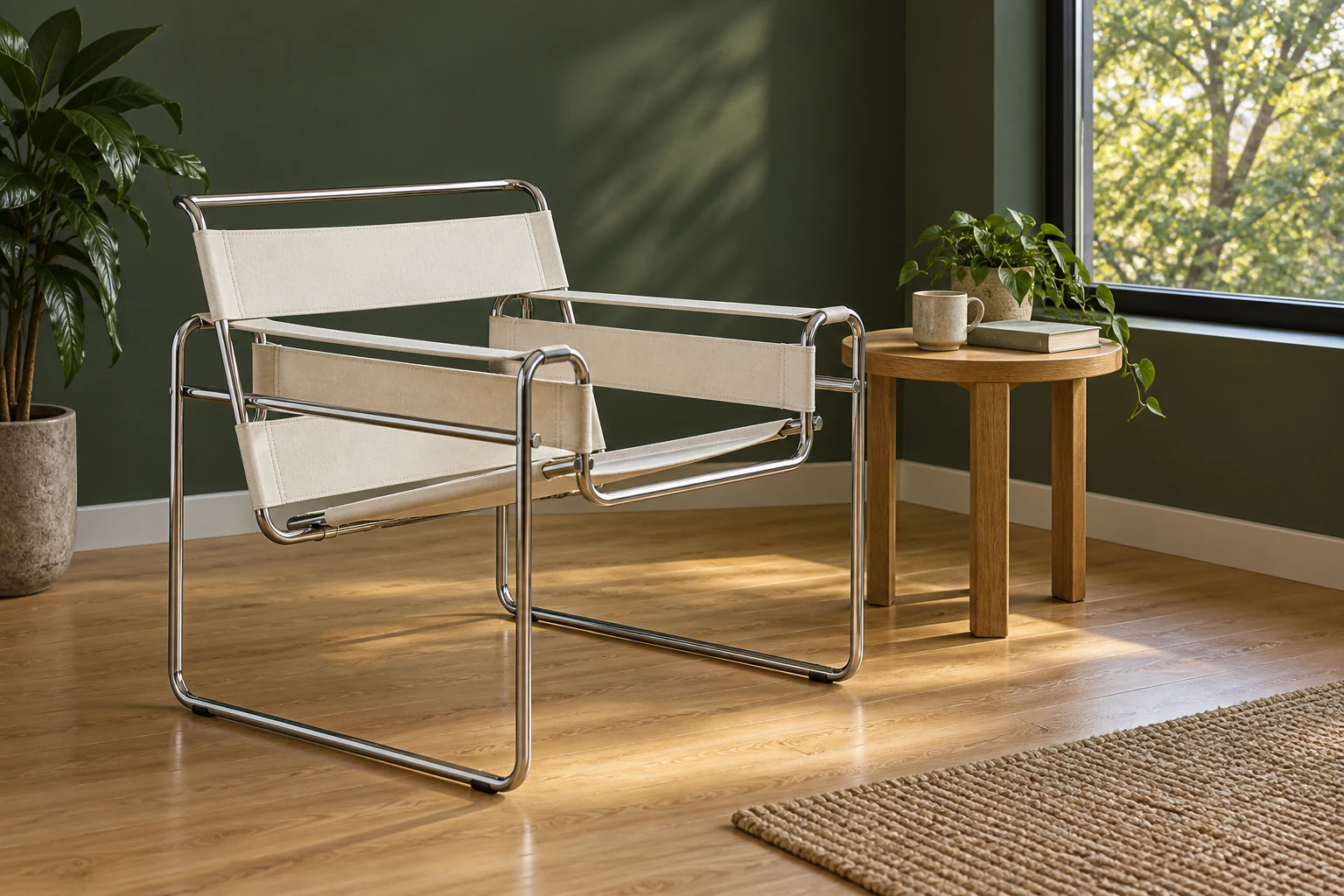
Knoll’s present Wassily specification includes belting leather, other hide choices and natural canvas. It also records the introduction of dark red, onyx and white matte frame finishes in 2024. This establishes current options; it does not date an earlier canvas chair or tell you whether a particular frame has been refinished.[1]
Ask whether the current slings were supplied with the chair and whether the finish has changed. If the seller calls it “original canvas”, the useful next step is a record of this example and its production. The fact that canvas appears in a current catalogue cannot authenticate a much older textile.
Earlier maker names also deserve investigation. Knoll’s account of Marcel Breuer records its acquisition of Gavina in 1968 as part of bringing his furniture collection into Knoll. A Gavina attribution therefore calls for the relevant earlier documentation, rather than comparison solely with a present Knoll stamp.[2]
Keep design date, frame production and sling replacement as separate entries. That simple record helps you compare a documented older chair with renewed seating against a later used example. It also prevents a new covering from becoming an unsupported claim about the age of everything underneath it.
Assess the frame before choosing new seating
View the chair from the front, both sides and behind, standing on an even surface. Ask about distortion, previous welding, loose connections or changes to the frame. Reflections can obscure a metal surface, so request additional views of any area that looks uneven or repaired.
The frame finish affects the work you might commission. Describe what is present and have the repairer identify it; avoid treating every reflective surface as interchangeable “chrome”. Agree whether the aim is to retain an older finish, address local deterioration or undertake a larger professional restoration.
For the wider surface and joint inspection, use the chrome and tubular-steel Guide. Here, connect the findings to the proposed sling work: a new seat should be made for an assessed frame.
Knoll’s customer-service route can begin an enquiry about a claimed Knoll production. Send the frame record and photographs before asking for replacement seating or fittings. Obtain confirmation for the exact version and job; the availability of a current complete chair does not establish parts availability for every older example.[3]
Price the version you actually want to keep
Compare the offered chair as it stands with the result you intend to create. If you like the old leather’s character, ask whether it can remain in service. If you want a complete change to canvas or another colour, confirm the suitable specification, cost and effect on the chair before treating that change as straightforward.
A message for the seller or repairer
Could you confirm the production you attribute this chair to and send the supporting records, actual dimensions and clear views of the complete frame? Please identify original and replacement slings, previous frame or finish work and any damaged attachments. I would like the frame and seating assessed together, with a quote specifying the material, fitting and transport required.
The right example has room around it, gives you a seating position you enjoy and has a credible path to any necessary work. Its open construction is part of the appeal: choose a frame and seating combination you are happy to see and use every day.