Two conservation cases, two different decisions
In its account of a Mason Monterey Tinoco bedside stand, MPF Conservation records a top that lifted at both sides. Within the agreed treatment scope, the conservators left that warpage untreated while addressing other condition issues. That is a documented decision for one object and budget, not a rule that all curved tops are harmless.[1]
In a separate account of a Civilian Conservation Corps table at Crater Lake, the same practice discusses warped and cracked boards in a structure intended for continued public use. The structural concern changes the job. The comparison is valuable because it makes purpose and construction part of the decision before anyone reaches for a flattening technique.[2]
Make a small condition record
Ask for a side-on view along and across the top, an underside view and photographs of the top’s attachments to the base. Have the seller show the table standing on a suitable level surface. A wedge beneath a foot may conceal rocking without saying anything about the top.
| Observation | Next question |
|---|---|
| Top curves across its width | Is the shape stable, and are boards or attachments under strain? |
| One board sits above its neighbour | Is the joint open, damaged or previously repaired? |
| Whole table rocks | Does the problem come from the floor, feet or frame? |
| Leaf fails to meet the main top | Are shape and extension supports both involved? |
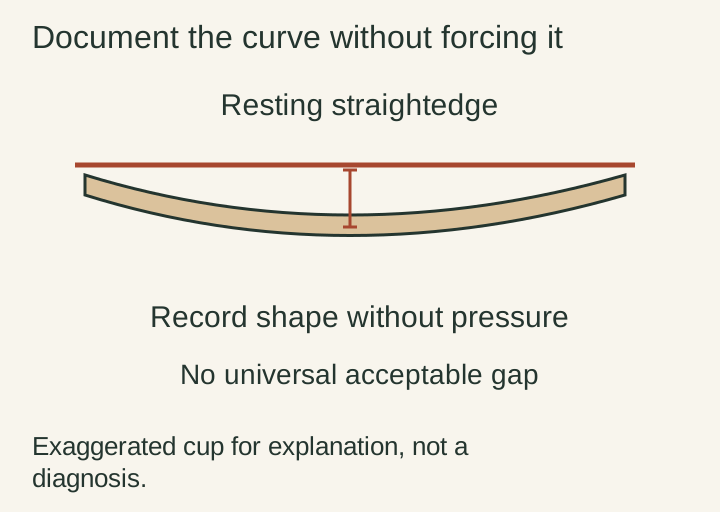
A straightedge resting lightly can help document the shape, with a photograph showing its position. Do not press the top flat to obtain a reassuring measurement. There is no universal acceptable gap in millimetres: a writing surface and an occasional table place different demands on the same curve.
Does the table still do its ordinary job?
For a dining table, look at where a plate, glass and serving dish would sit on the sound surface. For a desk, try a sheet of paper and the equipment you intend to use. For a bedside table, the requirements may be much simpler. These are gentle usability checks after structural concerns have been resolved, not load tests.
A tray can give small objects a convenient place on an otherwise serviceable occasional table. It cannot repair moving joints or make a structurally doubtful top safe. Similarly, a proposed glass overlay needs its own assessment of supports and fit; it should not be a heavy shortcut to flattening the wood.
Ask about recent storage and any known change in shape. Bring that history to the assessor. The Canadian Conservation Institute explains why the environment matters for wooden furniture. A move into different conditions does not justify promising the top will settle back by itself.[3]
Ask for options before asking for a flat top
Request separate proposals for keeping and monitoring a stable shape, repairing a structural fault, and more extensive treatment of the top. Have the conservator explain effects on finish, edges, thickness and future movement. A photograph alone may be insufficient to price those options.
Give the restorer a use case
I want to use this table for ___. These views show the shape, attachments and any open joints. Is the issue stable or structural, what would treatment change, and what is a realistic finished result?
Do not start with weights, water, heat or extra screws to force the top into place. Buy it when either the present shape is useful and understood, or the treatment is defined well enough that you still want the table afterwards.