“Roll-top” does not describe every curved closure
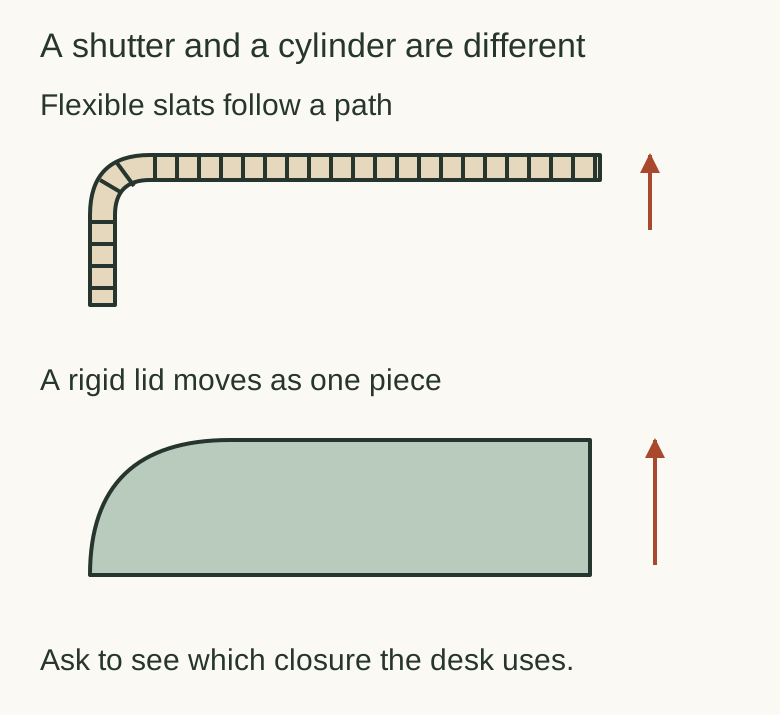
A tambour is a flexible assembly of narrow slats that follows a guided path. On some desks it moves upwards and back; on others the shutters slide sideways. A rigid cylinder lid moves as a single curved piece. Listings sometimes blur these descriptions, so ask to see the construction and movement.
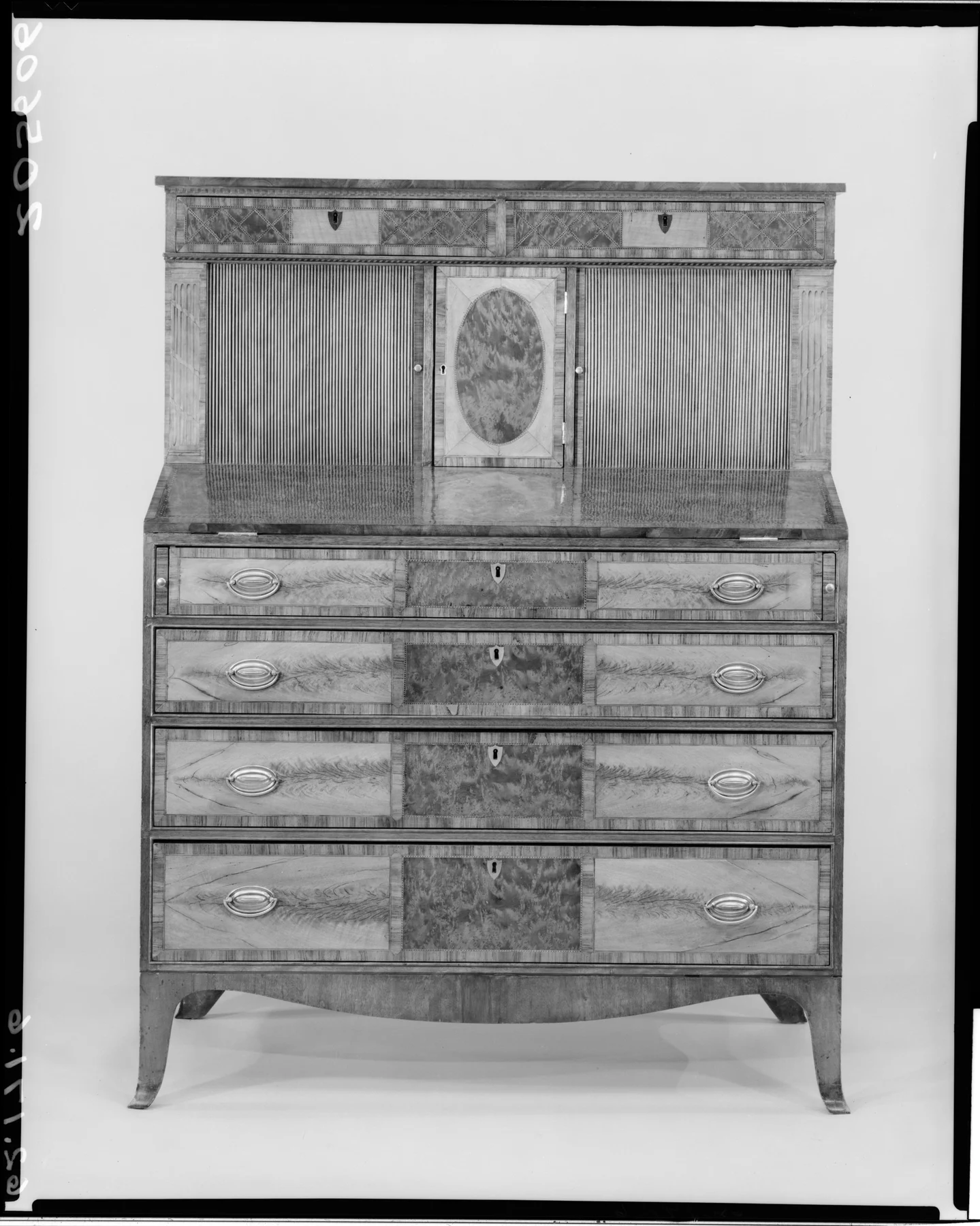
Reuben Swift’s tambour desk of about 1805 in the Met has two visibly slatted closures beside a central door. It is a useful historical comparison for recognising a tambour; its form and age do not identify a desk in a modern listing.[1]
Look at the complete desk before concentrating on the shutter. Where is the actual writing surface? Is there a pull-out section, a hinged fall or a fixed top? The closure and the working surface may be separate moving parts.
Follow the shutter along its whole path
Ask the seller to empty the working compartment and operate the closure gently by its intended handle. Watch both sides. Note where resistance begins, whether one side leads the other and whether the closure reaches the fully open and fully closed positions.
At accessible areas, ask for photographs of individual slats, their joins, the track entrances and any visible backing. A gap between slats or loose backing is useful evidence for a specialist. Do not pull the shutter out, peel the backing or dismantle the desk to reveal more.
A track can be obstructed, a slat can be damaged, or the case itself can be out of alignment. The same symptom may have different causes. Record the behaviour rather than deciding that it “just needs wax”. Check locks only with the supplied key and the seller’s agreement; do not shut a working compartment if you cannot reopen it.
Try the desk as a place to work
Measure the usable writing area after the closure has opened. Cubbyholes, small drawers and the curve of the top can take space away from a laptop or monitor. Put a paper template of your equipment on the surface at a viewing if the seller agrees.
Try your chair dimensions against the knee opening, apron and pedestal positions. A broad desk may still have a narrow opening for your legs. If the writing surface pulls forward, check its normal supports and how much room it occupies in that position.
Think about cables before closing anything over equipment. A desk designed for paper may have no cable route. Do not trap a cable in the closure or assume you can drill an old surface without changing the piece. Decide whether your equipment can be removed and stored elsewhere each evening.
Decide which wear you can live with
Ink marks, worn edges and a replacement handle can be part of a useful old desk. Ask whether the shutter backing, runners, locks or working surface have been repaired, and request any available description of that work. An old repair is not automatically a problem; what it does and how it now performs matter.
The Canadian Conservation Institute advises referring extensive furniture repair or cleaning to a conservator. For a valuable or fragile desk with a failing closure, obtain a proposed treatment before experimenting with cleaning, adhesive or lubricant.[2]
If you need it as a daily desk immediately, choose one whose operation has already been established. A restoration project can be rewarding, but it has a different budget and timetable.
Find out what separates for transport
Some desks have a separate upper section or removable pedestals; others do not. Ask for the actual construction and any known moving instructions. Do not infer that a visible horizontal line is a dismantling joint.
Agree who removes ordinary loose parts and how they will be labelled. Photograph drawer locations, keys and fittings before packing. Protect the closure in the position recommended for that desk, and keep its weight off fragile handles or slats.
Ask for movement and working dimensions
Message to the seller
Could you show the complete desk with its closure open and closed, and a short video of the full normal movement? Please photograph the accessible slats, track entrances and repairs without dismantling it. I need the usable writing area, knee opening and any extended working dimensions, plus confirmation of keys and documented transport sections.
A convincing purchase ends with two separate answers: the closure works, and the desk works for you. Do not let an impressive moving top answer the second question on its own.