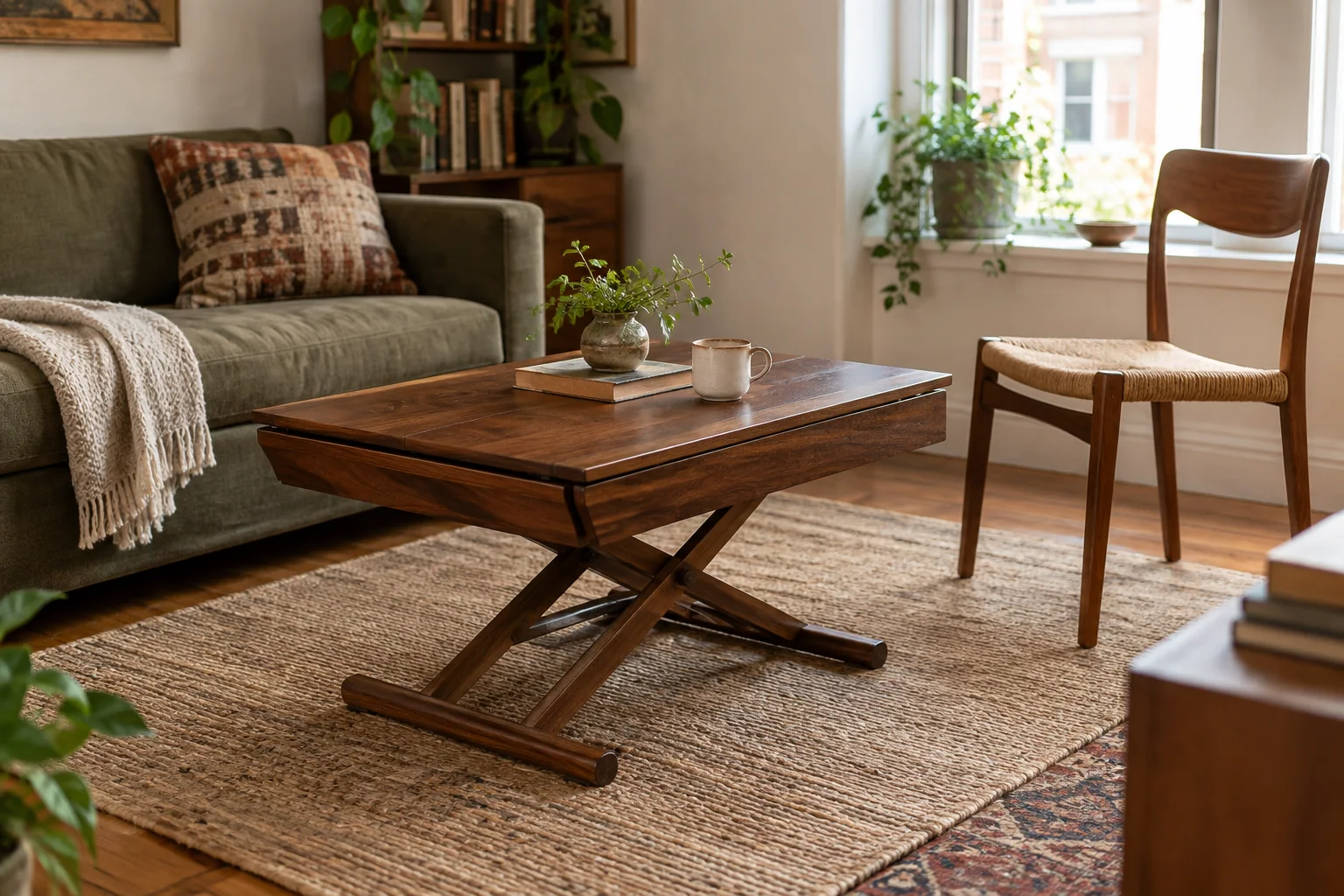
The appeal is real, but so is the daily changeover
The idea has a long practical history. A US patent filed in 1960 describes a table intended to change both height and length between coffee-table and dining uses. That record documents one design solution; it does not identify an unmarked table in an advertisement or provide operating instructions for it.[1]
Start with your evening. Where will the cups and books on the low table go before it rises? Where are the dining chairs stored? Can one person perform the normal conversion if that is how you live? The best version for you may be the simpler one that you will actually bother to change.
Draw the dining arrangement, not just the open top
Ask for height, width and depth in both fully secured positions. Include the base and any legs or supports projecting beyond the top. Then add your chairs and the space you need to sit down and pass behind them. A table can fit mathematically while leaving nobody a comfortable route to the sofa.
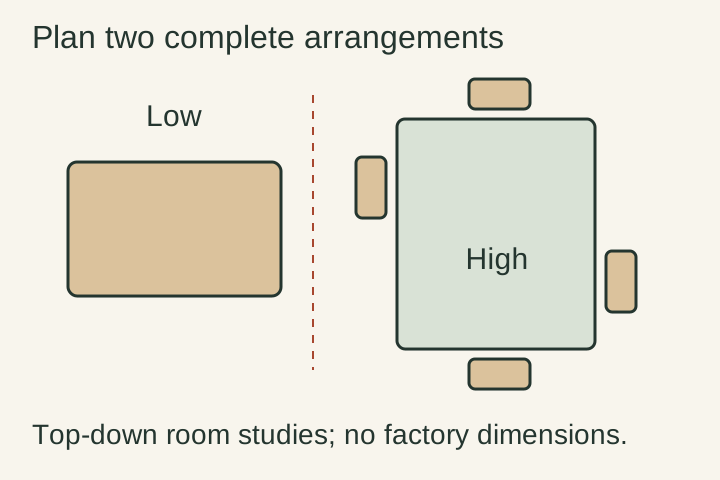
| Low position | Dining position |
|---|---|
| Reach a drink from the sofa without leaning far forward. | Sit on the intended chair and check tabletop height. |
| Check space for feet around the base. | Check knees against the mechanism, apron and supports. |
| Confirm the top is secure in normal use. | Confirm all leaves and supports are engaged as intended. |
| Find a place for the things normally left on it. | Check that each dining place has useful legroom. |
A broad top above a crossed or pedestal base can offer very different knee space at the ends and sides. Try the least generous position as well as the obvious seat. Do not infer a comfortable number of diners solely from the extended length.
Watch the seller change it all the way back
Request a demonstration of the actual table from its low setting through the full dining arrangement and back again. Ask the seller to explain its controls and locking points. If the operation is unknown, obtain the relevant instructions or a competent assessment before anyone improvises.
Watch for an uneven lift, parts failing to engage, an unsupported leaf or a top that moves after it should be secured. Keep hands clear of hinges and moving supports. Do not crawl beneath an unsecured raised top or deliberately push it sideways to see whether it collapses.
A smooth upward movement is only half the story. Returning the table may require releasing a catch, supporting a weight or following an order that is not obvious from a video of it opening. If a seller cannot show safe normal operation, treat that as an unresolved mechanism job.
Price the mechanism before the polish
Ask a repairer to identify the actual mechanism and the missing or worn parts. A workshop able to refresh the top may not be equipped to repair its lifting hardware. Have those tasks quoted separately, including transport and confirmation that both operating positions are ready for use.
In a hypothetical comparison, a tired-looking top above a complete, sound mechanism might be a more manageable project than a glossy table with an absent catch. “It only needs a small piece” tells you nothing about whether that piece can be sourced or made appropriately.
Compare three options
Price this table ready to use, a simpler vintage dining table with a small coffee table, and a different convertible example. Include where each arrangement lives when dinner is over.
Choose the convertible when it gives back space without making ordinary meals a performance. Its satisfying transformation should remain a convenience after the novelty wears off.