Decide whether it is your main chair
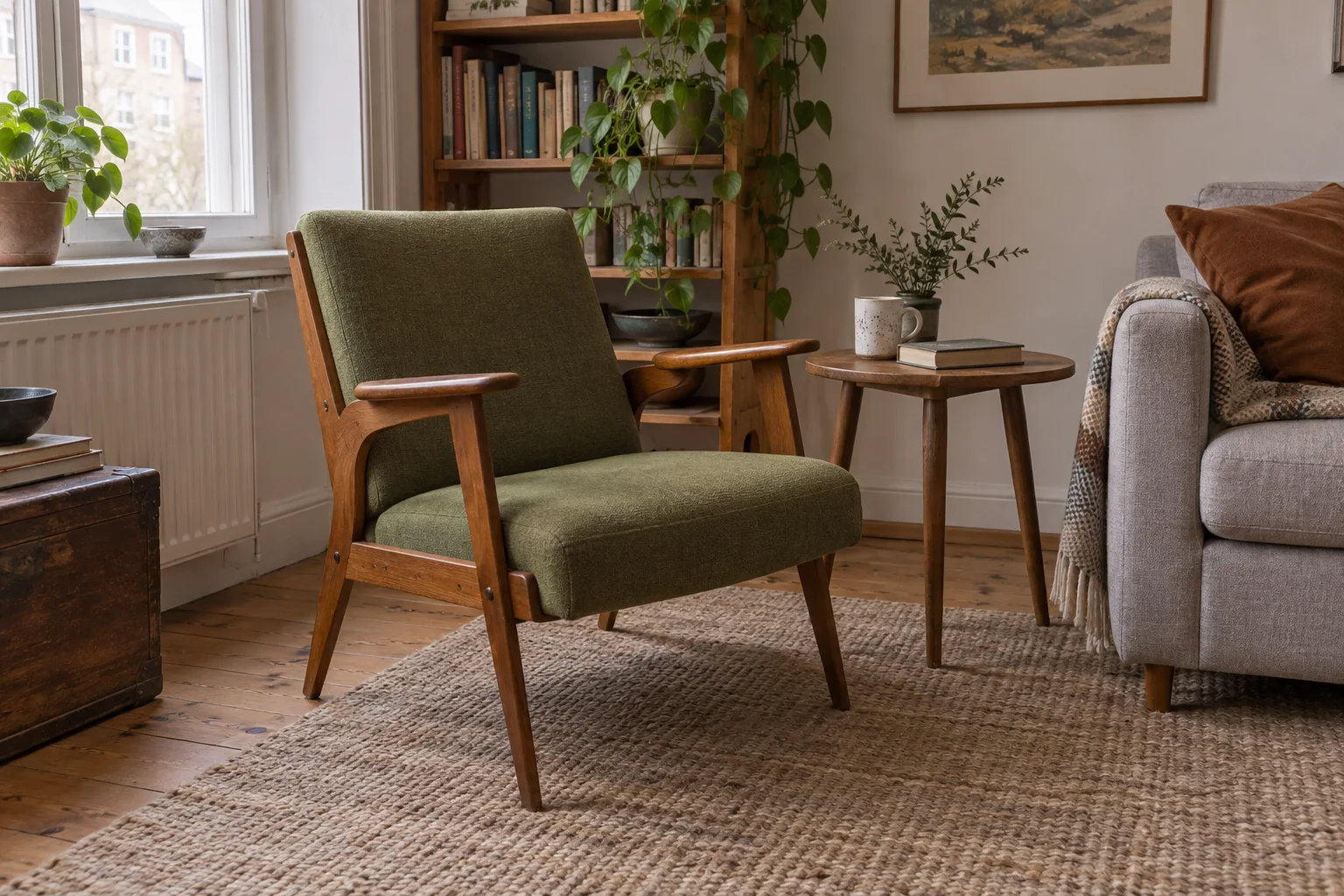
The 366’s exposed timber sides and compact upholstered body give it a presence without the bulk of a large lounge chair. That can be exactly right beside a sofa or in a bedroom. It does not mean it will replace a deep chair with head support for long evenings.
Write down the job: a conversation seat, a place to put on shoes, a reading chair or your only comfortable seat in a small flat. Then try the candidate in that role. A chair can be an excellent design and still be the wrong main seat for one person.
Use another chair you find comfortable as a reference. Compare the distance between its arms, usable seat depth and the height of the arms above the compressed sitting surface. Those relationships tell you more about personal fit than overall width alone.
An older chair and a licensed reissue are different purchases
366 Concept dates Chierowski’s design to 1962 and its licensed revival to 2014. The company describes changes in the current series, including hidden side screws and slightly adjusted frame dimensions. Do not use a modern reissue’s measurements as a template for authenticating every vintage frame.[1][3]
| Offered chair | What to establish |
|---|---|
| Older production | Evidence for the attribution and age; present frame, support and upholstery. |
| Restored older chair | What remains from the earlier object and how rebuilding changed the shape and sitting position. |
| Licensed 366 Concept reissue | Maker and order evidence for the actual version, with its own specification. |
Button count or visible screws alone cannot make that decision. Upholstery can be replaced and frames altered. If the seller claims a particular production period, ask what supports it and whether any part of the description is simply an informed attribution.
Do not mistake the box size for the chair size
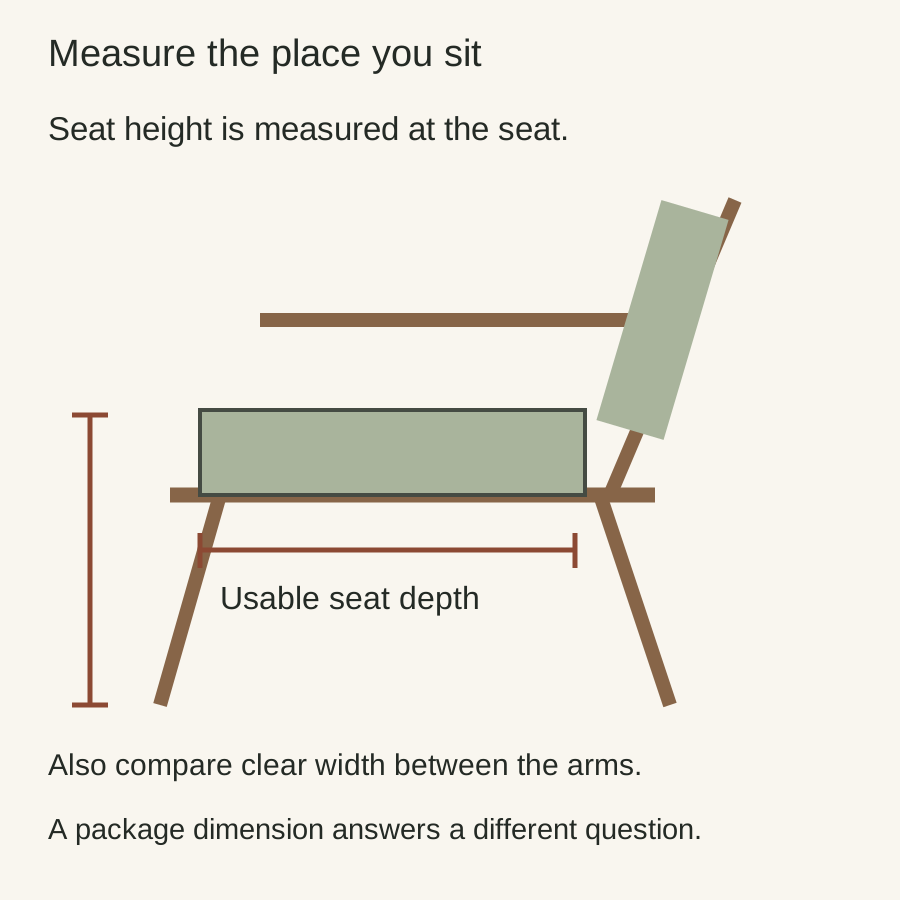
A useful caution appears on the current manufacturer’s specification page: 78 × 70 × 68 cm is labelled as package dimensions for an assembled product. Those figures describe the package, not the usable seat or necessarily the furniture’s maximum outline. Read the field name before borrowing a number from a search result.[2]
Ask the seller for maximum chair width and depth, floor-to-seat height, clear width between the arms and usable seat depth with the back upholstery in place. For a soft seat, the unoccupied height and the position under an ordinary sitter are different observations.
Measure the actual room too, including the side table and space to walk past the chair. A compact frame can fit into a corner while leaving no comfortable place for your feet or a lamp. Check the whole reading position, not a rectangle squeezed between two walls.
Fresh upholstery can change a small chair a lot
Look at the candidate in profile. Does the back padding push the sitter forwards? Has a thick new seat raised the body in relation to the arms? Are rounded upholstery edges hiding the timber outline you liked? These are reasons to ask about the rebuild, not to reject every restored chair.
Find out whether the work included the internal support and frame joints or only the visible covering. Ask for the work record and any photographs taken during restoration. “Professionally upholstered” is more useful when you know what the professional actually did.
Try sitting back, reading and standing up in your ordinary way. Notice whether your feet find support, the seat presses behind your knees, and the arms land in a useful place. Stop if there is unexpected movement or a frame issue; comfort testing assumes the chair is fit to use.
Two pretty chairs are not automatically a comfortable pair
If buying two, compare both in the same views and sit in both where possible. Differing upholstery thickness can make similar frames feel unlike each other. That may be fine for two different users, provided it is a choice you understand.
The practical question
Would I still buy this chair if I could not call it a 366? If the answer is yes because the seat, size and condition work, the remaining attribution question can be priced honestly. If the answer depends on a valuable early production claim, resolve that claim before paying for it.
Choose a 366 for the way its particular scale and posture fit your life. There is nothing second-best about using it as a compact conversation chair while choosing a different seat for long reading sessions.