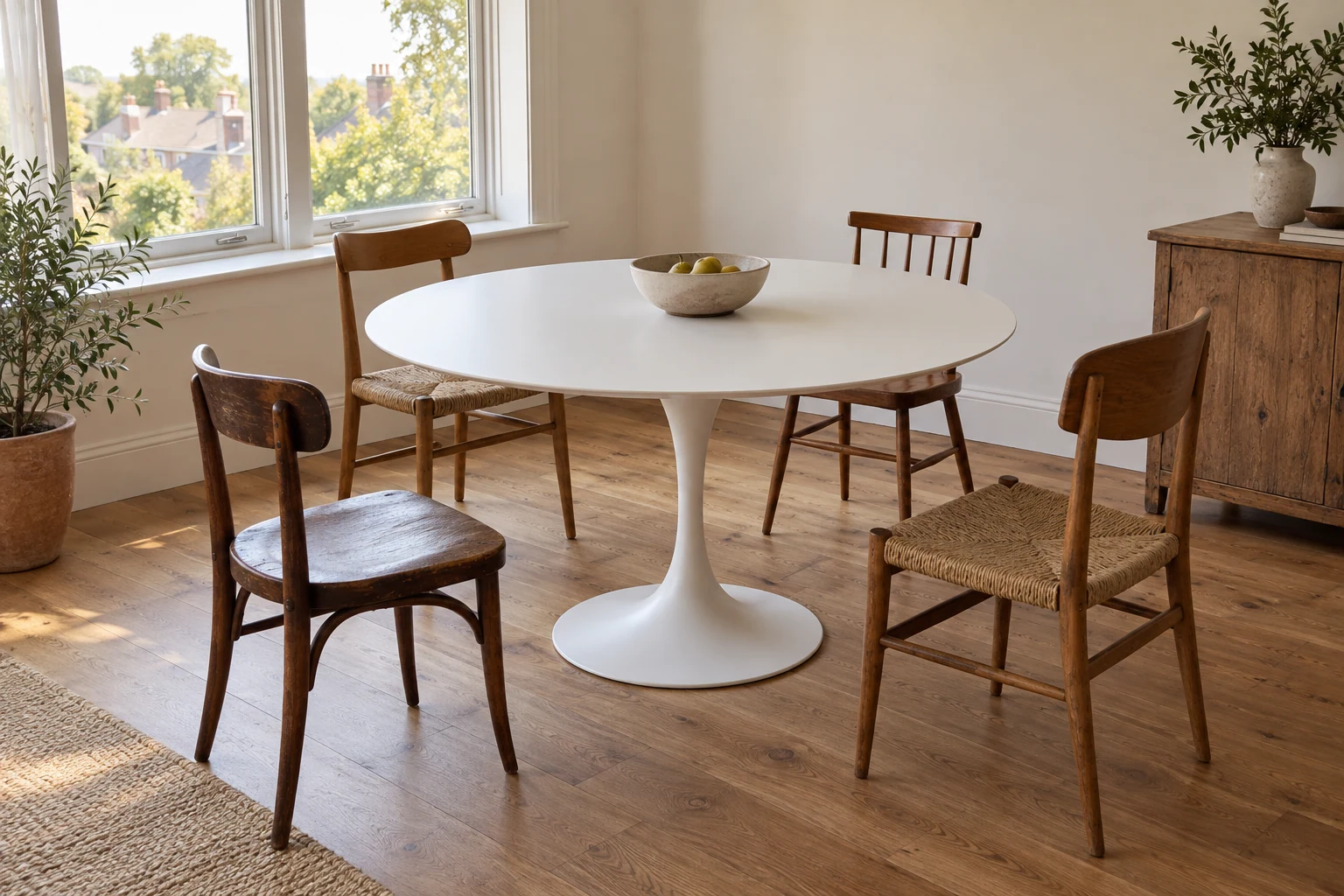
Start with the dining table you need
“Tulip table” is a useful search term, but a listing still needs a precise description. Establish whether the seller offers a Knoll Saarinen table, another identified design, or an unconfirmed pedestal table. Then ask for the top dimensions and actual height. A side table and a dining table can share the same visual idea without doing the same job.
Knoll’s European dining-table page lists round tops from 91 to 152 cm and oval versions measuring 198 × 121 cm and 244 × 137 cm. It gives 72 cm for the round tables and 73 cm for the ovals, noting that height can vary by 1 cm with the top. Use the appropriate reference, then measure the offered table.[1]
Make a paper outline of the chosen top in your dining space. Pull out the actual chairs and walk to the kitchen, sideboard and doors. An oval may suit a long room beautifully, but its ends still occupy the route you use every evening. Do not turn a manufacturer’s possible seating count into a promise that your wide chairs will fit.
For the chair-and-base trial, use the pedestal dining-table Guide. Keep that practical fit check separate from the question of who made the table.
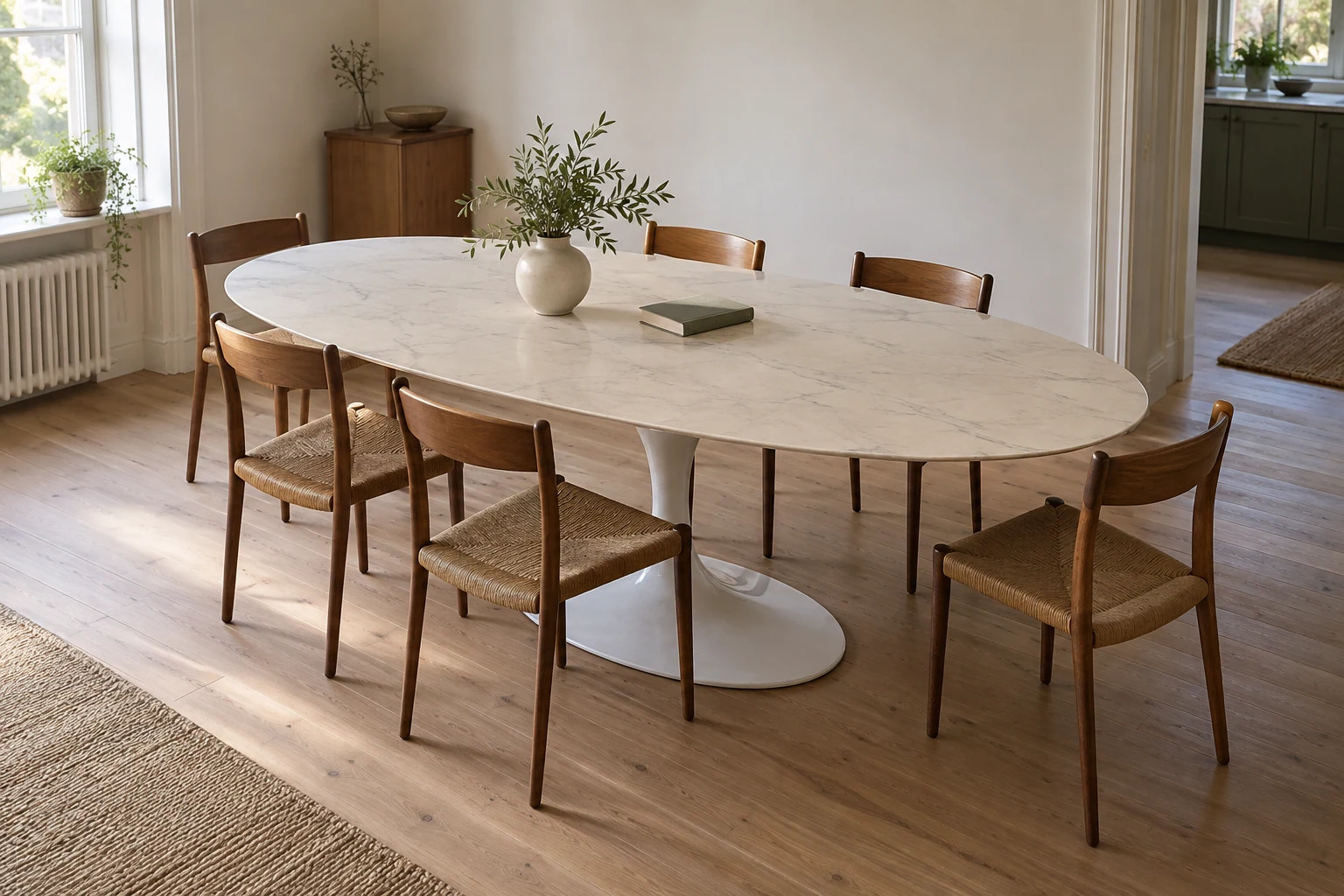
Read the top and base as a pair
Ask for the top, underside, complete pedestal and the connection between them. A replacement top may be a reasonable choice for everyday use, but the invoice should say so. A named base does not establish the origin, material or suitability of the surface resting on it.
Knoll describes its current base as cast aluminium with a Rilsan finish. Its current European identification information places marks beneath the base and a nameplate beneath the top or on the support plate. These are locations to document, not a universal age chart for every production period.[1]
Read marks alongside dimensions, construction, purchase records and disclosed repairs. If the evidence does not support the asking price for a particular Knoll production, settle that before buying. Do not let an attractive top turn an unexplained assembly into a confirmed attribution.
At a normal viewing, ask about movement between the top and pedestal, previous repairs and any missing fittings. Avoid rocking a heavy table to demonstrate its strength. A loose or altered connection needs a defined assessment and repair plan before you plan dinners around it.
A satin stone surface may be coated
Knoll’s European specification describes marble with a transparent polyester coating, including a satin treatment that can resemble a honed surface. It also notes possible yellowing of that coating. This matters when a seller calls a dull or discoloured top “marble that just needs polishing”.[1]
| Top in the listing | What needs to be established |
|---|---|
| Laminate | The condition of the surface, edge and substrate, including lifting or swelling. |
| Marble with a documented coating | Whether the reported mark is in the coating, the stone or both; what repair can retain the intended finish. |
| Stone with an uncertain treatment | The actual material and finish before choosing cleaners or a polishing process. |
| Replacement top | Its origin, dimensions, attachment and suitability for that base, confirmed by a competent supplier. |
Ask a restorer to describe the work on this particular finish. A quotation for bare-stone polishing does not automatically address a coated surface. Likewise, a freshly glossy photograph is not a record of what was removed and reapplied. Keep the proposed result and the retained material clear before committing to restoration.
For visible stone defects and their limits, see the stone-top inspection Guide. Keep routine care advice tied to the identified finish.
The same diameter can mean a different move
Knoll’s US specifications provide a useful comparison at one size. For a 42¼-inch round dining table, the listed weight is 63 lb for laminate or veneer and 125 lb for stone. Converted and rounded, that is about 28.6 kg against 56.7 kg: roughly 28.1 kg more at the same stated diameter. These are current product references, not the measured weight of a vintage offer.[2]
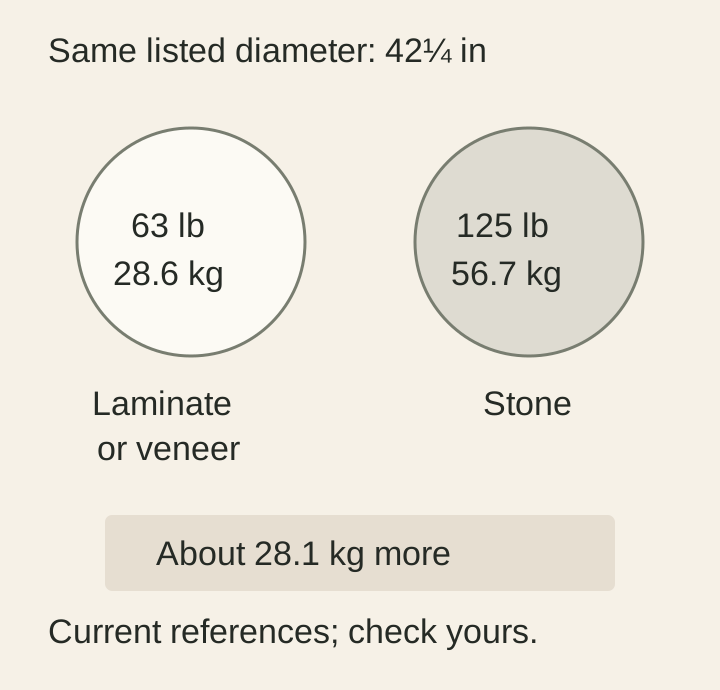
Send the carrier the actual material, dimensions, access route and any reliable weight information. Agree who is qualified to separate the top if that is appropriate, how the components will be protected, and who will assemble and check the table at the destination. “One small round table” is an incomplete transport brief.
Ask whether the quotation reaches the intended room, including stairs, parking restrictions and assembly. A low collection charge that ends at the pavement is not equivalent to a complete delivery. Resolve this while you can still compare it with another table nearby.
Compare the table ready for dinner
A laminate version may appeal because you want a simple everyday dining surface and an easier move. A stone version may be worth the extra handling because its material and presence are what you want to live with. Compare their actual condition, finish and delivered total, rather than assuming one surface is always the premium choice.
Add purchase, agreed finish work, any confirmed connection repairs, transport and assembly. If a proposed repair remains unpriced, keep it visible as an unresolved item. Choose the table whose complete result you understand, including the wear you are happy to retain.
A message for the seller
Please confirm the top material and finish, diameter or length and width, actual height, and what supports the stated maker and age. Could you show the underside, base, connection and marks in place, and describe any replacement top or repair? I also need known weight information and an agreed collection or delivery plan for this complete table.