Why one little joint matters
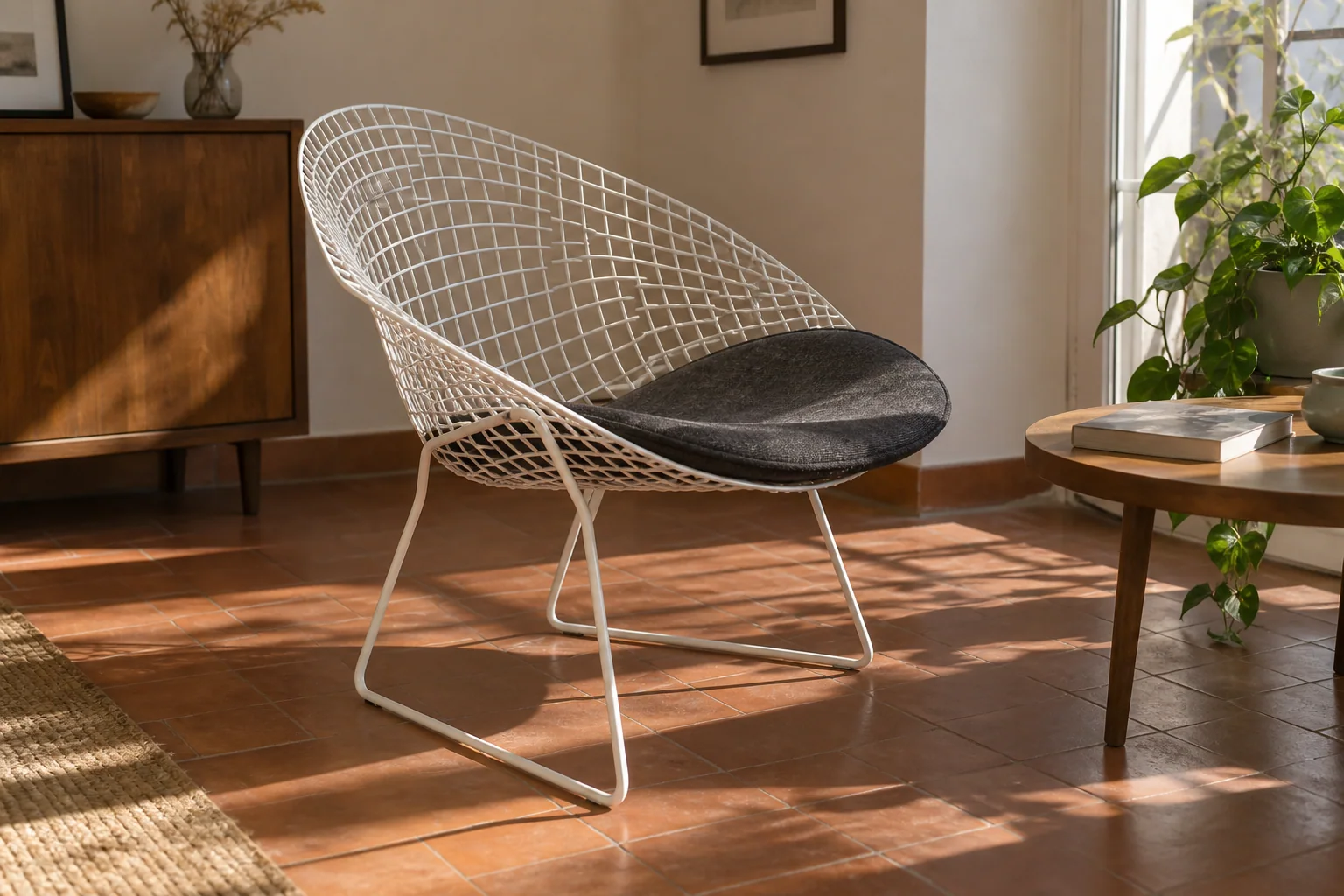
The Diamond gets its lightness from a welded network of steel rods. That network is also the seat: it is not decorative mesh sitting above a separate supporting shell. Knoll describes a welded steel seat and base, with different finishes and upholstery options. That helps explain why a detached crossing deserves attention even when the chair still looks beautifully transparent.[1]
Start with a clear view of the whole chair, from the front, side and behind. Does the outline look coherent, or is one wing lower and a patch of wire pushed out of line? Perspective can mislead, so ask for another angle before calling a frame bent. Do not sit in a visibly damaged chair to see whether it holds.
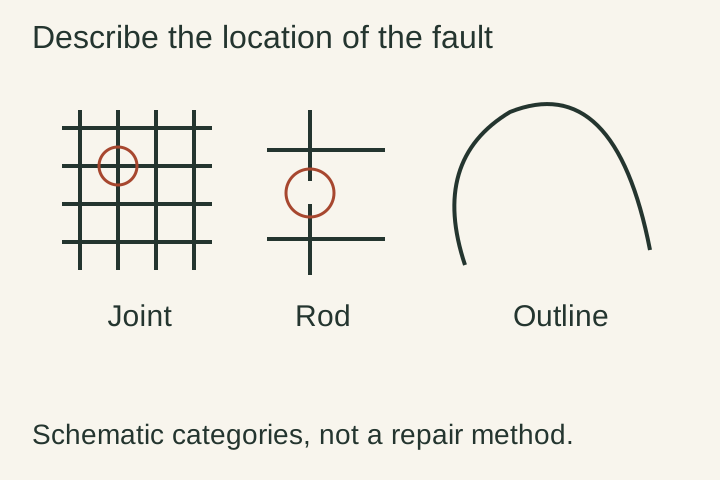
A broken weld and a broken wire are different jobs
| Visible observation | What the quote needs to resolve |
|---|---|
| Two intact rods separate at a crossing | How to reconnect the joint and examine neighbouring connections. |
| A rod itself has fractured or a piece is absent | Whether material must be replaced and how the original shape can be retained. |
| Several crossings have failed in a distorted area | Whether the seat geometry can be recovered, rather than simply closing individual gaps. |
| An old repair has a thick deposit or damaged coating | Whether previous work must be removed and how much surrounding finish will be affected. |
The Harry Bertoia Foundation identifies broken welds as a frequent problem and discusses specialist brazing or soldering approaches. Its notes are useful evidence that this is a particular metalwork job, not an invitation to let any workshop improvise with the first welding process available. Ask a repairer who knows these chairs to explain the proposed method and its effect on the finish.[2]
The coating can change the economics
On a painted or coated chair, a local repair may remain visible unless a wider area is refinished. On chrome, repairing the metal and restoring the decorative surface are separate questions. Ask whether the estimate includes removal of the existing finish, preparation, the new finish and handling between workshops. A polished patch is not automatically equivalent to renewed plating.
Consider two hypothetical listings: one has an intact frame with a shabby pad; the other has an attractive new pad hiding several failed joints. The second is not necessarily the better buy. Remove the pad for agreed photographs, then compare both as complete, usable chairs. If the repairer cannot yet bound the structural work, keep that uncertainty out of a supposed fixed restoration budget.
| Intact chair | Damaged chair |
|---|---|
| Purchase and delivery | Purchase and delivery to the repairer |
| Any chosen cushion replacement | Metal assessment and agreed repairs |
| Routine condition work, if needed | Coating or plating work and a suitable cushion |
| Ready for the room | Return delivery and confirmation of readiness for use |
Check the version before ordering the cushion
A Diamond name in a listing does not identify every size, finish or upholstery arrangement. Compare the complete object and its dimensions with the appropriate Knoll documentation. Ask whether the shell and base have always been together and whether a cover was supplied for this chair. A current logo or current finish list cannot date every older example.
Leave the cover choice until the metalwork plan is settled. The right pad may make daily sitting much more pleasant, but it does not stabilise broken joints. Likewise, a new coating does not make every indoor version suitable for a terrace. Knoll distinguishes its available finishes and outdoor suitability; get advice for the actual older frame.[1]
Send a repair brief before making an offer
Message to adapt
I am considering this Diamond chair. These whole-chair views and numbered details show the visible failed joints, wire breaks and previous repairs. Can you assess whether its shape and structure are repairable, specify the metalwork and finish work separately, and say what you need to inspect before confirming a total?
A repaired chair with an honest record can be a satisfying purchase. The point of the quote is to know what you are saving: an interesting usable object, rather than an open-ended series of jobs hidden behind a very small asking price.