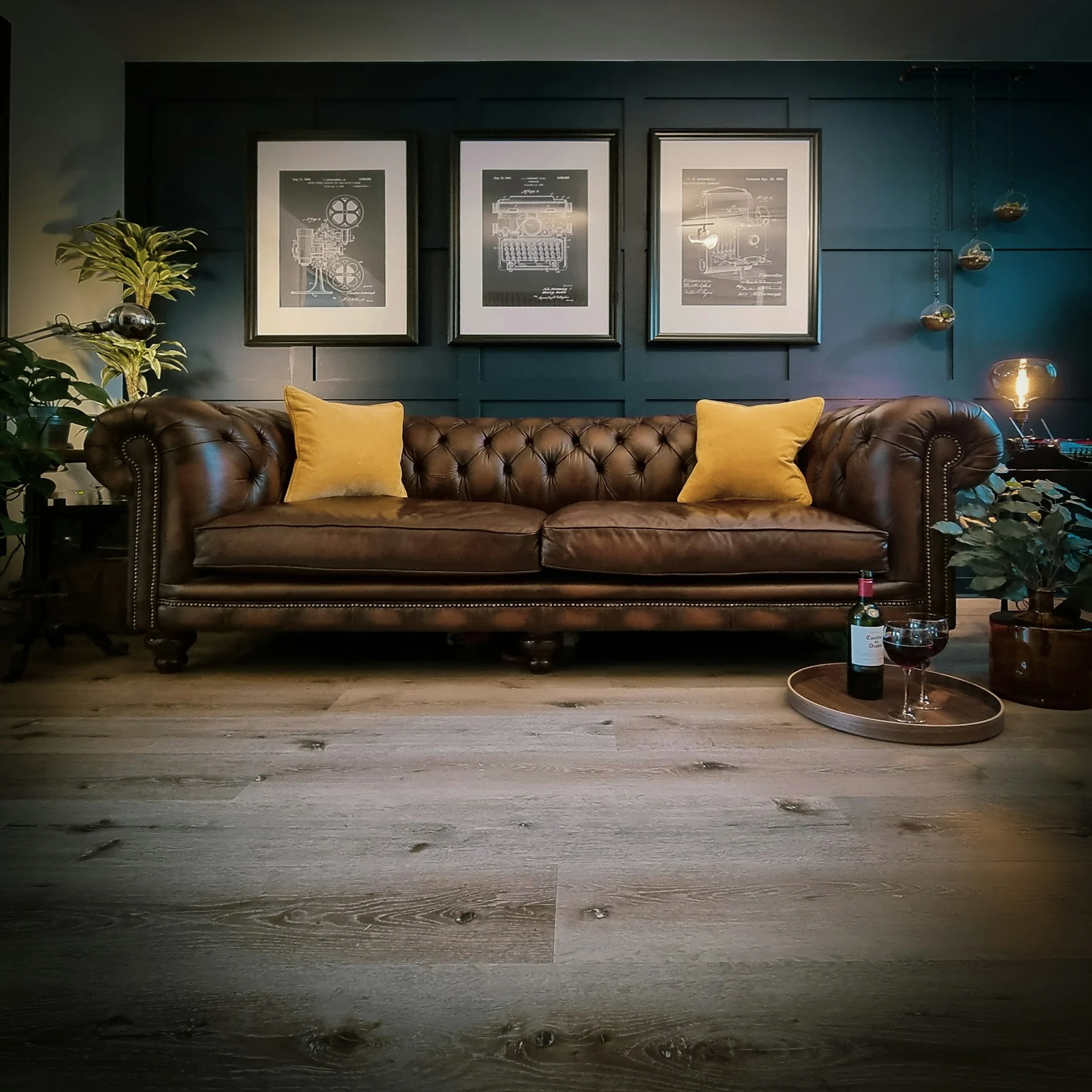
What does the seller mean by Chesterfield?
The familiar buying picture is a sofa with rolled arms and deep buttoning, but listings cover many makers, materials and periods. Record the seller’s exact claim and ask for labels, purchase documents or earlier restoration records when identity affects the price.
Timothy Oulton’s Westminster Button is a contemporary interpretation offered in leather and fabric finishes, with its own documented dimensions and construction. It is a useful example of why the style name does not specify one upholstery material or one historical build.[1]
Keep style, maker and condition as separate questions. A later sofa can be a good everyday purchase, while an older one can need substantial work. Avoid valuing an unmarked piece as a named maker merely because the button pattern or feet resemble a photograph.
How much sofa is actually seating?
Ask for the overall width at the widest part of the arms and the usable width between them. Measure usable depth to the face of the back upholstery, seat height with the actual cushions, and the height of the arms where you would rest against them.
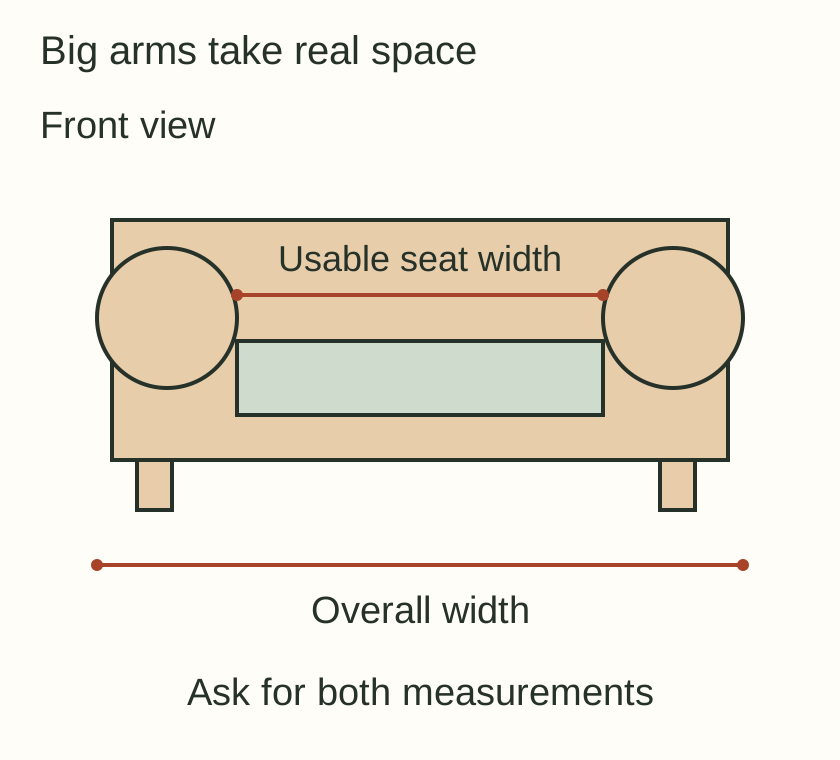
For its Westminster Button two-seater, code T-WBN-SS-0238-R, Timothy Oulton lists an overall width of 181 cm and seat width of 116 cm. That is a documented 65 cm difference across the whole sofa. It illustrates the question to ask; it is not a prediction for another Chesterfield.[1]
If two people normally sit together, try that arrangement at a viewing once the seller has confirmed normal use and no support fault remains unresolved. Notice whether the arms encourage the position you want, whether your feet rest comfortably and whether a low back suits a long evening. Seat count alone will not tell you.
Deep buttons need a close view
Inspect the inside back and arms in ordinary good light. Look into the folds around buttons and along seams, then compare the arm fronts, cushion edges and places touched by hands. Ask for a close photograph of any torn fold, missing button or area that looks heavily coated.
Distinguish softened creases and uneven colour from an opening seam, split surface or detached button. A photograph cannot establish the material underneath a coating. Ask about recolouring, patching, replacement panels and the date and extent of any upholstery work.
Do not pull on buttons or pick at a peeling surface to investigate. Ask an upholsterer what access and work a repair would require. A missing button is visible at the front, but the repair may involve more than attaching a new button from the outside.
New cushions cannot answer every sag
Ask whether the seat uses loose cushions or a fixed upholstered surface. With loose cushions, have the seller show their undersides and the accessible support beneath them. With a fixed seat, request the accessible underside and any relevant repair records without removing the covering.
Compare the feel across the normal sitting positions. A compressed cushion, a problem in the supporting upholstery and a frame defect are different possibilities. A seat that sinks unevenly needs assessment; buying new foam before identifying the cause can leave the original problem untouched.
Inspect accessible feet and their attachments and ask about previous moves or repairs. Do not tilt a heavy sofa alone or remove an underside cover to look inside. The sagging-sofa and upholstery Guides take those condition questions further.
Ask what the quote will actually replace
Send a repairer photographs of the whole sofa, buttoning, affected panels, cushions and accessible underside. Explain whether you want a local repair, replacement cushions or complete reupholstery. Ask which hidden conditions could change the estimate and what the finished seat specification would be.
Colour matching an old surface is a different job from choosing new upholstery for the whole sofa. Decide whether a visible, well-executed repair is acceptable to you. Avoid a budget based on “just conditioning the leather” when the material or damage has not been identified.
Add delivery to the comparison. Wide arms and a long rigid frame can make the route difficult even when cushions come off. Give the carrier maximum dimensions, door openings, turns and stairs; remove feet only when the documented construction permits it and the handling plan accounts for it.
Make the request about seating and condition
Message to the seller
Could you confirm the widest overall dimensions, usable width between the arms, seat depth and seat height? Please send labels and close views of button folds, arm fronts, cushion undersides and accessible supports. What recolouring, repairs or reupholstery are known, and which parts can be removed properly for delivery?
Choose a Chesterfield whose seating works for your household and whose upholstery costs you understand. A worn sofa you can use comfortably may be the better purchase; a handsome bargain that needs an unpriced complete rebuild has not yet earned that description.