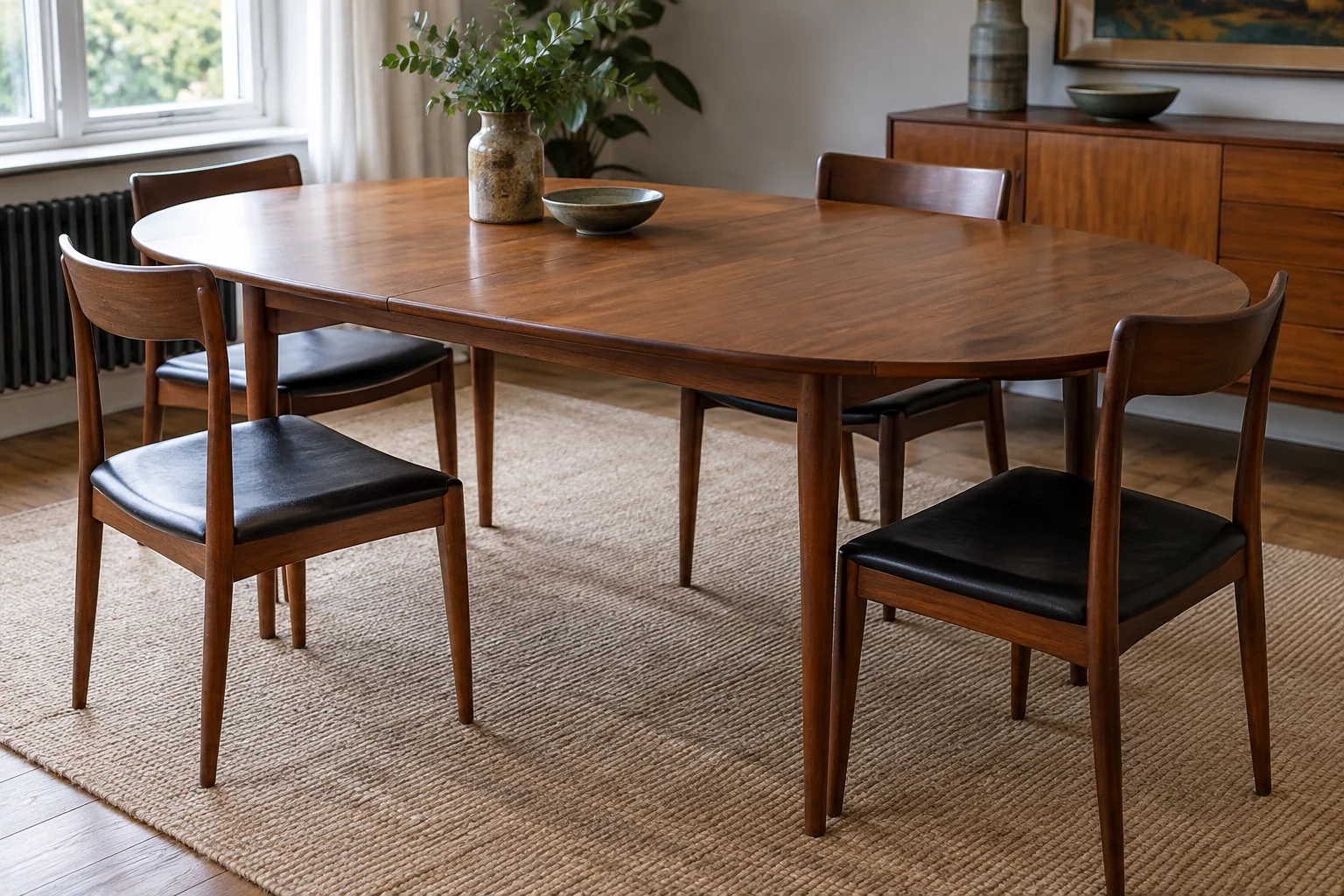
One extra stage can be more useful than maximum length
Vintage Midcentury records a sold table as a McIntosh T2: 150 × 82 × 74 cm closed, extending to 193 cm with one internally stored 43 cm butterfly leaf. These are the dealer’s measurements and identification of that example.[1]
A separate Pamono listing, described by its seller as a T3 from the Dunvegan collection, records a 160 × 92 cm closed top and lengths of 198 cm with one extension and 236 cm with both. It also reports a 115 cm gap between legs along the side. Treat the model attribution and measurements as that seller’s record, not a complete factory guide.[2]
| Configuration | Listed T2 | Listed T3 |
|---|---|---|
| Closed top | 150 × 82 cm | 160 × 92 cm |
| One extension | 193 cm long | 198 cm long |
| Two extensions | Not described | 236 cm long |
| What to test | Whether the single larger setting is enough. | Whether the intermediate setting works with your chairs. |
The nearly similar one-extension lengths hide different starting footprints and widths. The narrower closed example may suit daily life better even if the other accommodates a larger gathering. Draw both closed outlines before being persuaded by the longest measurement.
Extra top is not the same as extra leg space
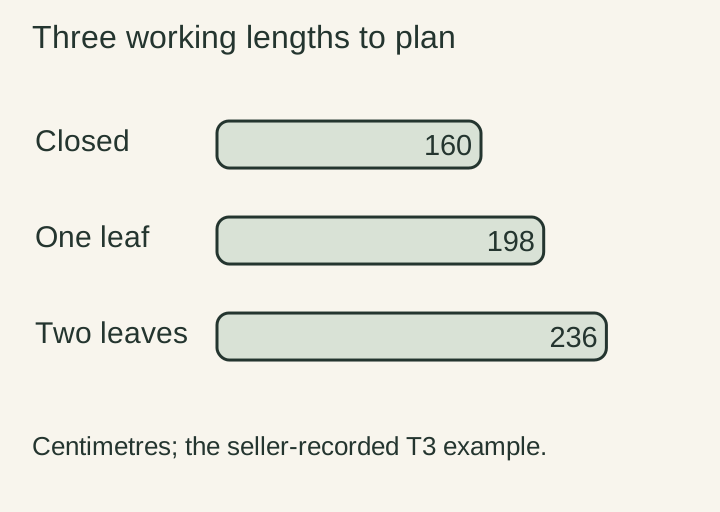
Mark the actual leg positions inside the floor outline, then place your chairs around it. In the listed T3 example, the reported 115 cm side gap is a separate constraint from the extended top’s length. Ask whether and how the leg positions change during extension on the offered table.
Do not turn a seller’s seating count into a promise. Two wide armchairs, three narrow side chairs and people sitting partly outside the leg line produce different arrangements. Try the intended places with plate templates, elbow room and a route behind occupied chairs.
If you entertain occasionally, decide where the extra chairs live between meals. A table that stores its leaves internally solves one storage problem; it does not solve the storage of six additional seats.
Watch the table open, support and close
Request one continuous demonstration from closed through every supported extension stage and back again. Ask the seller to show where the leaves rest, how they are supported in use and how they fold or store without fouling the mechanism. Avoid forcing a reluctant movement or improvising a missing support.
Have worn, loose or modified mechanisms assessed by someone familiar with the construction before buying a repair project. A leaf lying beside the table is not evidence that it fits, aligns or locks into the intended arrangement. Compare thickness, edge profile, hinge positions and the assembled result.
Look at colour with the table both open and closed. The T2 seller notes a lighter extension, while the T3 seller records sanding and an oiled refinish. These are disclosed histories of particular tables. They show why matching colour alone does not establish original finish or originality of every component.[1]
Write the offer around a usable table
Ask for the closed size, each extended size, leg clearances, the complete leaf count and disclosed repairs in the condition record. Include correct reassembly in the delivery plan if dismantling is necessary. Identify who will verify that the mechanism works normally after delivery.
A practical seller request
Please show this table opening and closing through all intended stages, measure the top and leg gaps at those stages, and photograph the leaf supports, hinges, labels and any repairs. Which parts and finish have been replaced?
Choose the table that works on an ordinary Tuesday and expands sensibly for the dinners you actually host. Maximum capacity is useful only after the everyday arrangement feels right.