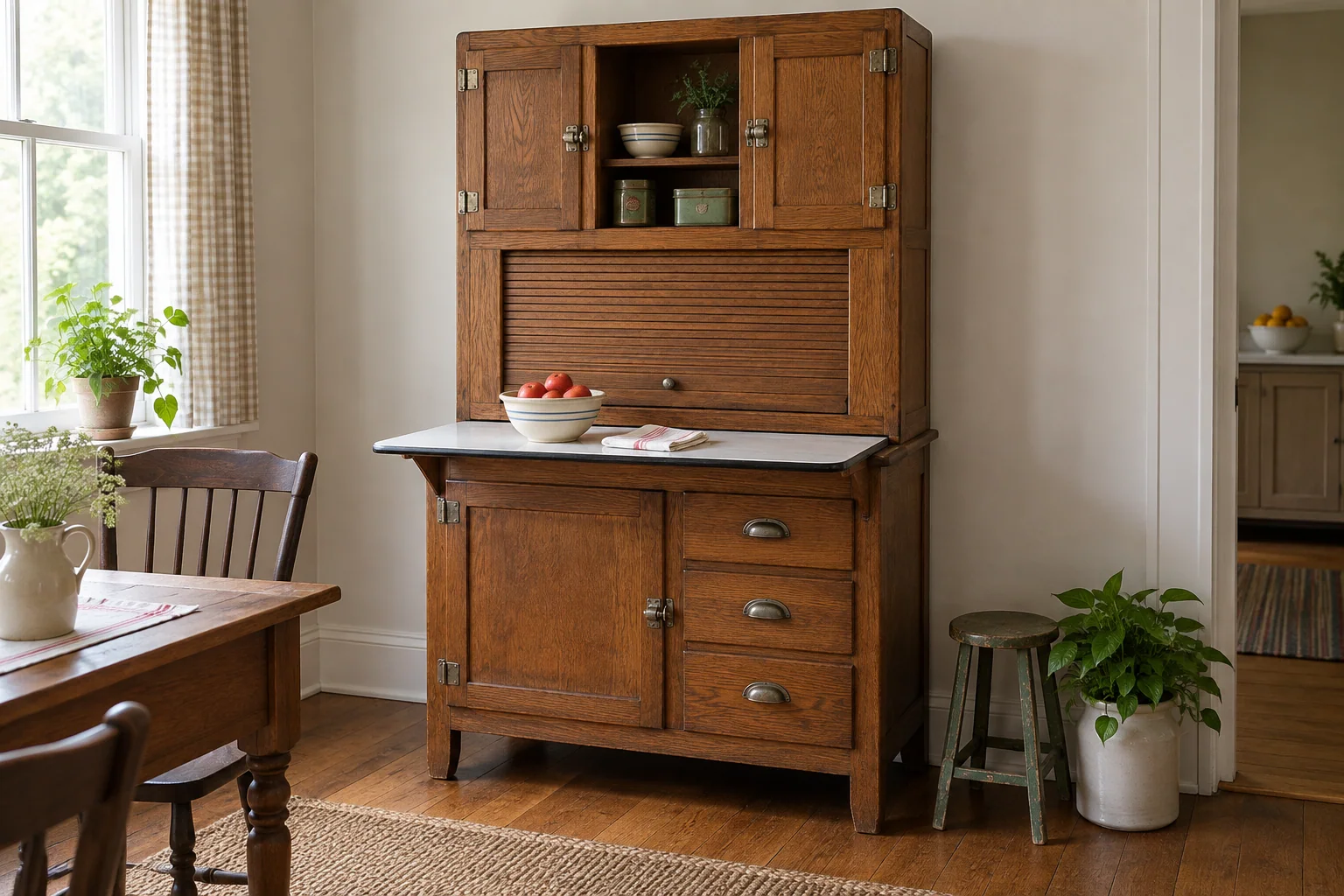
The name hides several kinds of cabinet
The Animas Museum explains the distinction with its own cabinet: a piece made by G. I. Sellers & Sons, within the wider type often called Hoosier. The museum describes specialised storage and a flour-bin arrangement. That is a useful reason to look for the maker’s evidence before assembling a supposedly original set of accessories.[1]
Historic New England’s collection record for a Hoosier cabinet includes its maker label, enamel work surface, flour sifter and sugar dispenser. Those documented fittings belong to that object. Their presence in a museum record does not establish that every cabinet should have the same containers or mechanisms.[2]
Open every compartment before judging completeness
Ask for photographs of all doors, drawers and the tambour or roll front where fitted. Have the seller identify the flour bin, sifter, bread drawer, spice storage, original charts and any loose accessories individually. Note absent supports and later replacements as carefully as decorative glass jars.
| Aim | Priority |
|---|---|
| Useful kitchen cupboard | Sound structure, accessible storage and a manageable surface. |
| Preparation station | Working height, extension support and suitability for the intended task. |
| Documented complete example | Maker-specific references and an itemised original/replacement inventory. |
A cabinet missing a flour sifter may still make a delightful home for crockery and cookbooks. It should be priced and described for that use. If completeness is the attraction, do not let a collection of attractive jars substitute for evidence that they fit the correct model.
The pull-out top is the practical test
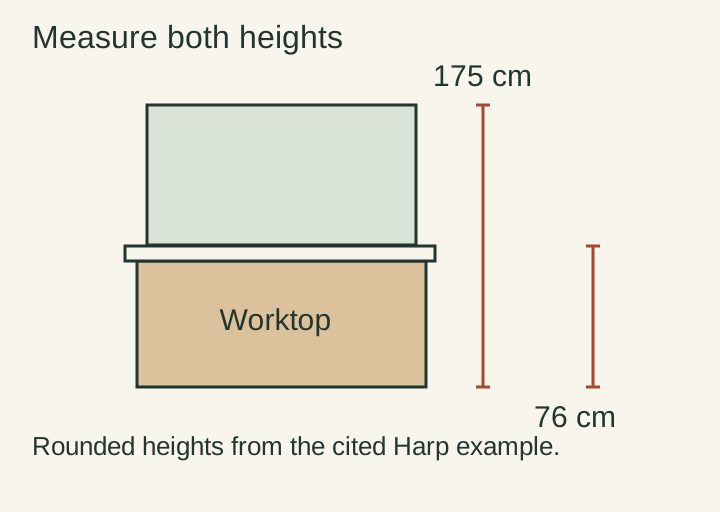
Harp Gallery records one offered cabinet at 43 inches wide, 69 high and 28 deep, with a work surface 30 inches high. That is roughly 109 × 175 × 71 cm overall, but only 76 cm at the working surface. Use those as an example of why two heights matter, not a specification for the whole category.[3]
Ask for the usable surface size and the maximum supported extension on your cabinet. Have the seller demonstrate it gently and show the runners and stops. A surface that slides out is not necessarily intended to support a person leaning heavily on its front edge.
Try the work height against your intended activity. It may be agreeable for arranging cups while feeling low for prolonged preparation. Photograph chips, filled areas and repainting on the top, and establish suitable use rather than treating old storage fittings as automatically ready for food.
Plan the move as two sections only if it really separates
The same Harp example has a removable upper section. Ask how the sections of your cabinet connect and who will separate and reassemble them; similar appearance does not prove the same arrangement. Record fragile internal fittings before transport, and agree how they will be protected.[3]
Measure the doorway route, the space for doors and drawers to open at home, and the location of sockets or other obstructions. A tall cabinet may need a suitable restraint; have the installation assessed for this furniture and wall. Do not casually alter the back to make an appliance fit inside.
Send with your intended use
Please identify the maker and show every compartment, specialist fitting and replacement. What are the working height and supported extension? Does the upper section separate, and what assembly or restraint will it need?
Let the old kitchen organisation suggest a new one. The cabinet can be useful without pretending your kitchen still needs a flour dispenser, and collectible without every jar being filled for use.