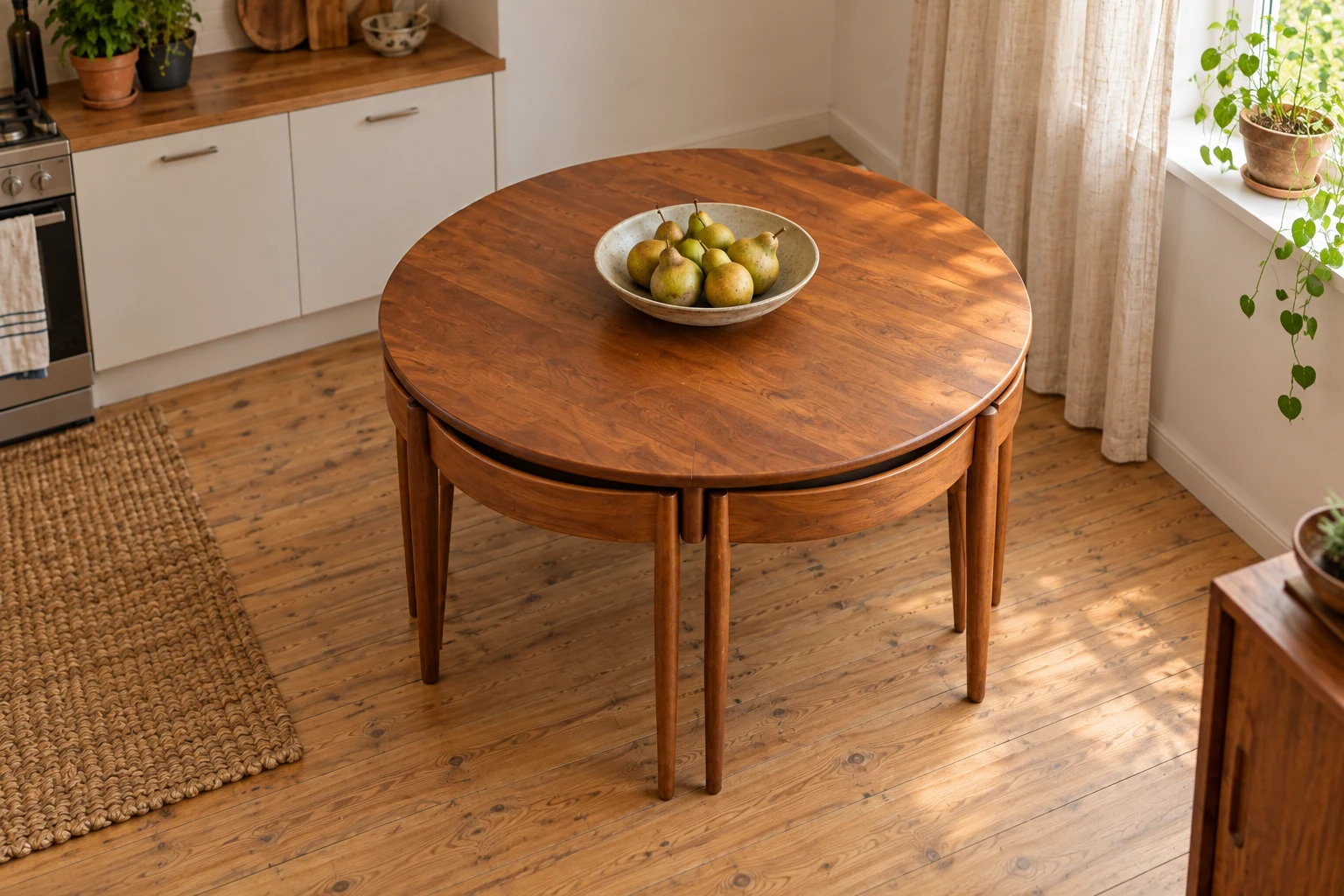
The appeal is in the way it packs away
A round table is pleasant to sit around, but the Roundette adds another attraction: low curved chair backs can meet its apron when the chairs are tucked in. Danish Homestore’s sold record DT1068 describes that relationship on a Hans Olsen set made by Frem Røjle, with four three-legged chairs. The room gains a compact piece of furniture between meals.[1]
That is also the buying test. Ask for a view of the whole offered set closed, with every chair in its intended position, followed by the chairs pulled clear. If only one chair fits neatly, you have not yet seen the feature you are paying for. Similar curves and timber colour are a starting point, not proof of compatibility.
Make a simple inventory: table, chair A, chair B, chair C, chair D and any extra pieces. Keep each underside photograph with its whole-chair view. This avoids losing track when a seller sends several close-ups that might all belong to the same chair. Record marks, replacements and repairs against the correct item.
The name does not give you one diameter
Two sold dealer records show why you should ask for measurements. Danish Homestore reports a 106 cm diameter; Old Design reports 120 cm for a set it describes as having extensions. These are records of those sellers’ offered sets, not a factory chart of every Roundette version or proof that their chairs interchange.[1][2]
| Sold record | Seller-reported table size | Question still worth asking |
|---|---|---|
| Danish Homestore DT1068 | 106 cm diameter; 75 cm high | Do all four offered chairs nest as shown? |
| Old Design, Hans Olsen dining set | 120 cm diameter; 75 cm high; extensions described | Which extension pieces are included, and what is its measured open size? |
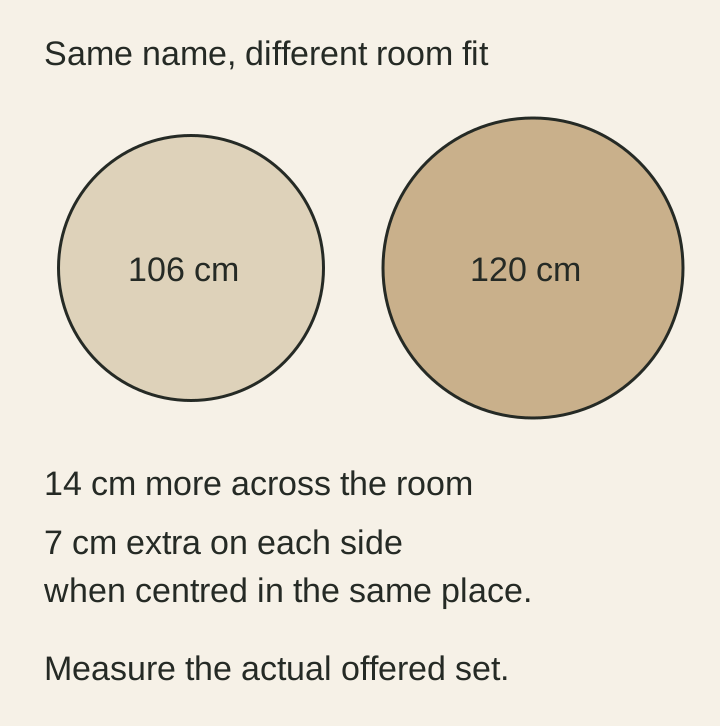
Use the seller’s actual diameter to mark a circle in your room. Then add the space occupied by the chairs when people are seated and getting up. A set that stores inside a tidy circle still needs a dining area. Check the doorway, radiator, sideboard doors and the route through the room with the chairs in use.
Check the chair against the table
With the set on a level floor, ask the seller to slide each chair into its intended place without forcing it. Look at where the curved back meets the table edge and whether the seat or frame catches underneath. A chair that must be pushed hard, tilted or squeezed into place needs an explanation.
If a seat has been reupholstered, ask whether it still clears the underside and whether the new shape changes the sitting position. Danish Homestore explicitly describes replacement black leather on its recorded set. Renewed upholstery can be useful for everyday dining, but matching fresh covers do not establish that the frames started life together.[1]
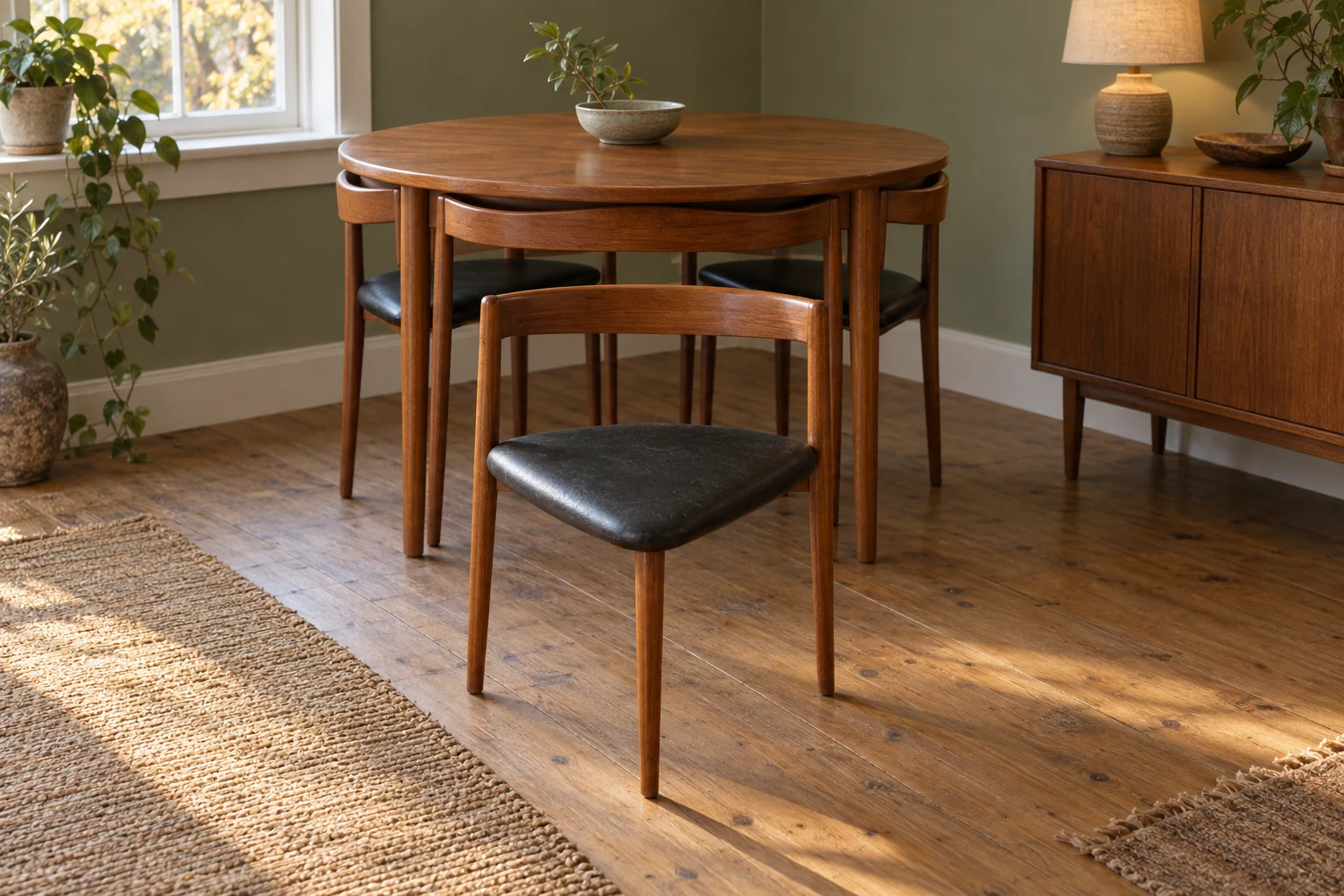
Try each apparently sound chair normally. Check the low back, the seat shape and your knee room under the apron. If a joint moves or a split is visible, stop the trial and have the problem assessed. The distinctive shape is a reason to inspect the actual chair carefully, not a substitute for doing so.
Treat an extension as a separate part of the deal
If the listing describes an extending version, ask for the table fully open with every included leaf in position. Confirm the number of leaves, their dimensions, where they are stored and the measured open length. A photograph of a closed round top cannot answer those questions.
Also ask how many chairs are included and where any extras live when the table is closed. Four chairs that nest around the round table and enough seats for occasional guests are different requirements. Decide which you need before comparing two prices.
Use the extending-table Guide for the mechanism and leaf inspection. Here, the extra task is to confirm that the complete table-and-chair arrangement works in both its closed and open states.
Compare complete sets with complete sets
Price a missing or unsuitable chair as an unresolved sourcing problem until you have found a verified match. Do not turn a plausible search result into a guaranteed replacement. The cheaper incomplete set may still be appealing, but only if you would enjoy owning it without the missing piece.
For restoration, agree the desired result for the whole group: sound frames, compatible seats, an acceptable tabletop and the nesting fit preserved. Ask the restorer to assess changes to chair backs or seat thickness in that context. A good finish on separate pieces is not the same result as a usable set.
A message for the seller
Please show all included pieces together, every chair tucked into place, then the chairs pulled out. What are the table’s actual diameter and height, and any open length? Please identify replaced upholstery, frame repairs and the marks on each piece. If it extends, show and list every included leaf and any additional chairs.