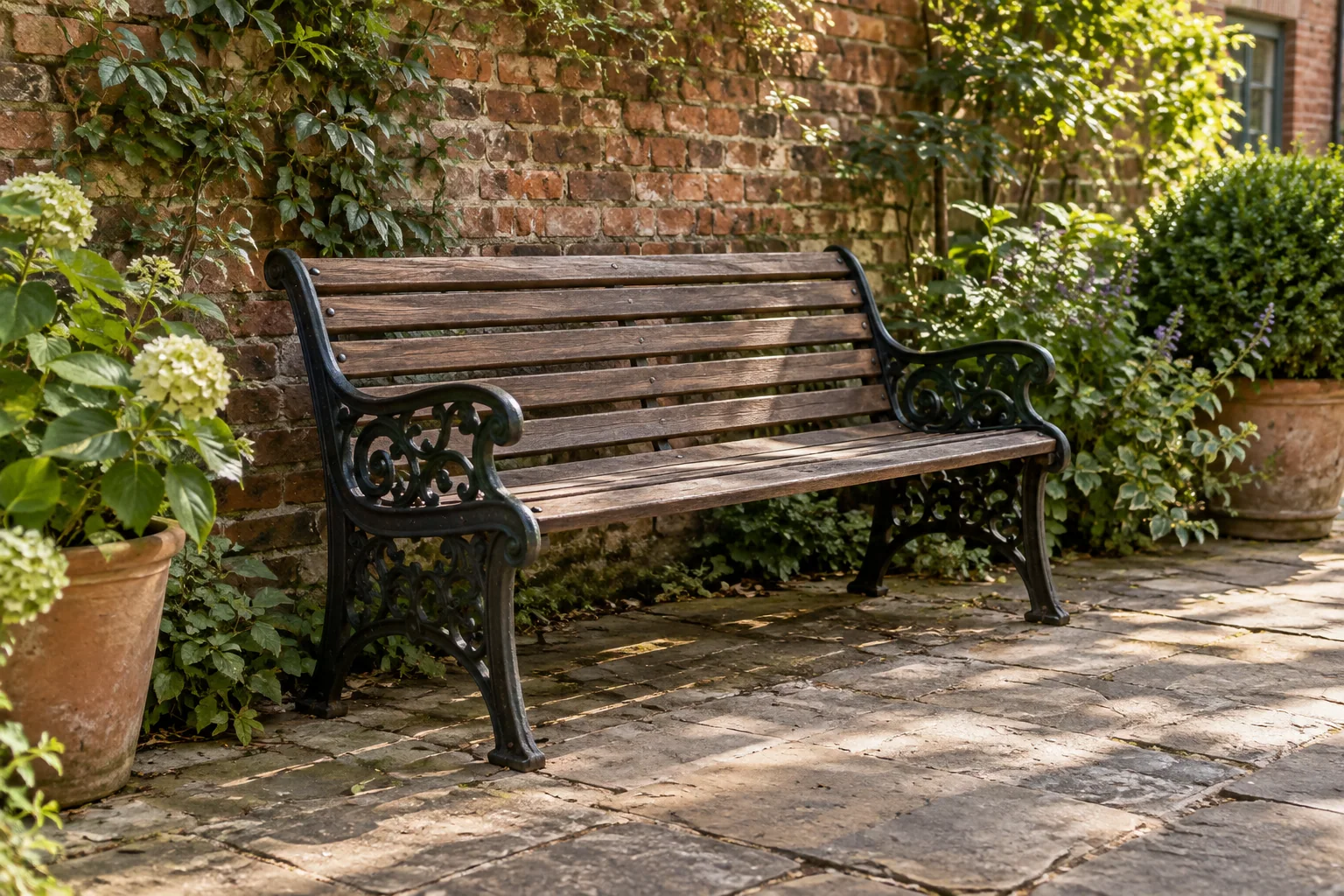
The wood and metal age differently
The worn slats are often the first thing you notice, but the frame deserves its own inspection. A first-hand repair account from Cast Iron Welding Services describes a Coalbrookdale bench with both rotten oak slats and a broken metal support. The workshop assessed and repaired the casting as well as replacing timber. It is one documented repair, not a prescription for every bench.[1]
That distinction is useful even for a modest unmarked example. A bench described as needing “just new wood” should have a frame whose condition has actually been considered. Ask what was checked and whether braces or connecting parts are missing.
Give the metalworker a map of the bench
Request whole-bench views from the front, rear and sides, then details of the feet, lower ends, slat attachments and any apparent crack or old repair. Include enough surrounding structure to locate each detail. Paint can conceal a repair, so an attractive finish should not end the inspection.
Do not sit on a bench with visibly compromised supports or rotten seating to test how much strength remains. Nor should filler over a crack be accepted as a structural repair. Have a competent cast-iron specialist assess the actual damage and explain whether a durable repair is appropriate.
Ask whether metal preparation, repair and recoating are one workshop’s responsibility or several separate services. Identify who will inspect the finished assembly. If the bench must travel between specialists, include that handling in the budget before dismissing the asking price as negligible.
There is no universal set of garden-bench slats
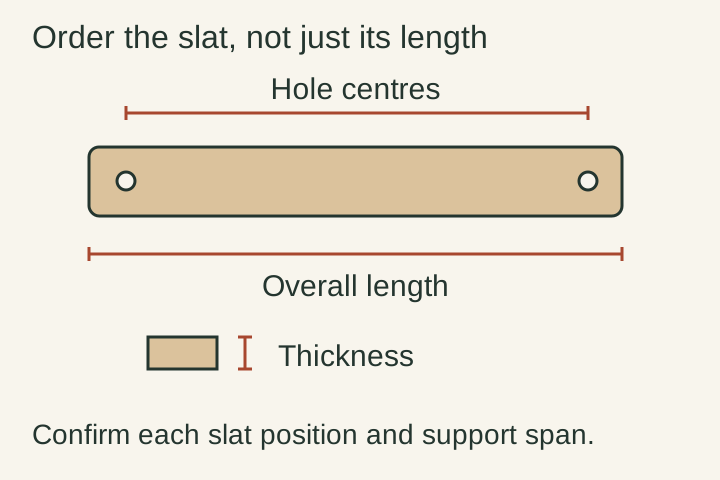
| Record | What the supplier needs to know |
|---|---|
| Position and quantity | Seat, back and any differently shaped front or top pieces. |
| Length and supported span | Both the overall piece and the distance between supports. |
| Width, thickness and edge profile | The section that fits the frame and intended seating geometry. |
| Fixing positions | Hole centres and any countersink or recess required by the agreed fittings. |
| Wood and finish specification | A suitable material and coating plan for the particular outdoor use. |
Keep a sound original slat or a measured template where the repairer considers it useful. Do not assume every row is identical, or that copying a rotten piece reproduces its original dimensions accurately. Have the supplier and assembler agree the specification before timber is cut.
Check any central support or brace as an identified part of the design. Removing one to simplify the work changes the span the slats must bridge. Ask the repairer to resolve absent components rather than compensating with an improvised thicker board.
Compare the finished seat, not two loose iron ends
A pair of attractive cast ends can look inexpensive until it needs connecting parts, bespoke slats and specialist metalwork. List purchase, collection, assessment, repairs, timber, fittings, coating, assembly and final delivery. These are cost headings to obtain quotes for, not assumed market prices.
Keep maker and age claims separate from repairability. A decorative pattern repeated on later benches does not authenticate an old casting. If a named maker commands a premium, request the supporting marks and records; an unmarked bench can still be worthwhile on its own practical merits.
Before committing
Ask for confirmation that the frame can be made ready for use, a complete slat and fittings specification, and a total for the assembled bench. Plan a firm, suitable position in the garden and the maintenance the chosen finishes require.
The satisfying result is a bench you can leave by the wall and actually use for a cup of tea. Start with the sound support that makes that ordinary pleasure possible.