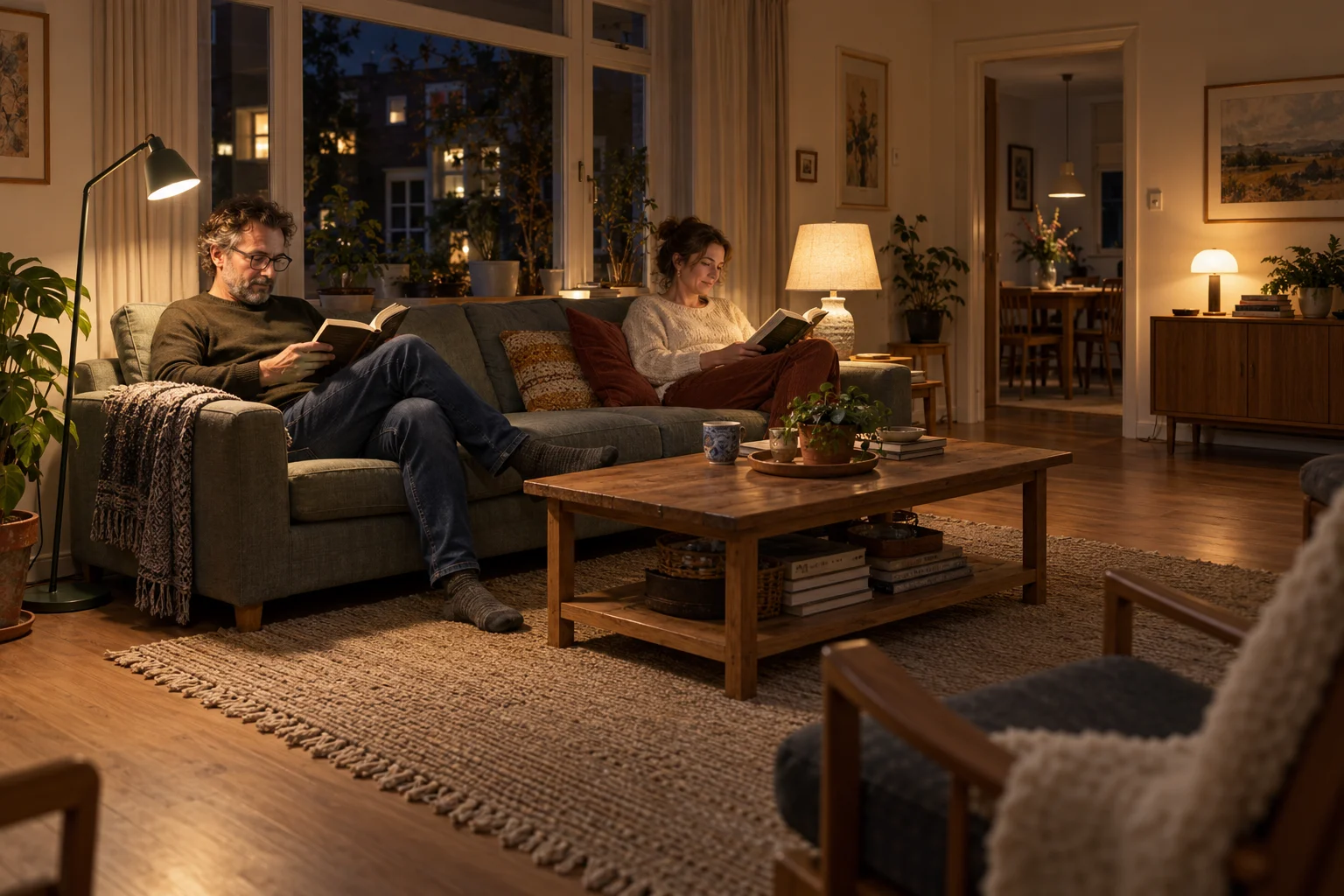
Name the evening before counting the lamps
List what actually happens after dark. Perhaps one person reads while another talks, a sideboard holds drinks, and the route to the kitchen passes behind the sofa. Those are useful jobs for light. 'Three beautiful lamps' is a collection; a light for the page, a gentle background and a visible route are the beginning of a room plan.
Flos distinguishes general room illumination from task lighting for activities such as reading, and suggests considering zones and access when positioning a floor lamp. Use that distinction to assign jobs, rather than treating every lamp as a smaller version of the ceiling light.[1]
Map the lamps you already have
On a simple room sketch, mark the seats, tables, sockets and usual walking line. Add the full base and shade of each lamp, its switch and its cable route. Keep a floor lamp's base visible in the plan even when it disappears behind a chair in a photograph. A tabletop lamp also occupies useful table space: include the book, cup or other object that shares its surface.
For each lamp, note what it lights from the intended position and where its bright source is visible. Then sit in the other seats. You may discover that two lamps duplicate one job while a useful corner remains difficult to use. Move a suitable portable lamp within its assessed use before shopping for a fourth.
Try each light alone, then the useful combinations
Begin after dark with the actual shades and approved light sources in place. Switch on one lamp and use the place it serves. Add a second, then remove the first from the combination. This simple comparison makes it easier to see which lamp contributes something and which merely adds another bright point. It is a room observation, not a light-level measurement or a health assessment.
| Evening activity | Try | Observe from the occupied room |
|---|---|---|
| Reading and company | The reader's light with a separate background lamp | The page, the other sitter's view and the reachable switches |
| Conversation | A combination that lets the seated people see one another comfortably | Faces, exposed sources and the route between seats |
| Putting the room away | The existing lights that serve shelves, the doorway and the walking line | Whether ordinary tasks remain easy without rearranging furniture |
Keep the preferred combinations simple enough to use. Record the switches involved and try them in the order you actually enter and leave. A pleasing photograph with every lamp on can conceal the daily inconvenience of reaching behind a full cabinet for the only useful switch.
Give two readers a shared trial
Imagine a sofa with one reader at each end. One likes a brighter page; the other prefers less light across the room. Start with a separate, already suitable reading light at the first seat and an existing shaded lamp across the room. Ask both people to hold their own books and look up towards one another. Move the portable light if its source enters the neighbouring reader's view, keeping its support and cable route suitable.
Next try the background lamp with and without the task light. Does it contribute a useful view of the room, or is it pointing attention at an unused corner? Test another permitted position before choosing a brighter bulb or new control. A lamp's electrical assessment and manufacturer instructions still govern the light source and any adjustment; this room trial is not permission to change a fitting or add a dimmer.
There may be no single combination both people want all evening. Two useful switching arrangements can be the successful result. Write down what each serves rather than searching for a universal 'cosy' setting or a colour-temperature number that promises the same response from everyone.
Choose the missing job before another object
Only after the trial, describe the gap. 'Light on a book beside this chair, without a bright source facing the sofa' gives a seller or lighting specialist something to work with. 'A matching vintage lamp' may give you another object that leaves the gap untouched. Repeated metal, shade colour or a related curve can connect different lamps visually; electrical and practical suitability remain separate questions.
Before buying, obtain the new lamp's complete dimensions, shade and base footprint, reachable controls, cable length and professional assessment plan. Use the lampshade Guide for the actual fitting and shade relationship. If the solution needs fixed wiring, a new control, installation or an uncertain accessory, give that work to the appropriate professional. Keep the buyer's room brief clear: the exact activities, seats, existing lamps, photographs and combinations that already worked.