Before the brush reaches the wood
The V&A follows lacquer artist Kenji Honma in Okukuji, Japan, where the work includes cultivating trees and collecting sap. A usable tree takes roughly a decade to grow. The film places the finished object within a much longer cycle than its last coating might suggest.1
A small box or a cabinet door can be held in the eye all at once. Its material history cannot. The tree has occupied a place, the sap has been gathered and prepared, and the craftsperson begins with something already shaped by that work.
Honma’s practice also makes the source tangible without standing for every workshop. Growing, harvesting, preparing and applying may be undertaken by different specialists. The continuity of the material does not require one person to perform every task.
A surface built a little at a time
Urushi does not harden merely because a liquid is left out to evaporate. The Met describes a process in which exposure to oxygen and humidity helps the lacquer polymerise. Moist conditions can therefore assist the making of a hard surface.4
The apparent contradiction is part of the material’s fascination. We often imagine a dry room as the obvious place for a wet coating to become dry. Lacquer demands a more particular understanding of what the substance is doing.
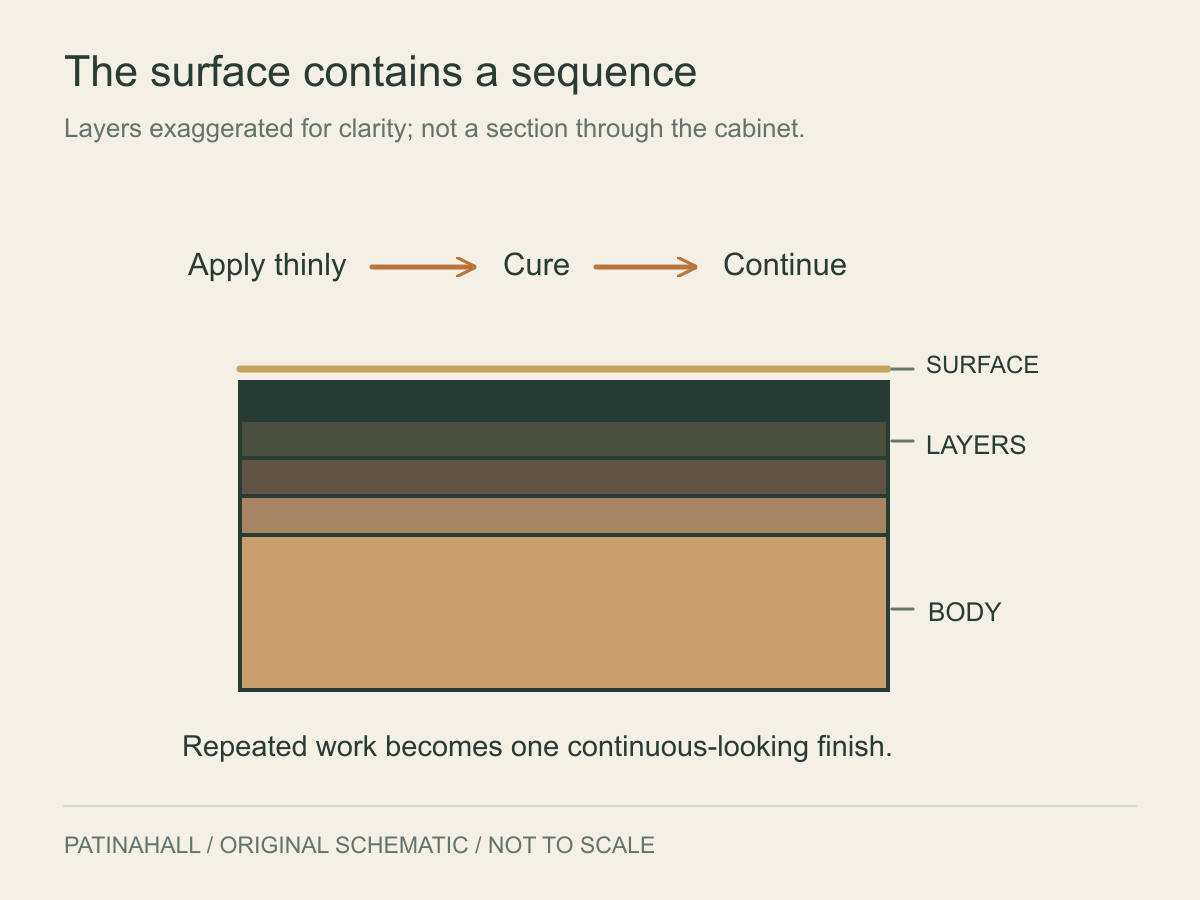
Thin applications and repeated work build the finish. The Met describes objects curing in warm, humid cabinets between coatings; the number of layers depends on the work being made.2
Seen in section, the surface becomes a sequence rather than a single skin. The diagram exaggerates the layers to make that sequence visible. The final reflection conceals the intervals that made it possible.
A ground that can hold light
Lacquer can also receive other materials. In maki-e, metal powder is sprinkled onto damp lacquer to form decoration. The Met’s account distinguishes this from techniques that inlay shell or carve into built-up lacquer. A dark surface with bright ornament may contain several different kinds of making.2
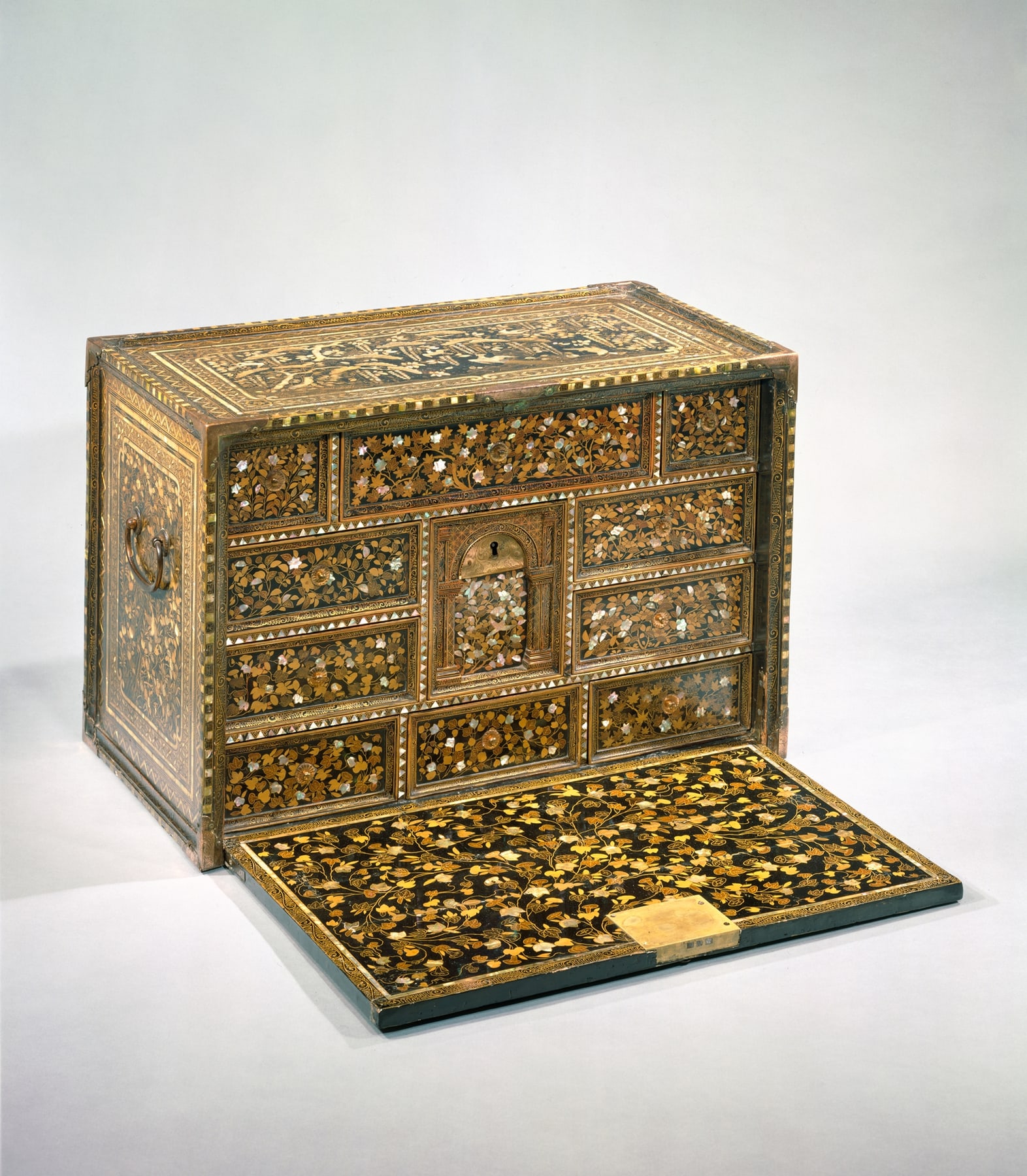
The Japanese cabinet 1989.17a–l offers a particular example. Dating from the late sixteenth century, it combines lacquered wood with gold and silver hiramaki-e and mother-of-pearl inlay. Birds, plants and a court carriage occupy a form adapted from European drop-front writing cabinets.3
The shell and metal do not behave like the dark ground. They catch the light differently as the viewer moves. The cabinet’s appearance comes partly from that changing relationship, not just from the outlines of its designs.
What the gloss leaves out
A smooth finish is good at hiding its own labour. It presents continuity where the making involved waiting, judgement and repeated returns to the object.
The cabinet’s fall front makes this particularly easy to forget. It looks like one decorated plane, then opens to reveal storage and another working surface. The furniture has a practical interior; its finish has a history of its own.
Looking at urushi slowly means allowing both to remain present: the surface available to the eye now, and the long sequence of work that the reflection does not show.