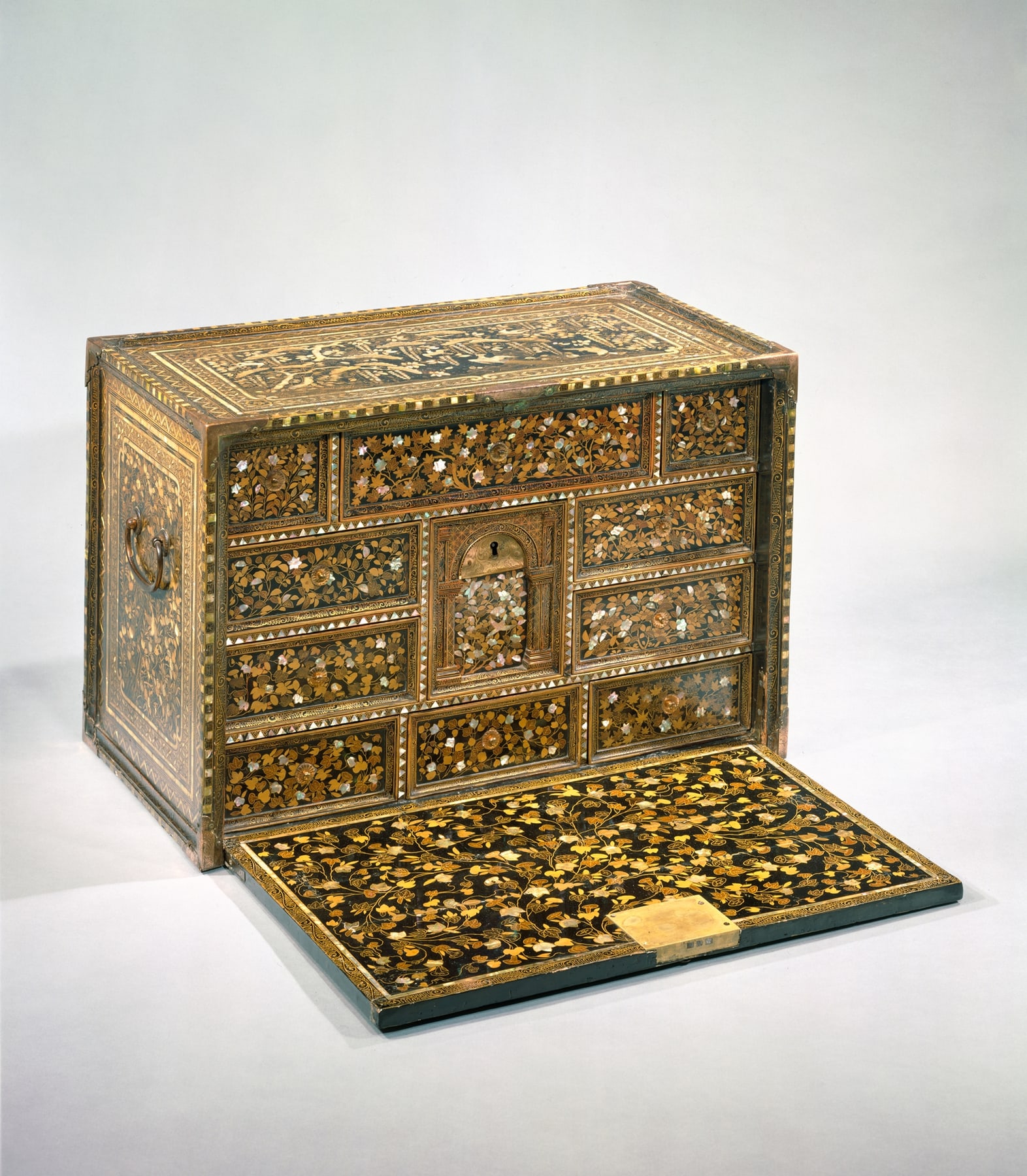
The outside is a scene
The closed front gives the eye a continuous decorated panel. A court carriage and surrounding motifs occupy a dark lacquer field, while bright shell and metal-coloured decoration catch the light. Before the cabinet opens, its practical divisions are largely withheld.
The Met dates the object to the late sixteenth century and records gold and silver lacquer decoration with mother-of-pearl. The materials make the surface change as the viewpoint changes: the dark ground remains steady while small bright passages become prominent.1
The front becomes a place to write
In the open photograph, the large panel lies forward. What previously presented a scene now forms the space immediately before the drawers. The cabinet’s depth extends into the room through that lowered front.
The Met’s acquisition study describes ten drawers arranged around a central arched, lockable compartment. This is a compact interior with a pronounced centre, rather than an undifferentiated box. The central arch makes the small façade feel architectural.2
The opening action changes how decoration is encountered. The exterior scene gives way to a rhythm of drawer fronts, borders and little fittings. A single object offers two quite different compositions.
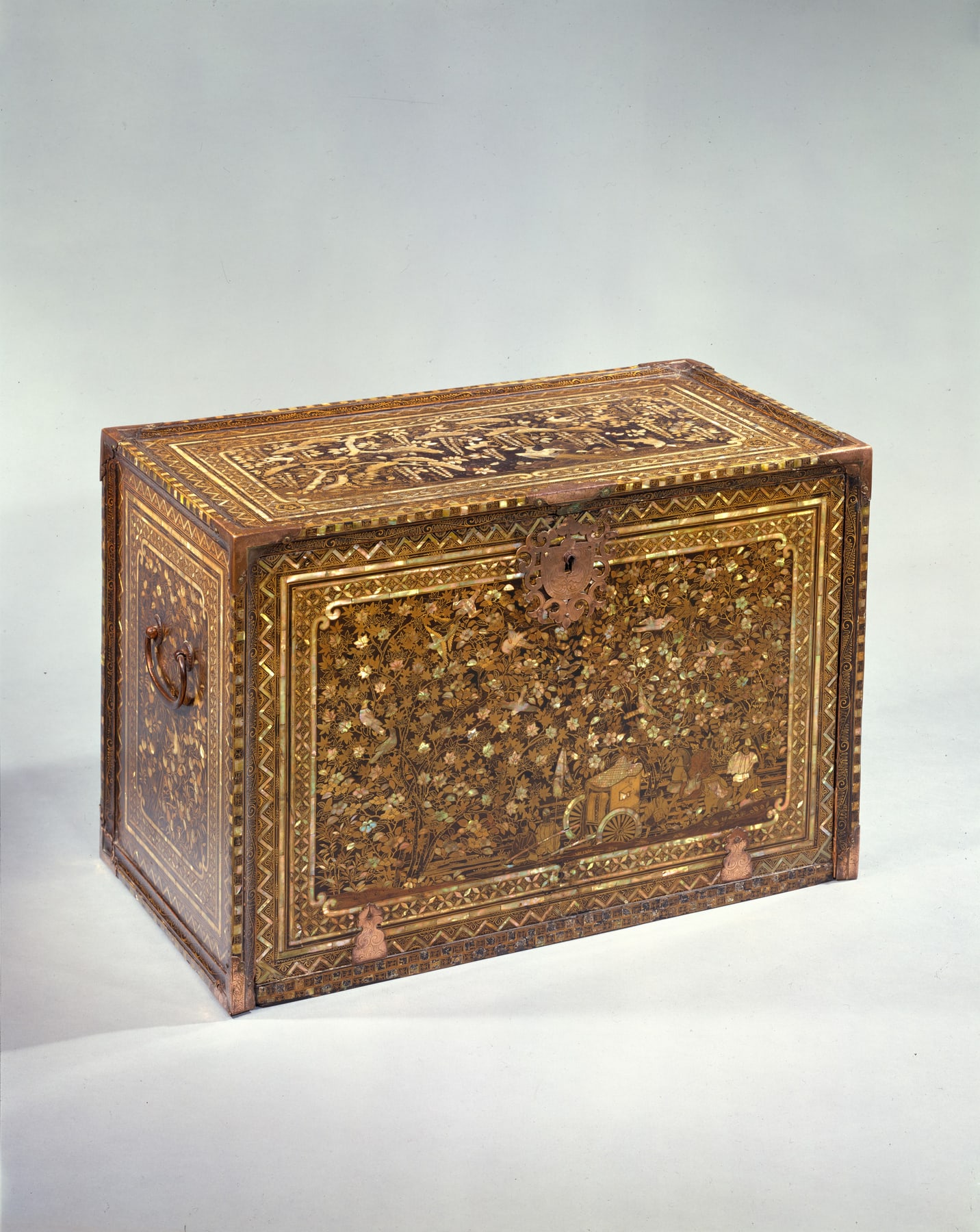
A familiar mechanism crossed a trading route
The acquisition account connects the form with the European escritorio and with export for Spanish and Portuguese trade. It attributes the cabinet to Kyoto. These are claims about a production and trading context, not the biography of a known purchaser.2
The cultural meeting is specific. A way of storing papers and working at a lowered front was joined to a Japanese decorative practice. Describing the piece only as a mixture of East and West would lose the useful details: what opens, what stays fixed, and which surface a sitter would face.
Two photographs prevent half a reading
The closed view explains why the cabinet could command attention as an object in a room. The open view explains why its divisions were worth making. Neither photograph replaces the other.
Follow the border around the fall front in both states. It belongs first to a vertical image and then to a horizontal work area. That continuous decorated edge is a simple way to see the cabinet’s central achievement: a practical transformation that carries its visual richness with it.