Colour stays in the making
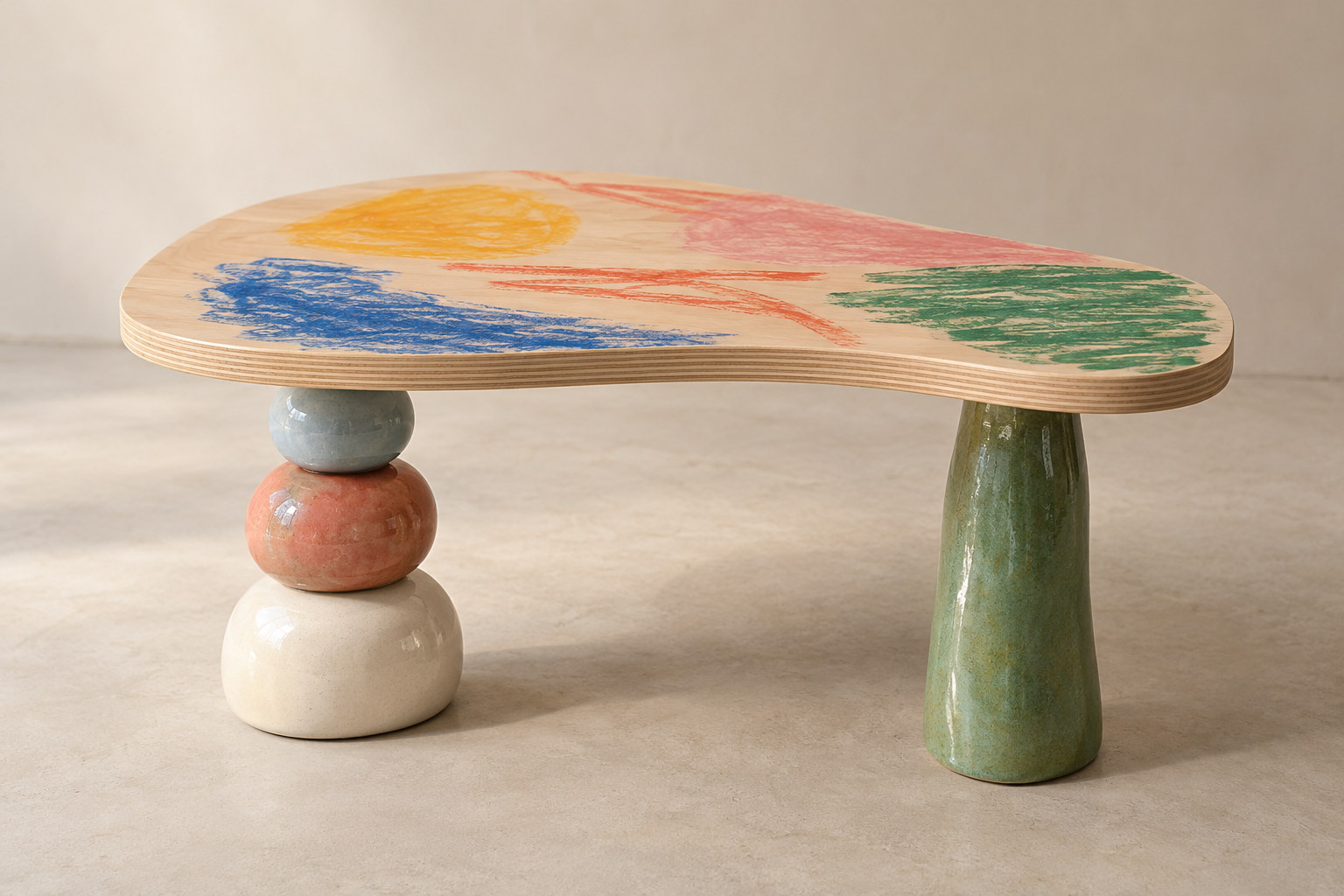
Kiki van Eijk's 3D Collage Tables let a drawing remain present in a finished piece of furniture. The studio describes hand-applied wax crayon on wood, protected by varnish, alongside hand-built glazed clay elements. Colour is part of the way the objects are made.1
Wax crayon is an approachable material: it can put a mark directly onto a surface through a movement of the hand. Here that action enters a table's material description, giving drawing a place in an object intended to occupy a room.
Varnish carries another part of the idea. It preserves the coloured surface as a finish, allowing a familiar drawing material to participate in furniture.
Collage gains volume
A paper collage brings selected pieces into a new arrangement. These tables explore that way of composing through wood and clay, with different materials retaining different visual roles.
The move into three dimensions changes what a combination can do. A coloured surface can spread across a top; a formed element can occupy the space beneath it. Looking around a table becomes part of reading the arrangement.
The hand-built clay introduces another kind of making beside the coloured wood. Both retain a relationship with the hand, through forming or marking, while contributing to a larger piece.
A series, then particular tables
The studio dates its series to 2020. The representing gallery's The New Harvest catalogue presents individual tables with their own material descriptions and dates, including works dated 2021. The series and each later object therefore need different levels of description.12
That individuality suits the idea of collage. The attraction comes from a particular combination of forms and surfaces, rather than from expecting every table to repeat exactly the same arrangement.
Wax crayon is applied by hand, varnish covers the coloured wood, and clay is formed and glazed. Each action remains part of how the finished table can be read.