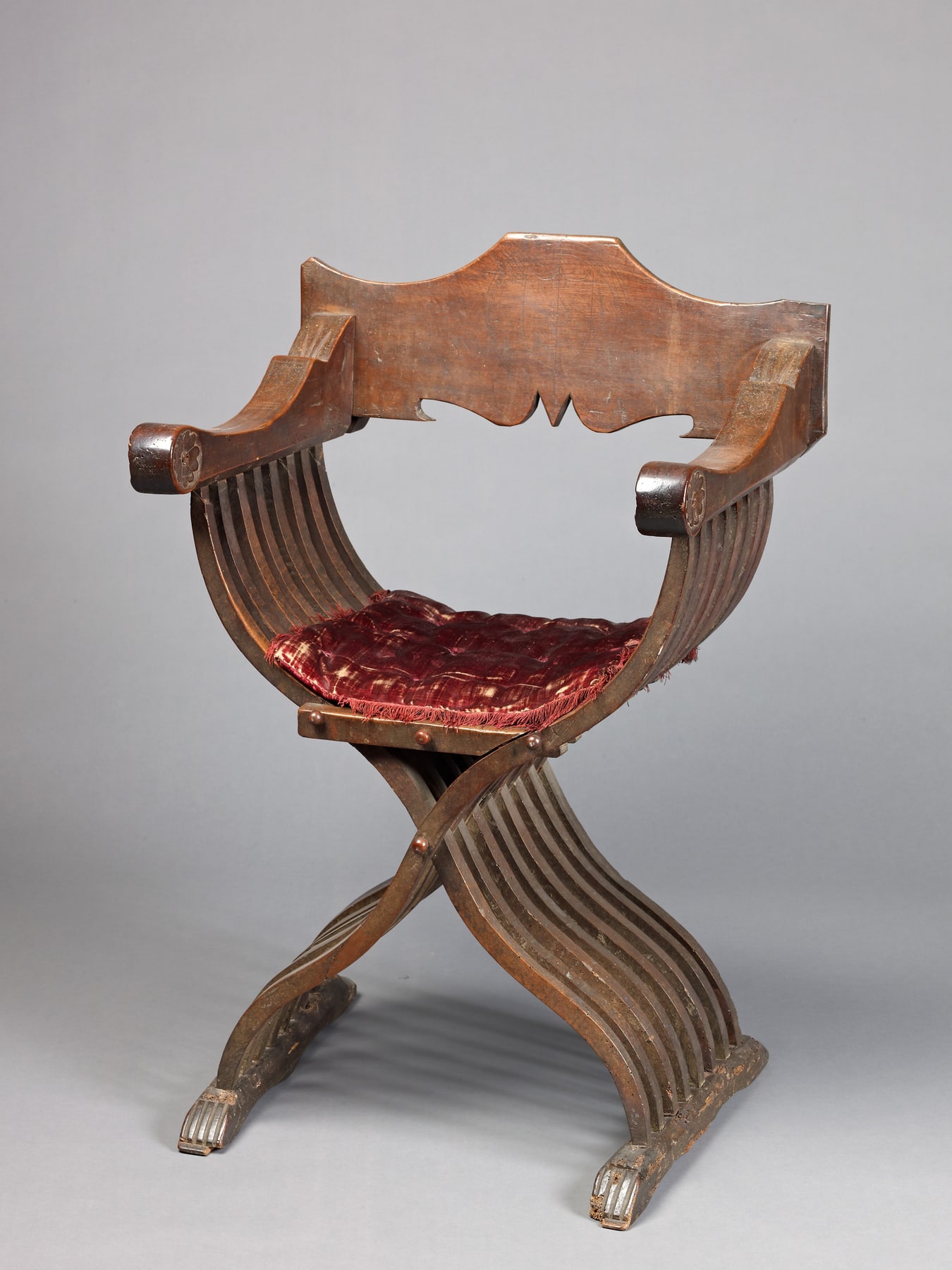
The side view explains the outline
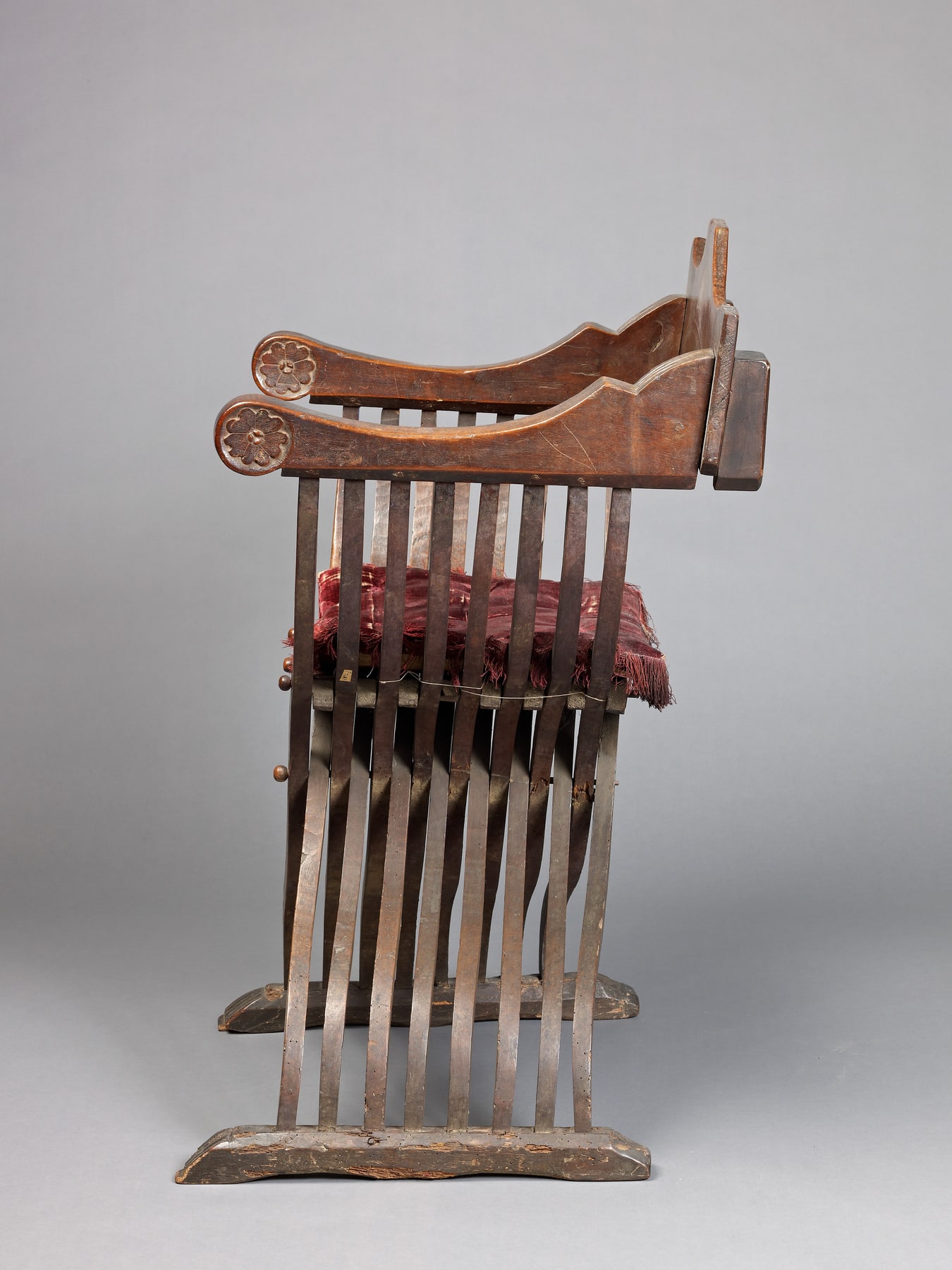
From the front, the chair appears broad and strongly symmetrical. Move to the side photograph and the crossing curved members become much easier to follow. Wood passes through the central area and spreads towards the feet, creating the characteristic folding-chair silhouette.
The red velvet introduces a different kind of surface. Where the walnut defines a line, the fabric presents a soft field. The contrast is clear even before the museum’s dates enter the picture.
Two dates occupy one object
The Met describes the chair as nineteenth-century with earlier parts, and the textile as fifteenth-century. It lists partly turned and carved walnut alongside red plain velvet.1
Those details make the object a meeting point of different histories. An old textile does not automatically date the frame around it. Equally, a later assembly does not make its earlier component unimportant. The meaningful question is how the parts relate, rather than which single century can be attached to everything at once.
Another Savonarola has another history
The Met holds a different walnut Savonarola chair, accession 37.80.18, dated to the fifteenth or sixteenth century. That earlier example provides a useful comparison for the persistence of the form.2
The shared name does not make the two objects interchangeable. Their catalogue dates concern particular chairs, not a rule that every crossing frame belongs to the Renaissance. A silhouette can survive through revival, reconstruction and the reuse of older parts.
Place the two records beside each other mentally: one dates an earlier chair; the other describes a later composite. The difference becomes more interesting once the familiar shape stops supplying an automatic answer.
The joins deserve as much attention as the style
Look again at where the wooden curves cross, and where the textile meets the upper structure. These are the places at which separate elements become the chair now in the museum. The photographs let us locate those relationships, although they cannot provide a complete history of assembly.
The object rewards a layered description. Its form belongs to a long chair tradition, its present assembly has a nineteenth-century date, and its velvet carries an earlier one. Holding those facts together preserves the unusual thing about this chair: several periods remain physically present in one apparently unified piece of furniture.