Artefact story

Pugin’s Speaker’s House chair: a Gothic design made after its designer

Pugin died in 1852, but this chair was made in 1859. The dates make sense once design and manufacture are separated: Holland & Sons produced a chair based on his design for the Speaker’s House. An institutional interior could continue to take shape through a designer’s work after his death.

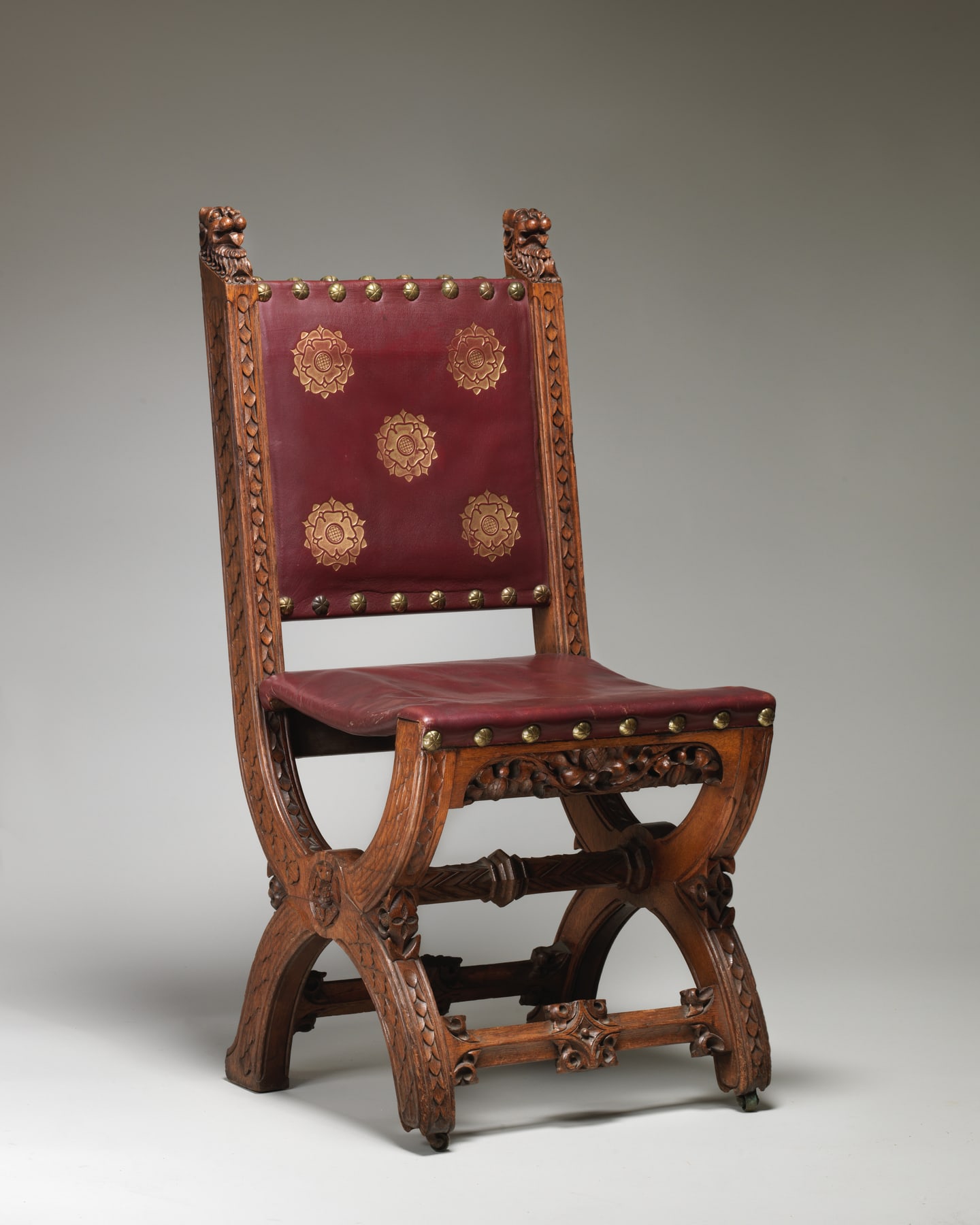
Pugin-designed Speaker’s House chair made by Holland & Sons in 1859, with a carved oak X-frame and modern red leather.
Pugin-designed Speaker’s House chair made by Holland & Sons in 1859, with a carved oak X-frame and modern red leather. Accession 2015.638. The Metropolitan Museum of Art. Public domain (CC0).
On this page
Key facts & takeaways

At a glance

Subject
Dining room chair from the Speaker’s House, Palace of Westminster 2015.638
Entry
Artefact story
Last reviewed
6 September 2026
Object dated
1859documented

Three things to remember

  1. The chair’s 1859 manufacture follows Pugin’s death in 1852.
  2. Holland & Sons made the object; Pugin supplied the design.
  3. The X-shaped appearance does not make this a folding chair.

The crossed frame stays still

From the side, the oak members cross below the seat to produce a strong X. Carving emphasises the junctions and ends, making the chair’s structure an active part of its appearance. It looks backward towards historical forms while presenting a substantial fixed frame.

The Met relates the design to a chair shown in Crispijn de Passe’s 1642 furniture publication. That comparison is more precise than calling the object a surviving medieval chair, and it does not imply that the nineteenth-century frame folds.1

A design can outlive its author

Pugin died in 1852. Holland & Sons made this chair in 1859 for the Speaker’s House. The two dates belong to different kinds of work: conception and production.1

This is a useful correction to the way furniture is often named. “Pugin’s chair” can identify the design without claiming that he supervised this particular object as it left the workshop. The maker’s name preserves the practical continuation of the scheme.
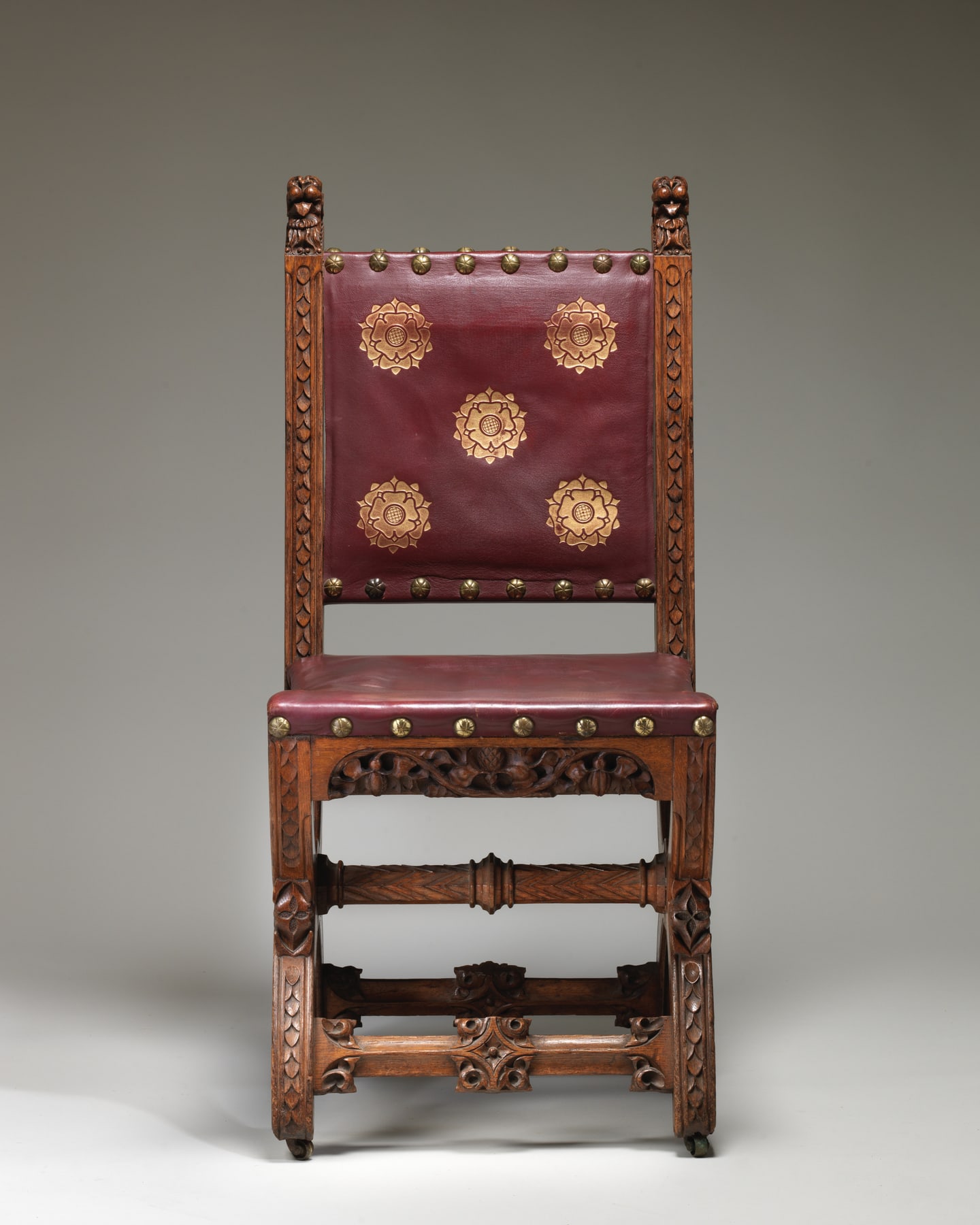
Frontal view of the Speaker’s House chair, showing the carved oak frame surrounding stamped and gilded modern leather.
Frontal view of the Speaker’s House chair, showing the carved oak frame surrounding stamped and gilded modern leather. Accession 2015.638. The Metropolitan Museum of Art. Public domain (CC0).

An institutional room gathers different dates

Parliament’s account of the Crimson Drawing Room describes a mixture of furnishings, including pieces associated with the 1850s, Pugin chairs acquired much later and a carpet using a historic design again in the 1980s. That room is a separate setting from the Met chair’s specific history, but it shows how the Speaker’s House has accumulated and renewed its furnishings.2

A room can therefore look stylistically coherent without everything in it sharing one manufacturing date. Institutions preserve designs, move objects and commission replacements. Their interiors have histories of use as well as moments of origin.

The leather has a later life

The chair’s red leather is modern, although its stamping and gilding contribute strongly to the present appearance. The oak and the visible upholstery cannot simply be assigned the same age.1

In the frontal photograph, the red field makes the carved frame easier to read. In the angled view, the X construction comes forward. Together they show how structure and surface cooperate, even when their histories differ.

The chair’s most memorable lesson is in its dates. A designer’s death did not end the use of his forms, and a surviving wooden frame did not keep its covering unchanged. The object now before us carries both continuity and renewal.

Research notesEvidence, connections and limits

The Met documents this chair’s maker and date and identifies the leather as modern. Parliament’s account of the separate Crimson Drawing Room provides context for accumulated furnishing, not an alternative attribution for this chair.

Evidence map

Connected subjects and evidence

Reviewed facts

  • Object dated 1859documented

    The primary source records 1859 as the object date. This is not an inferred design-family origin.

    Reviewed 6 September 2026 by PatinaHall editorial.

Reviewed connections

  • Dining room chair from the Speaker’s House, Palace of Westminster 2015.638uses materialCarved oak and modern stamped red leatherdocumented

    The primary record lists these materials for this subject. The full material list and object dating remain in the cited accession record; listed replacement or uncertain materials retain their qualifiers.

    Reviewed 6 September 2026 by PatinaHall editorial.
  • Dining room chair from the Speaker’s House, Palace of Westminster 2015.638made byHolland & Sonsdocumented

    The primary record identifies Holland & Sons for this subject.

    Reviewed 6 September 2026 by PatinaHall editorial.

Research trail

Sources and further reading

  1. Dining room chair from the Speaker’s House, Palace of Westminster — 2015.638The Metropolitan Museum of ArtAccessed 6 September 2026
  2. The Crimson Drawing Room: furniture in the Speaker’s HouseUK ParliamentAccessed 6 September 2026

Last reviewed 6 September 2026. Found an error or a stronger primary source? Contact PatinaHall.