Artefact story

Paper Chair: a stack of sheets takes a seat

A sheet of paper is easy to imagine as a surface to write on. A stack introduces thickness; joining and pressing introduce another set of possibilities. Jeroen Wand’s Paper Chair follows those possibilities far enough for paper to become the material of a chair.

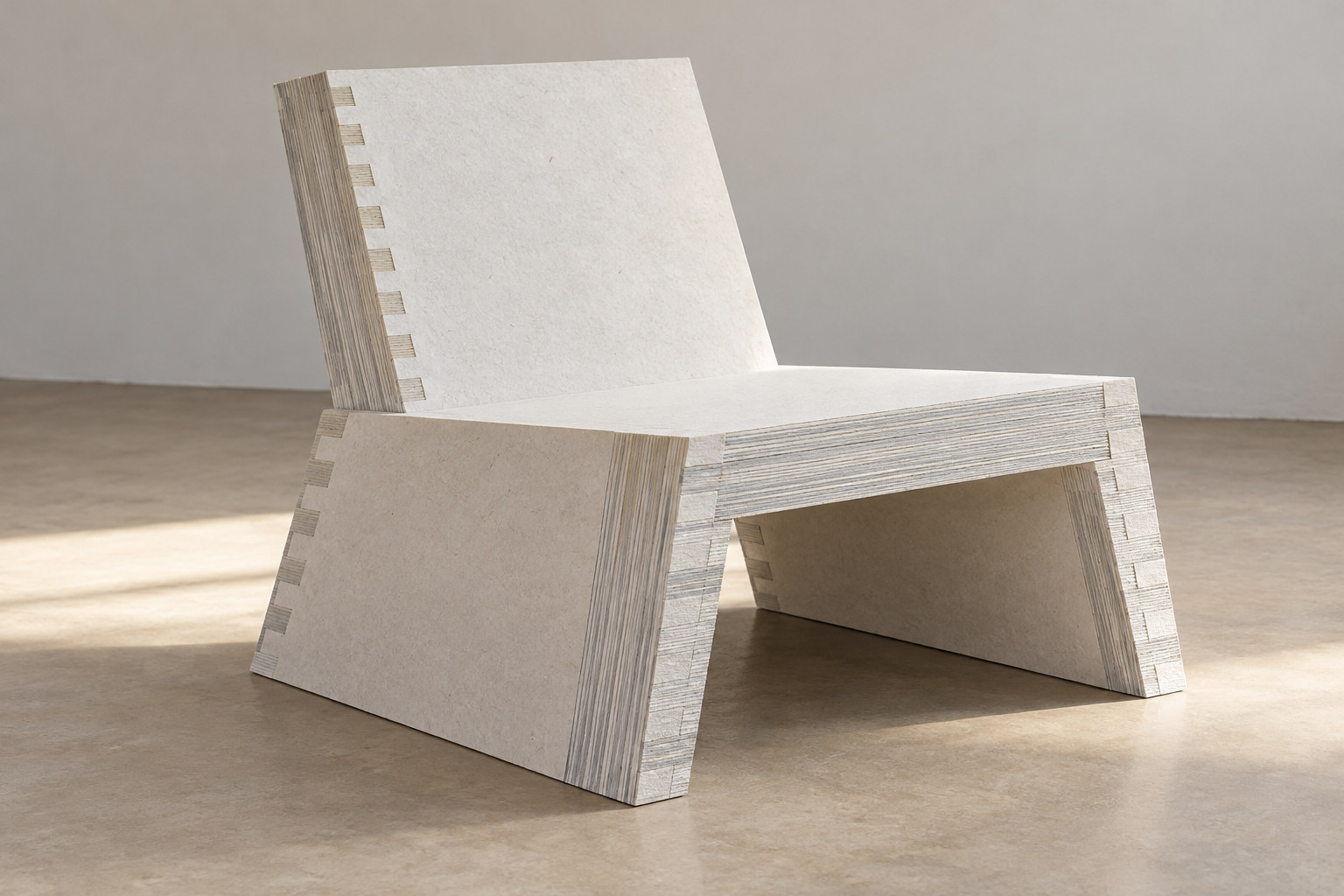
Pale paper-like planes and finely layered exposed edges form an angular chair.
PatinaHall editorial reconstruction. It is not a documentary photograph. This interpretation of Paper Chair makes fine layers and the broad planes’ thickness visible. This interprets paper lamination and joining without reproducing the museum artefact’s measurements, exact joints or condition.
On this page
Key facts & takeaways

At a glance

Subject
Paper Chair, BoijmansV 2506(KN&V)
Entry
Artefact story
Last reviewed
26 October 2026
Object dated
2006documented

Three things to remember

  1. The museum records laminated and pressed paper.
  2. The studio names finger joints in its Paper Chair account.
  3. A geometric idea can move between materials without making their fabrication identical.

Paper acquires an edge worth looking at

Paper Chair turns attention towards a feature that a single sheet keeps small: its edge. When sheets are brought into layers, thickness becomes visible and the material begins to suggest different kinds of form.

Boijmans records its V 2506(KN&V) as laminated and pressed paper. It names Jeroen Wand as maker, dates the object to 2006 and records acquisition in 2008.1

Those facts place the chair beyond a visual joke about an unlikely material. Lamination and pressing describe a way of making, while the museum object gives that proposition a specific physical identity.

Thickness changes what a sheet can suggest

The studio’s Paper Chair entry names lamination and finger joints. It also presents wear—tearing, staining and folding—as part of the work’s aesthetic attitude, comparing it with a favourite book.2

That comparison keeps paper’s familiar identity close. The material has taken a new role without losing the associations that made the experiment interesting in the first place.

The visible edge offers a useful route into the chair. A broad plane gives the object its outline; attention to the layers reminds the viewer how many sheets can contribute to that plane. The material is readable at two scales.

Finger joints add another question about the meeting of parts. In the studio account, even those connections remain part of the paper proposition, making the join as interesting as the larger surface.2
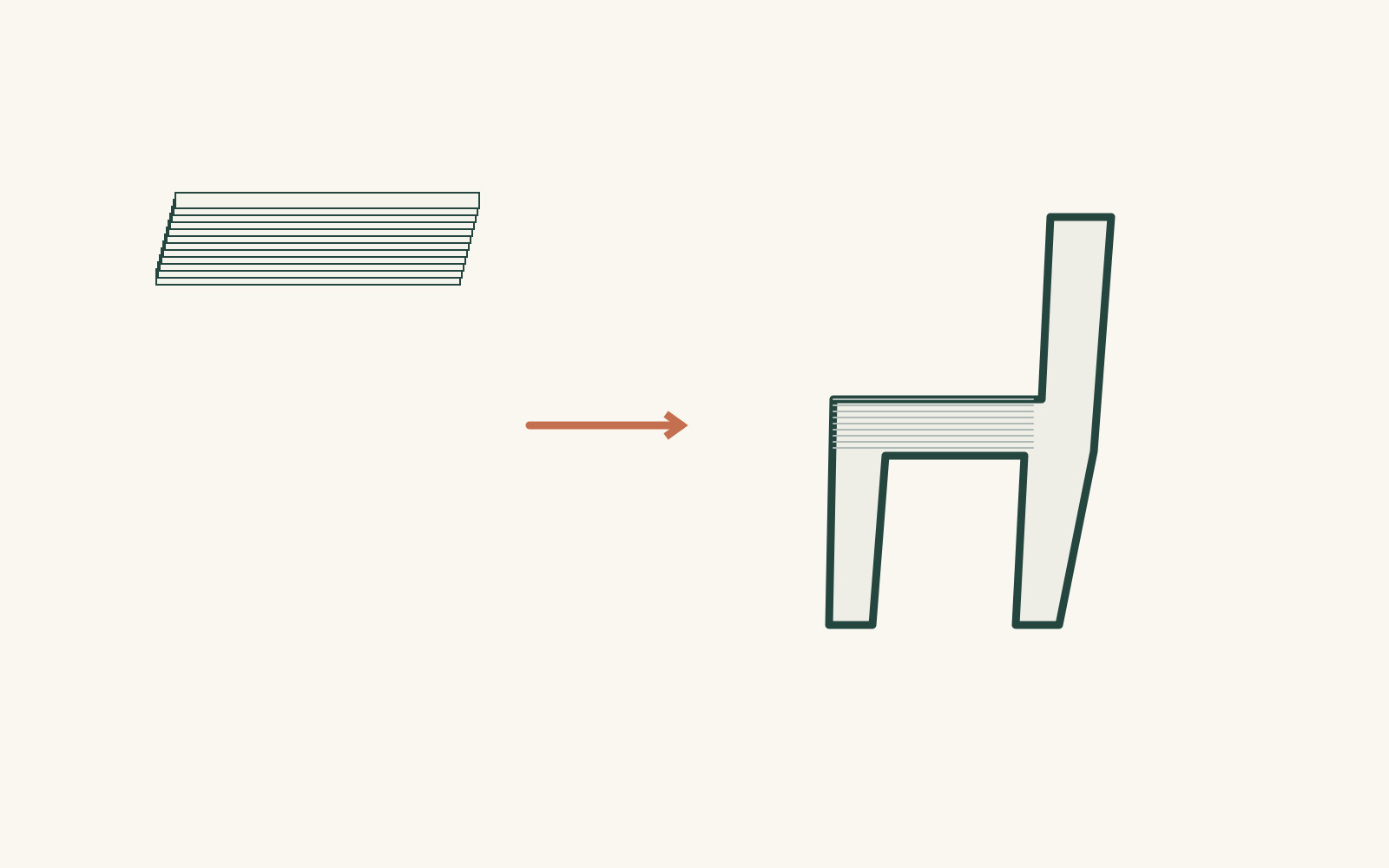
A stack of pale sheets is linked to an angular chair form with fine lines along a thick edge.
Repeated sheets make thickness available as a visible design feature. The comparison explains layers and planes. Original PatinaHall schematic, not to scale.

An idea returns in another material

The studio’s later Aluminium Chair account explains the design lineage. It describes borrowing lamination from wood production, links Paper Chair’s form with folded sheet metal and traces subsequent veneer work before a return to aluminium in 2019.3

That is an exchange of ideas between materials, with each material retaining its own process. A form can suggest one industry while being made through another material’s possibilities.

Paper Chair makes that exchange easy to remember because the ordinary sheet remains mentally present. The object asks the viewer to follow it from surface to layer, from layer to part, and from joined parts to a chair.

Research notesEvidence, connections and limits

The museum artefact’s 75.5×47×59 centimetres differ from the studio model listing. The 2019 Aluminium Chair retrospective explains a lineage, not metal fabrication of the 2006 paper object or a tested load rating.

Evidence map

Connected subjects and evidence

Reviewed facts

  • Object dated 2006documented

    Boijmans dates creation of V 2506(KN&V) to 2006 and acquisition 2008; these are different events.

    Reviewed 26 October 2026 by PatinaHall editorial.
    • Source 1Specifications 139–159; laminated/pressed paper, maker, 2006 creation/2008 acquisition

Reviewed connections

  • Paper Chair, BoijmansV 2506(KN&V)made byJeroen Wanddocumented

    Boijmans names Jeroen Wand as maker of V 2506(KN&V), 2006, acquired 2008. The museum’s dimensions are not the studio model dimensions.

    Reviewed 26 October 2026 by PatinaHall editorial.
    • Source 1Specifications 139–159; laminated/pressed paper, maker, 2006 creation/2008 acquisition
  • Paper Chair, BoijmansV 2506(KN&V)uses materialLaminated paper in Paper ChairV 2506documented

    The museum specifies laminated/pressed paper; the studio specifies lamination/finger joints. A later studio account links the form to folded sheet metal, but paper fabrication is not the 2019 aluminium process. The suspect printed paper unit is omitted.

    Reviewed 26 October 2026 by PatinaHall editorial.
    • Source 1Specifications 139–159; laminated/pressed paper, maker, 2006 creation/2008 acquisition
    • Source 2Paper Chair 21–26: technique/year
    • Source 3Narrative 20–23; Year 2019

Research trail

Sources and further reading

  1. Paper Chair, V 2506(KN&V)Museum Boijmans Van BeuningenAccessed 26 October 2026
  2. Paper ChairStudio Jeroen WandAccessed 26 October 2026
  3. Aluminium ChairStudio Jeroen WandAccessed 26 October 2026

Last reviewed 26 October 2026. Found an error or a stronger primary source? Contact PatinaHall.