The sofa before the modern chair
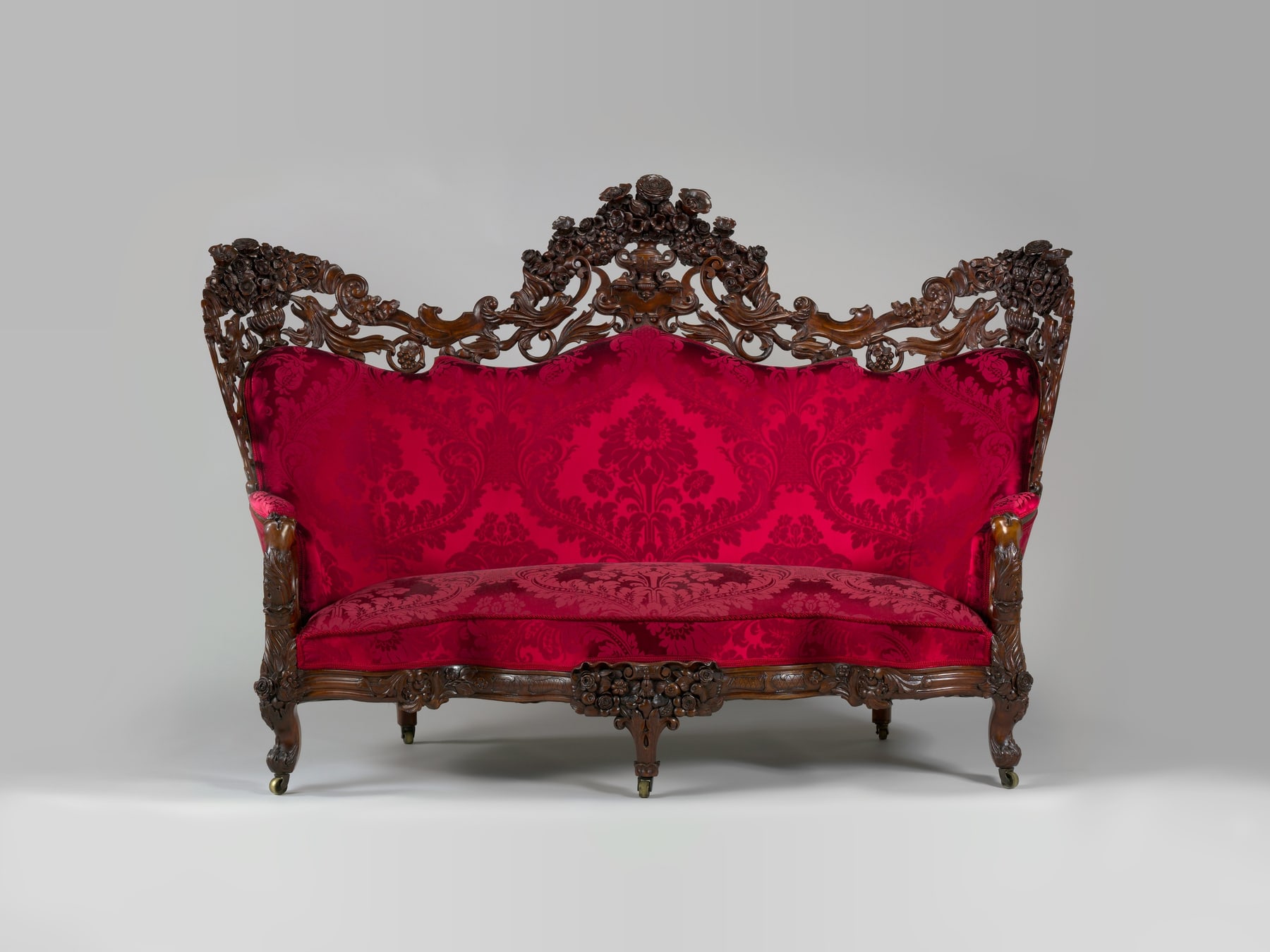
The Met’s sofa 1999.396, dated 1850–60, has a high, pierced back, elaborate carving and curling outlines. It is credited to John Henry Belter or J. H. Belter & Co. The museum connects such forms with his patented methods of bending and compressing layers of wood.3
Plywood does not have to look plain, economical or modern. Here, laminated construction helped support a Rococo Revival display of abundance. The technique served a taste very different from that of the later spare wooden shell.
Look at the spaces cut through the back. The decoration depends on material remaining around those openings while the whole rises and curves. Construction and ornament are working together, even when the carving attracts nearly all the attention.
The grain turns between the layers
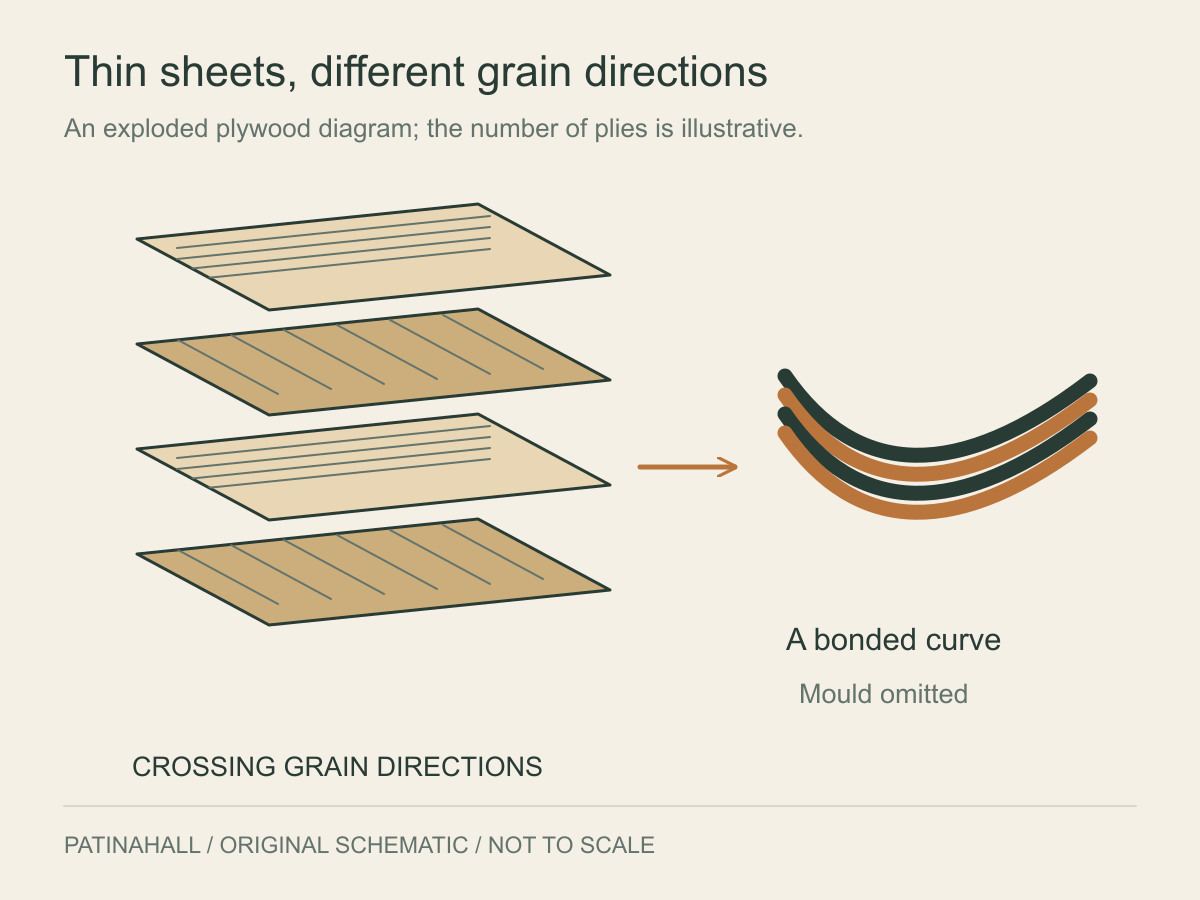
In plywood, veneers are bonded with grain directions arranged across one another. The V&A explains how the changing direction contributes to strength and dimensional stability. Thin sheets can also be formed over a mould before being fixed into a thicker, shaped component.1
The important change is in the order of operations. Instead of beginning with a thick piece and removing material to reveal a curve, the maker brings flexible layers into a curved arrangement and bonds them there. The mould supplies a repeatable shape.
That does not make every bend easy. The veneers still have grain, the adhesive must suit the job, and the layers must fit the surface being asked of them. The finished edge is often a small record of these decisions: a set of narrow lines where a solid board would show one continuous section.
A splint as a manufacturing lesson
During the Second World War, Charles and Ray Eames developed a moulded plywood leg splint. The Eames Office describes openings that relieved stress in the shaped wood while also providing places for bandages. The constraints of material and use were answered by the same cut-outs.2
Production also changed the scale of the work. A partnership involving Evans Products provided facilities beyond the Eameses’ apartment experiments. Their wartime projects included aircraft components, and the office turned back towards furniture in 1945 with a developed process and a larger team.2
This is a more useful connection than treating the splint as a chair in disguise. It was a different object, made for a different need. What travelled into furniture was experience: shaping, tooling, joining and producing a consistent result.
The factory beyond the furniture shop
Aircraft were already part of plywood’s wider history. The V&A traces shaped wooden fuselages and, during the Second World War, the Mosquito aircraft’s use of woodworking skills from furniture manufacture.1
That exchange makes the material’s history less tidy and more interesting. Knowledge moved between industries because a strong, shaped wooden surface could answer several kinds of problem.
The Belter sofa and the Eames splint remain very different things. Look at them through their manufacture, though, and the family resemblance appears: thin layers, a planned curve and wood persuaded into a form it did not have when it grew.