Artefact story

Belter’s sofa: a carved garden built from layers

Belter’s sofa looks like a carved garden, yet its making belongs partly to the history of pressed and laminated wood. Curved structure and intricate ornament could be developed together. A patent issued to Belter in 1858 helps explain the workshop thinking behind that combination, without proving the precise method used for every part of this sofa.

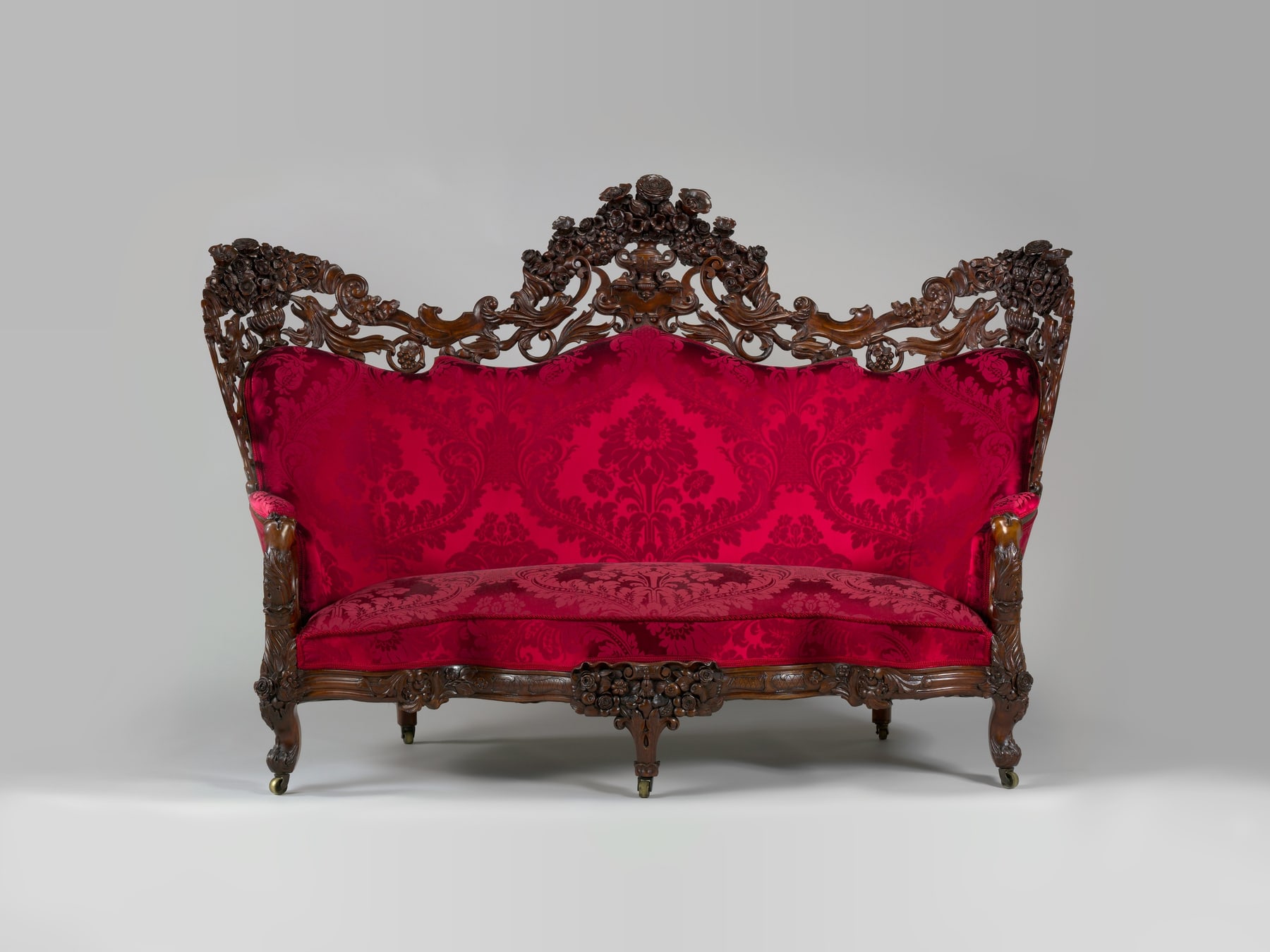
Belter sofa with a pierced rosewood crest and red modern upholstery framed by elaborate carving.
Belter sofa with a pierced rosewood crest and red modern upholstery framed by elaborate carving. Accession 1999.396. The Metropolitan Museum of Art. Public domain (CC0).
On this page
Key facts & takeaways

At a glance

Subject
Sofa 1999.396
Entry
Artefact story
Last reviewed
6 September 2026

Three things to remember

  1. Elaborate carving and laminated manufacture could belong to the same workshop practice.
  2. Belter’s 1858 patent describes a method, not the complete manufacturing record of this sofa.
  3. The gallery photograph shows a museum arrangement, and the sofa’s visible upholstery is modern.

A garden follows the back

Trace the sofa’s upper edge from one arm to the other. Carving rises and falls above the upholstered back, leaving small openings that make the silhouette unusually active. The ornament is easiest to understand at the edge, where light passes around it.

The Met dates this rosewood sofa to 1850–60 and gives its maker as John Henry Belter or J. H. Belter & Co. The material record also includes veneer, chestnut and pine: the object is not a single mass of one luxurious timber.1

Layers could precede the carving

Belter’s 1858 patent describes furniture manufacture using glued compound layers, shaped with heated forms and pressure. Carving could follow the formation of the rough shape. The sequence makes a useful distinction between creating a curved structural blank and cutting the ornament that a viewer finally sees.2

This helps explain why the sofa’s lavish appearance need not imply that every curve was carved from a vast solid block. It also gives the word “industrial” a more interesting role: workshop apparatus could contribute to furniture whose finished surface still required extensive skilled work.

Openings make the carving readable

The most intricate parts sit where the upholstered back ends. Against open space, the pierced ornament gains a clear outline; against the red fabric, the wood reads as a darker frame. The different backgrounds let the same material perform two visual jobs.

In the museum room photograph, neighbouring furniture makes the sofa’s scale more apparent. The view shows how an energetic back can remain legible among other objects. It is a present gallery installation, rather than evidence of the sofa’s original parlour arrangement.
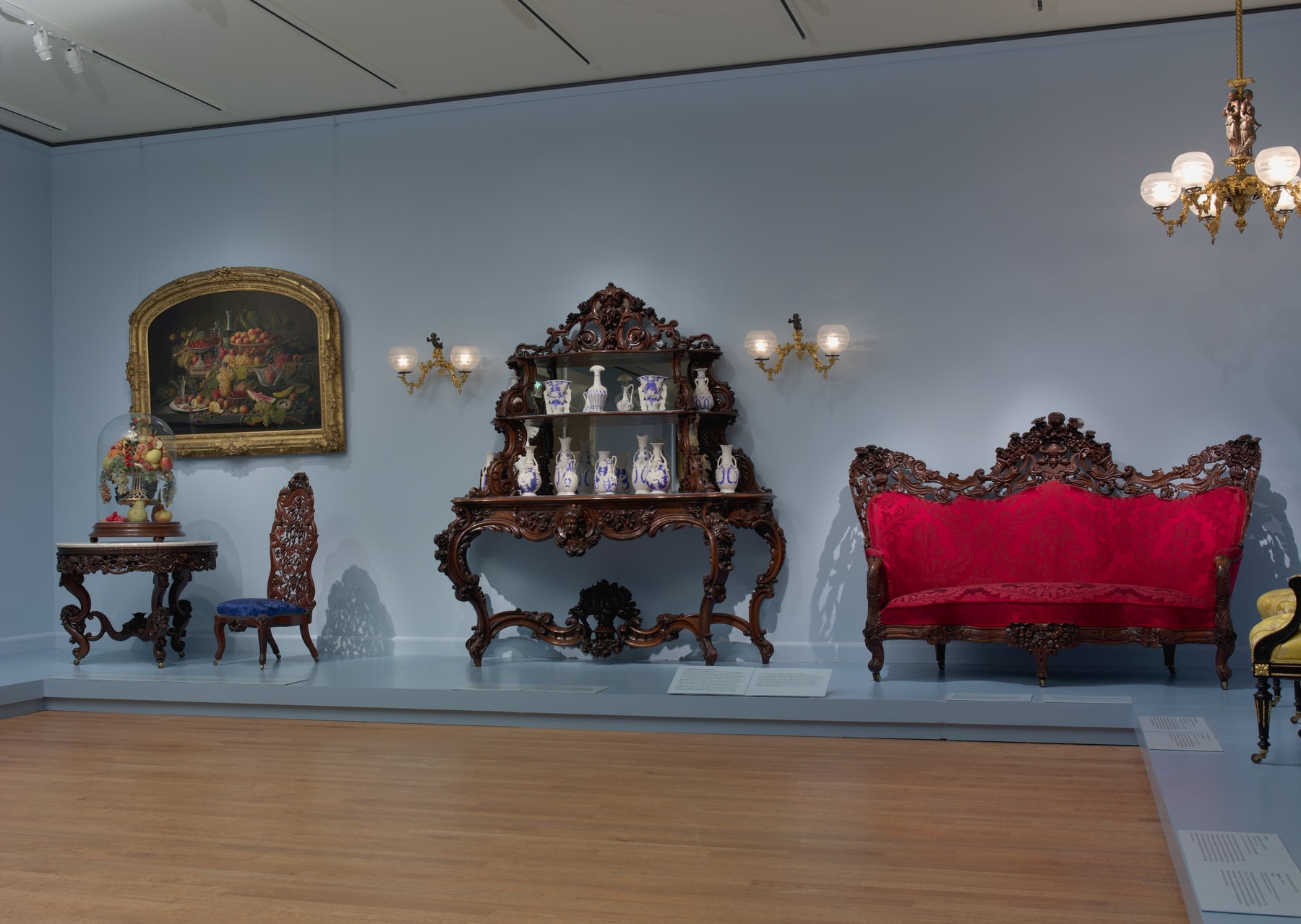
The Belter sofa at right in a Met gallery installation with other furniture; this is a museum arrangement, not its original parlour.
The Belter sofa at right in a Met gallery installation with other furniture; this is a museum arrangement, not its original parlour. Accession 1999.396. The Metropolitan Museum of Art. Public domain (CC0).

Fabric has its own chronology

The Met identifies the upholstery as modern, while recording some original under-upholstery. The visible fabric and the wooden frame therefore do not offer the same kind of survival.1

That does not prevent a reading of the form. The broad seat, enclosing arms and rising carved back are still clear. It means that a claim about original colour or textile must come from separate evidence.

What makes this sofa memorable is the combination of processes suggested by the record and visible in the result. A shaped support becomes a field for carving; the carving becomes a frame for fabric; the fabric makes the open wooden edge easier to see. Its richness comes from those relationships as much as from the quantity of ornament.

Research notesEvidence, connections and limits

The attribution includes Belter or his company, and the broad date range overlaps the patent’s date. Neither the patent nor the exterior photographs establish how each individual component of this sofa was formed.

Evidence map

Connected subjects and evidence

Reviewed connections

  • Sofa 1999.396uses materialRosewood veneer, chestnut, pine and upholsterydocumented

    The primary record lists these materials for this subject. The full material list and object dating remain in the cited accession record; listed replacement or uncertain materials retain their qualifiers.

    Reviewed 6 September 2026 by PatinaHall editorial.
  • Sofa 1999.396associated with placeNew York Citydocumented

    The Met records this exact sofa as made in New York. Its maker field names John Henry Belter or J. H. Belter & Co.; that alternative remains in prose rather than being collapsed into a falsely certain sole-maker relationship.

    Reviewed 6 September 2026 by PatinaHall editorial.

Research trail

Sources and further reading

  1. Sofa — 1999.396The Metropolitan Museum of ArtAccessed 6 September 2026
  2. John H. Belter, Improvement in the Method of Manufacturing Furniture, US 19,405United States Patent Office, via Google PatentsAccessed 6 September 2026

Last reviewed 6 September 2026. Found an error or a stronger primary source? Contact PatinaHall.