First the roses, then the chair
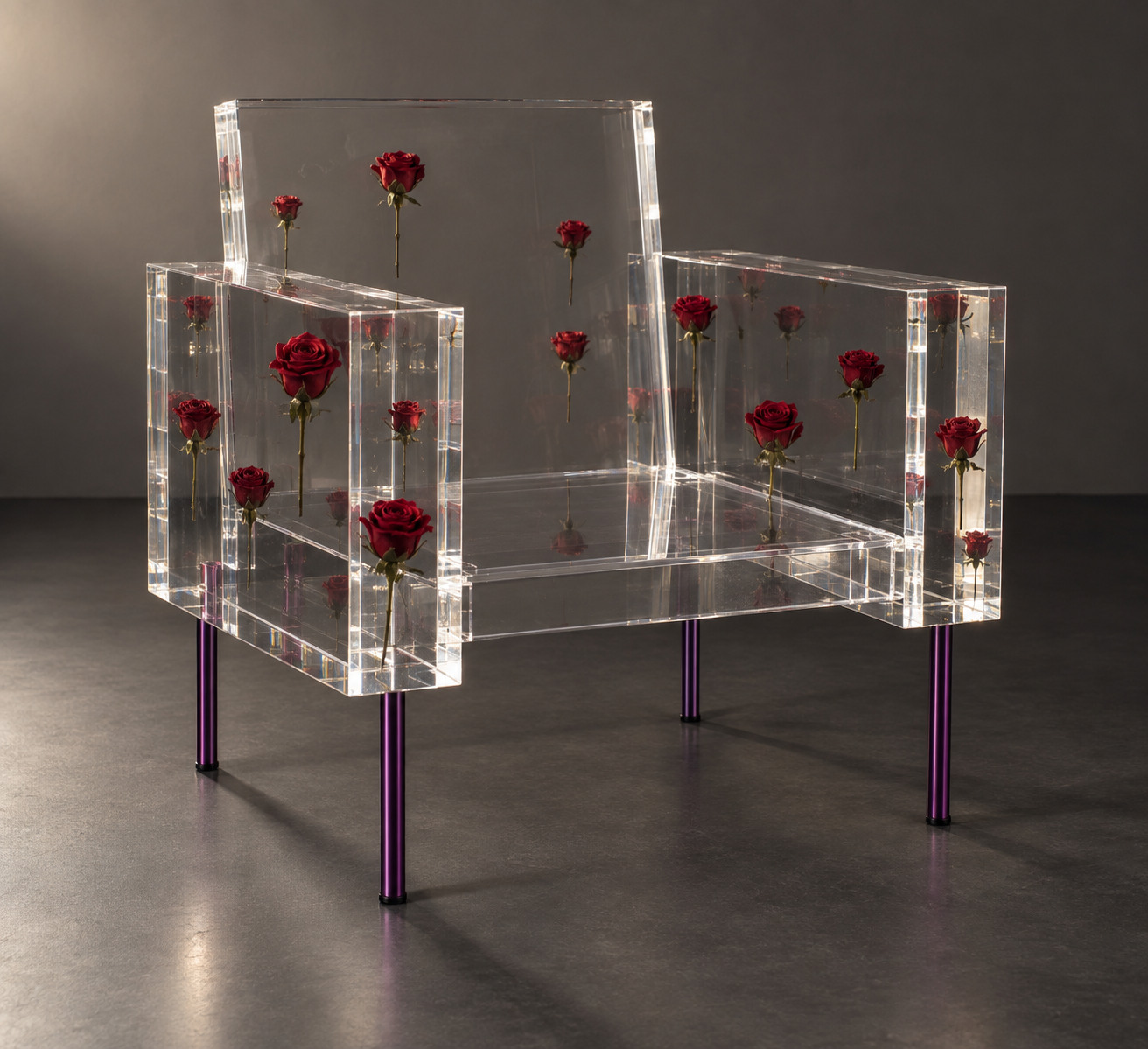
A chair normally announces its frame before its decoration. With Miss Blanche, the red roses can arrive first. They scatter through the back and sides while the clear panels allow the surrounding room to remain visible. The edges are easiest to follow where light catches them.
The purple legs provide a more definite outline. Vitra Design Museum records acrylic, plastic roses and anodised aluminium in its example, identifying the 1988 design and manufacturer Ishimaru. These are three materials with sharply different visual jobs: the flowers attract attention, the panels interrupt it as little as possible, and the metal carries the clear body above the floor.2
Transparency does not make the chair disappear completely. It makes the act of seeing it unstable. Move a little, and a reflection that described one surface gives way to a view through it.
A flower needs something to float in
The roses are held by the substance that seems to release them. MoMA’s account describes each flower being positioned with tweezers while the acrylic resin hardened. The apparent ease of the finished object conceals a patient manufacturing task.1
Position matters because this is a three-dimensional arrangement. A rose close to the front of a panel meets the eye differently from one deeper inside. Seen from another angle, the flowers overlap differently. The clear material gives the composition depth that a floral pattern printed on a surface would not have.
That also changes the meaning of the chair’s thickness. An opaque panel shows a face and an edge. A transparent one can expose its interior. Kuramata uses that interior as a place for something to happen.
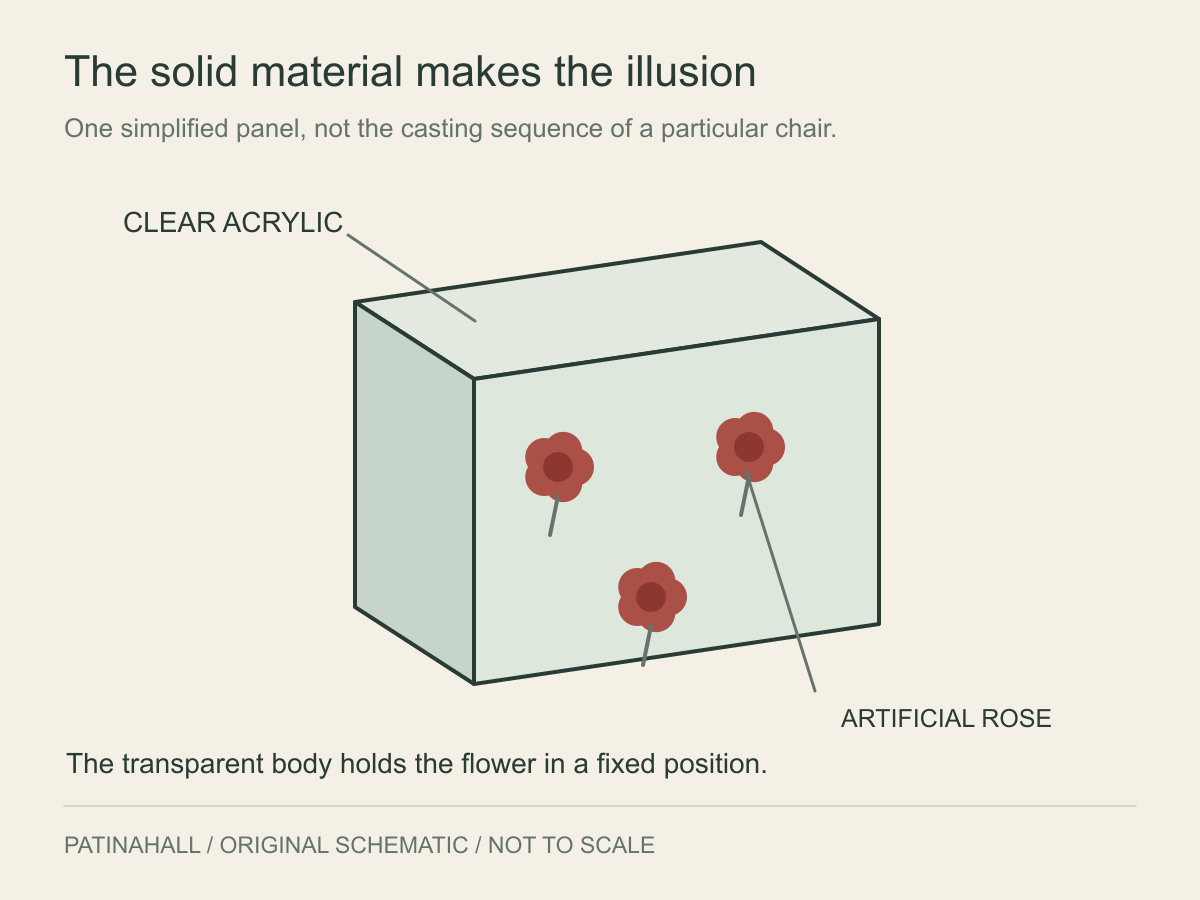
The diagram separates these roles so they can be understood at a glance. The acrylic is both a structural body and a transparent setting; the rose remains an object enclosed within it.
Blanche and the artificial flower
The name comes from Blanche DuBois in Tennessee Williams’s 1947 play A Streetcar Named Desire. MoMA connects that character with Kuramata’s use of artificial flowers. Its account also describes an unsuccessful experiment with natural roses, which were damaged during casting.1
The resulting flowers do two things at once. They resemble fragile living things, yet they belong to a manufactured world of plastic and metal. There is no need to know the play to notice the visual contradiction. Knowing the name adds another reason to distrust the first impression.
Miss Blanche is therefore an unusually literal piece of furniture about appearances. The flowers look suspended, but are fixed. The chair looks insubstantial, but has a solid body. The eye is offered an illusion and enough clues to work it out.
A room seen through roses
An upholstered chair places its own colour between the viewer and the room. Miss Blanche allows parts of the room into the composition. A dark wall makes different edges visible from a pale one; movement changes what can be seen between the flowers.
The object remains still while its appearance keeps adjusting. That is why the illusion lasts beyond the first encounter. The roses have nowhere to go, but the space around them never quite settles.