Artefact story

Mesh Chair: cut and joined like clothing

Clothing begins as flat pieces that become a volume when joined. Chris Kabel uses that comparison to explain Mesh Chair. Its metal surface does two visible jobs: it outlines a place to sit and participates in the construction that gives the chair its form.

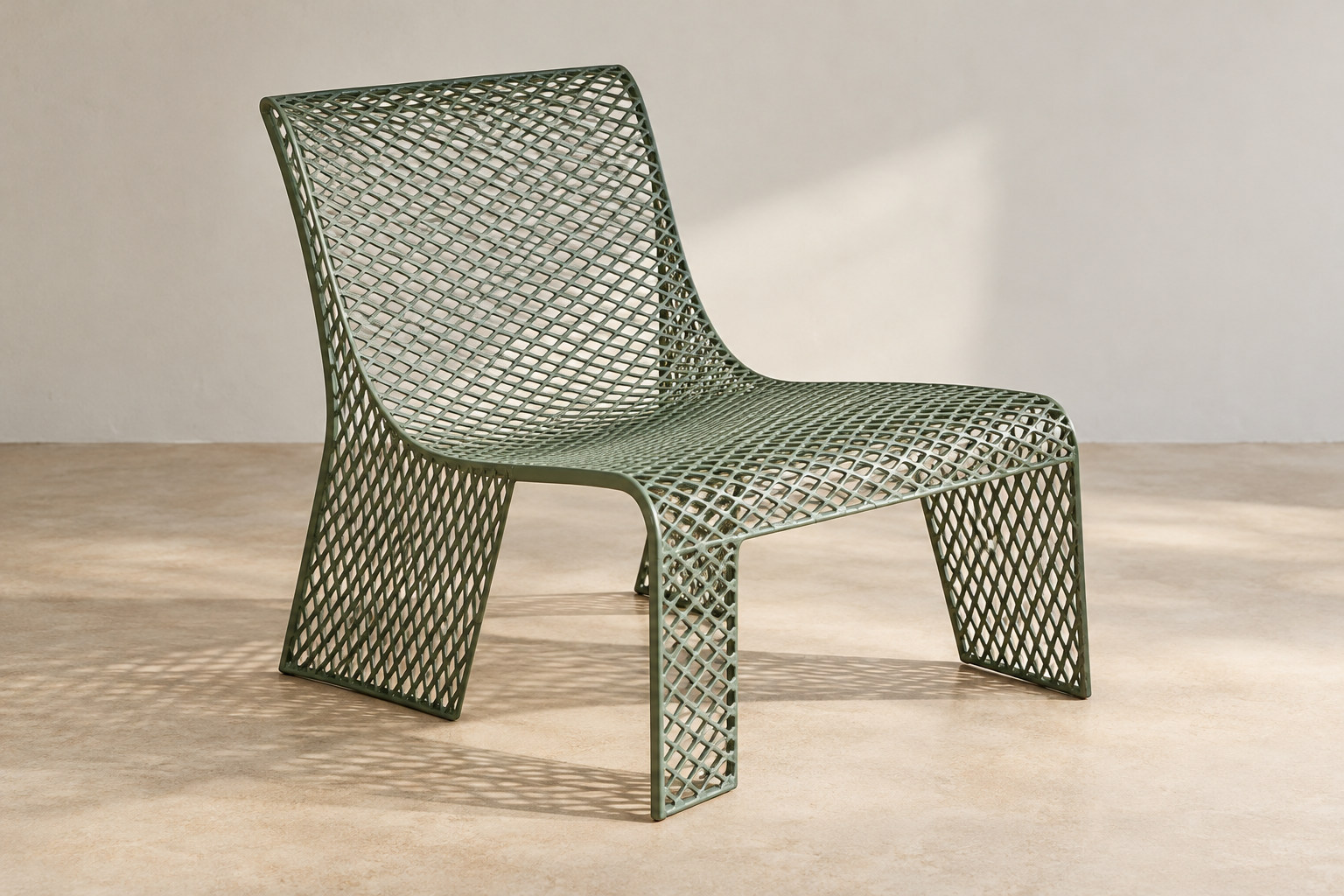
Open diamond-patterned metal-like planes form a chair’s seat, back and supports.
PatinaHall editorial reconstruction. It is not a documentary photograph. This interpretation of Mesh Chair follows the open patterned surface into three dimensions. The view illustrates the expanded-mesh idea, without reproducing MoMA’s exact panel geometry, seams or dimensions.
On this page
Key facts & takeaways

At a glance

Subject
Mesh Chair, MoMA 128.2010
Entry
Artefact story
Last reviewed
26 October 2026
Object dated
2005documented

Three things to remember

  1. The pattern belongs to expanded metal, rather than a separate fabric cover.
  2. Kabel compares the cut pieces and seams with clothing.
  3. MoMA’s 2005 object date and 2010 accession number are different facts.

A surface with two jobs

Mesh Chair makes the usual distinction between a supporting frame and an added cover less easy to draw. The expanded-metal surface describes the seat and back while also belonging to the construction of the chair.

MoMA records its example as powder-coated expanded metal mesh, dated 2005. It credits Chris Kabel and names Werkplaats Martin van Oel as manufacturer.1

The holes are part of the visual argument. They let the eye read through a surface that still has a definite outline, so the chair can appear open and continuous at the same time. The repeated pattern keeps the material legible as it changes direction.

A seam can be a structural line

In the explanation quoted by MoMA, Kabel compares the chair’s manufacture with clothing. Pattern pieces are cut from expanded metal and joined along seams; their three-dimensional arrangement gives the resulting shape its rigidity.1

The studio describes forming the pieces over a mould and welding their edges together. That account helps explain why a seam deserves attention: it is the line where shaped surfaces become one object.2

The comparison with clothing is especially useful because it moves attention from a flat pattern to a volume. A piece that begins as a surface can turn, curve and meet its neighbour. The form depends on those relationships as well as on the material’s appearance.

A seam therefore becomes something the eye can follow through the chair. It gives a route between the repeated small openings and the much larger shape that contains them.
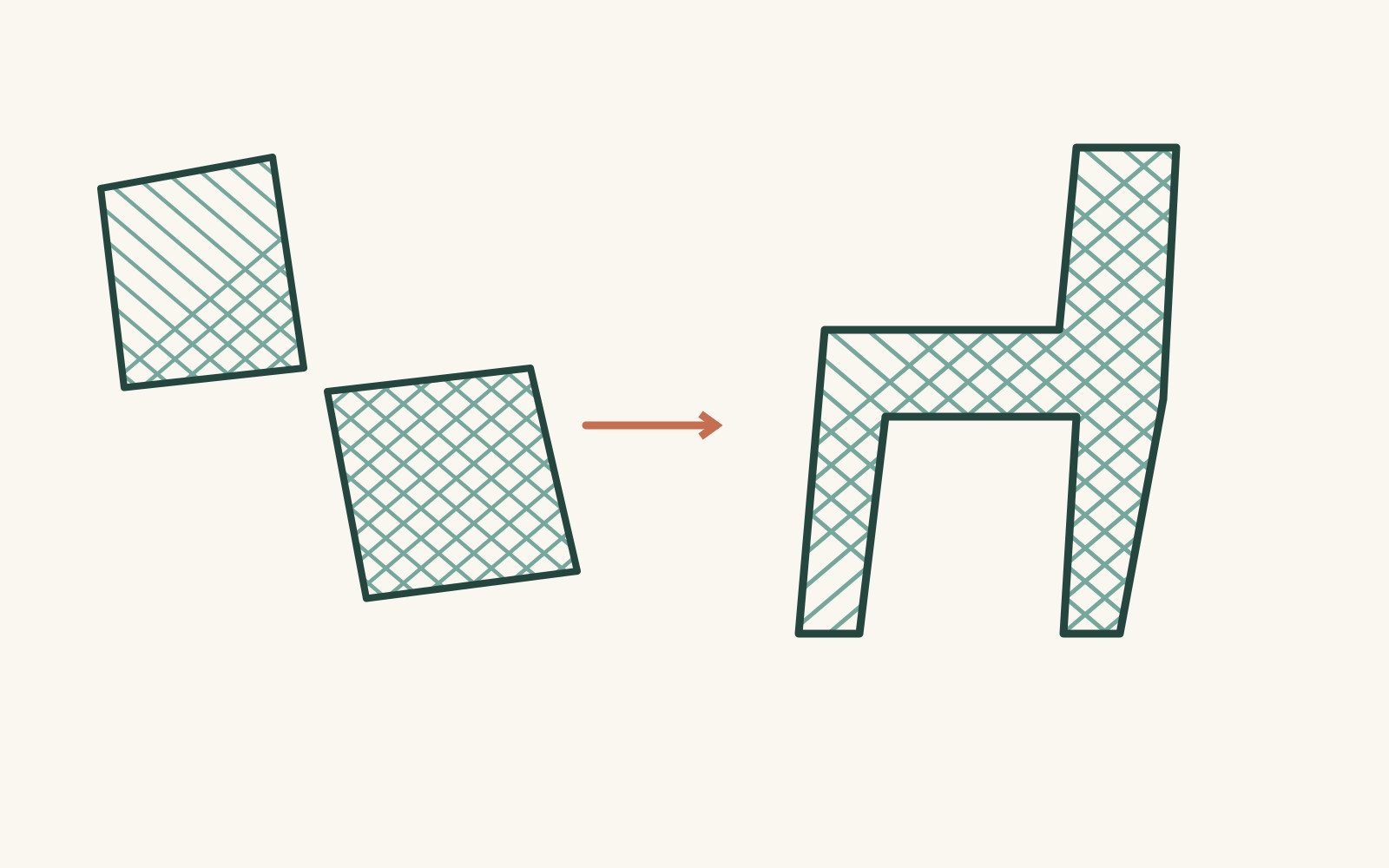
Separate patterned planes sit beside a related chair-like volume, linked by an arrow.
Shaped panels and their meetings can turn a surface into a volume. The arrow explains a design relationship; these outlines are not a cutting template or a welded-joint specification. Original PatinaHall schematic, not to scale.

Looking through the pattern

At a distance, the chair has a silhouette. Closer attention reveals the expanded-metal pattern and the lines where its shaped pieces meet. Moving between those scales is part of the pleasure of looking.

The powder coating also belongs to the museum’s recorded material description. It gives the metallic mesh a finished surface while allowing its open pattern to remain visible.1

Kabel’s clothing analogy stays useful after the technical account ends. The chair asks a familiar question in an unfamiliar material: how can a set of surfaces be joined so that a volume appears?

Research notesEvidence, connections and limits

The subject is MoMA 128.2010. Its dimensions differ from the studio model listing. The construction account is not a measured comfort or load test.

Evidence map

Connected subjects and evidence

Reviewed facts

  • Object dated 2005documented

    MoMA dates its Mesh Chair 128.2010 to 2005. The 2010 accession component is not the object’s date.

    Reviewed 26 October 2026 by PatinaHall editorial.
    • Source 1Title/date; gallery label 79–83; manufacturer 87; object number 94

Reviewed connections

  • Mesh Chair, MoMA 128.2010attributed toChris Kabelattributed

    MoMA credits Chris Kabel; its gallery label attributes the cut-pattern/welded-seam explanation to him. The powder-coated expanded mesh is structural material, not a separate textile cover.

    Reviewed 26 October 2026 by PatinaHall editorial.
    • Source 1Title/date; gallery label 79–83; manufacturer 87; object number 94
    • Source 2Mesh Chair description 12–17
  • Mesh Chair, MoMA 128.2010made byWerkplaats Martin van Oeldocumented

    Both records name Werkplaats Martin van Oel. MoMA’s 76×49×67 cm object and the studio’s 60/45/65 cm model dimensions stay separate.

    Reviewed 26 October 2026 by PatinaHall editorial.
    • Source 1Title/date; gallery label 79–83; manufacturer 87; object number 94
    • Source 2Mesh Chair description 12–17

Research trail

Sources and further reading

  1. Mesh Chair 2005, 128.2010The Museum of Modern ArtAccessed 26 October 2026
  2. Mesh ChairStudio Chris KabelAccessed 26 October 2026

Last reviewed 26 October 2026. Found an error or a stronger primary source? Contact PatinaHall.