The tree has already drawn the lines
From across a room, marquetry can look like painting. Up close, the image breaks into decisions: a cut edge, a change of grain, a pale leaf fitted beside a dark stem. The tree supplied the first drawing. The cabinetmaker cut it apart and made a second one.
The V&A defines marquetry as differently coloured veneers laid onto the surface of furniture and connects its development to French and Dutch cabinetmaking.2 That definition keeps the technique physical. The image is not printed or painted on top. It is assembled from thin pieces whose colour, figure and reflection remain materially different.
Marquetry is therefore not one ornamental style. It is a way of organising surface material into a picture, border or pattern. The useful question is not only what the image depicts, but how cut pieces make the image change with light and viewpoint.
Thin enough to rearrange
Three ideas are often bundled together and are easier to understand when separated.
- Structure is the case, panel or support carrying the furniture's load.
- Veneer is a thin visible layer fixed over that structure.
- Marquetry is a composition made by fitting selected pieces into a pattern, border, motif or image.
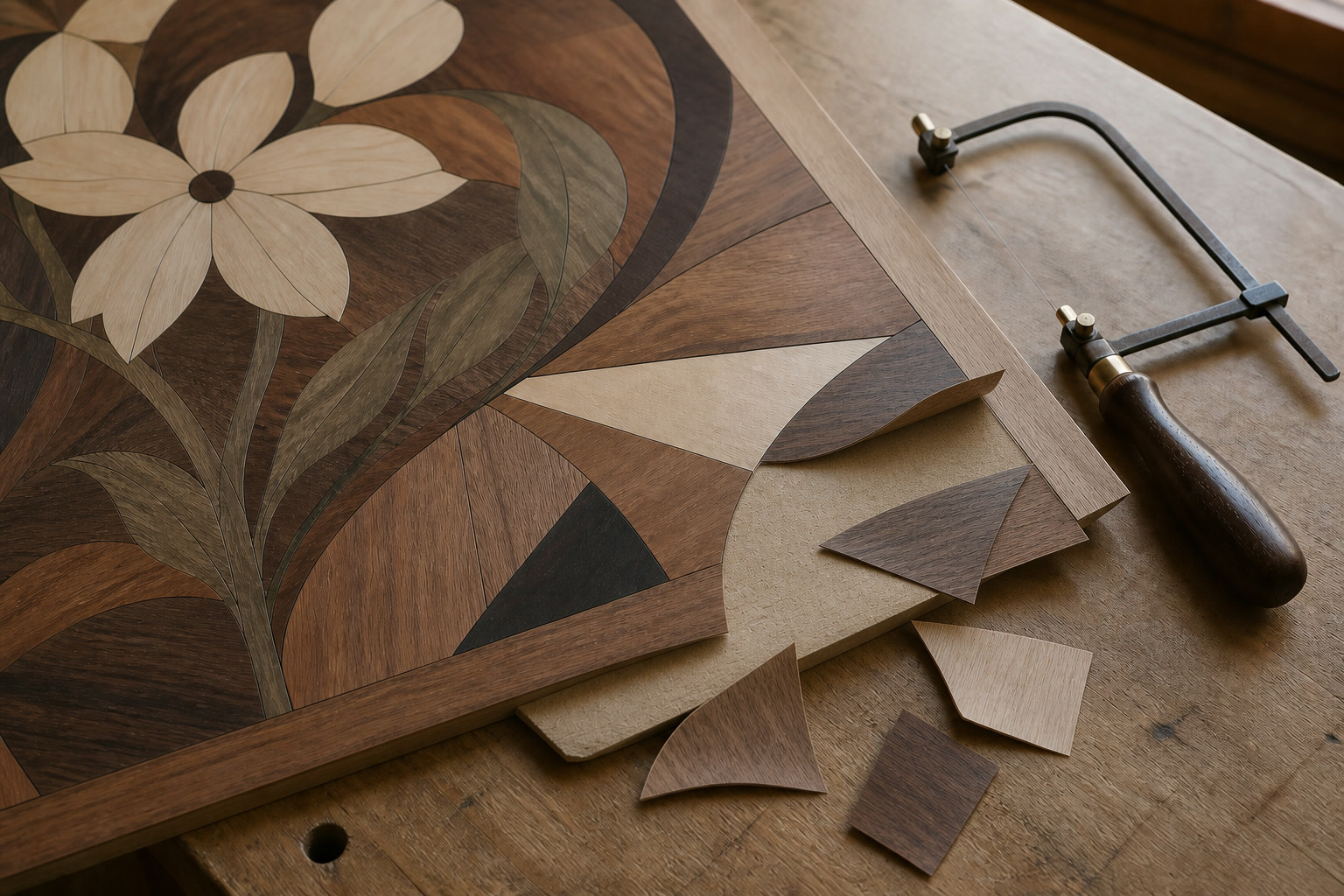
Veneer is a material, not a character flaw. Thinness lets a maker use figured wood where it will be seen, turn it to catch light differently and mirror neighbouring pieces. A veneered cabinet may have no marquetry at all; a marquetry field may combine several woods and, in some historical objects, other thin materials.
The V&A's account of furniture making describes the surface as a distinct layer over a supporting structure.1 The workbench reconstruction beside this section explains that layered idea. It is interpretive, not a historical recipe: workshops used different saws, adhesives, substrates and assembly sequences.
Grain does part of the drawing
Wood will not behave like flat colour. Every sheet has pores, rays, knots and directional figure. Rotate one piece and its response to light changes. Put two neighbouring pieces in opposite directions and the join may become visible even when their colour is almost identical.
Marquetry works with three systems at once.
- Outline gives each fitted piece its shape.
- Colour and value separate one material or treated area from another.
- Grain and figure supply lines and movement that already existed in the tree.
A leaf can be cut so the grain suggests veins. Two pieces from one figured sheet can open into symmetry. A narrow band can make a drawer edge look sharper. The maker draws with a saw, but the material contributes marks of its own.
One cut, two reversed pictures
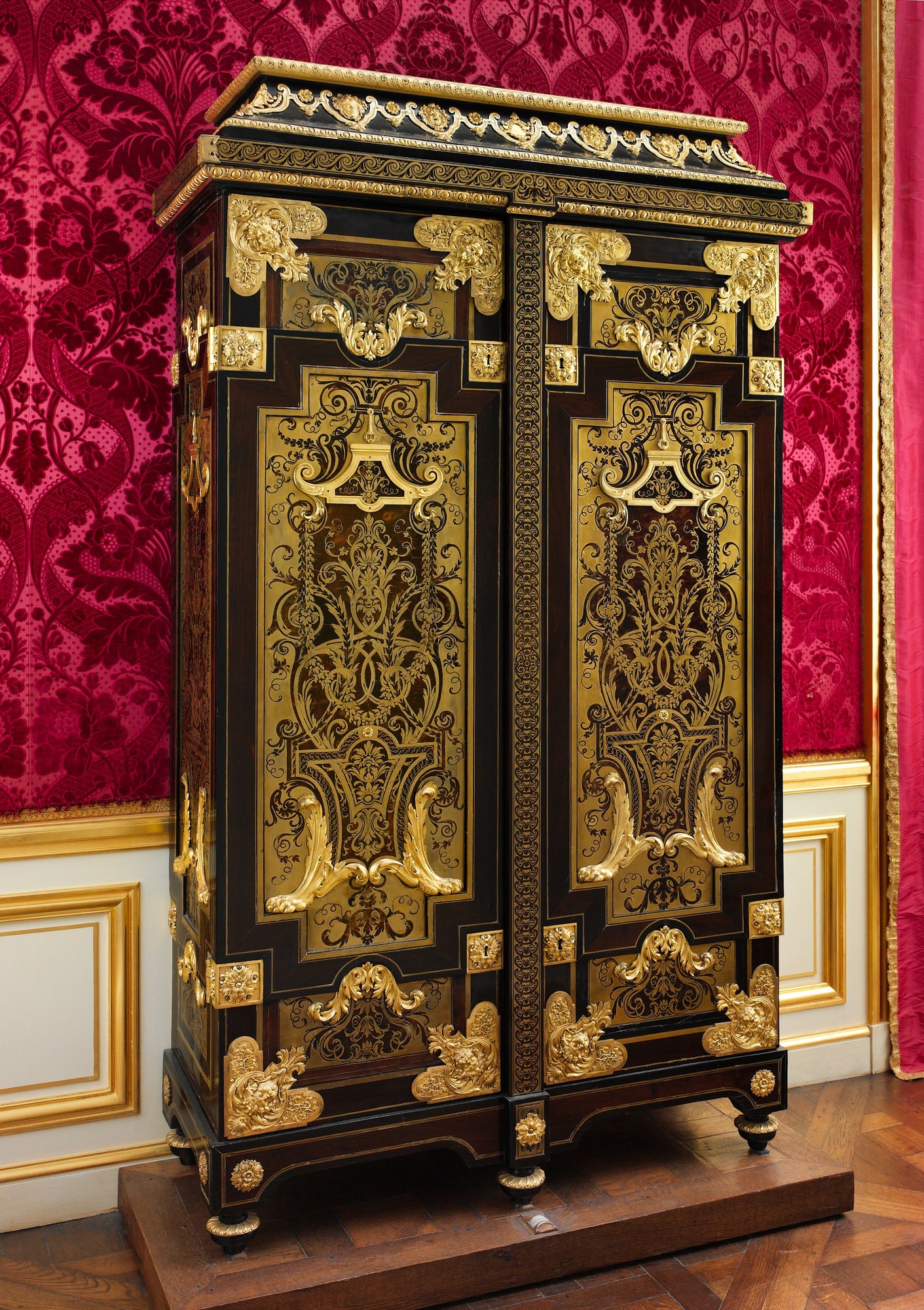
The cabinet in The Metropolitan Museum of Art, object 59.108, provides one documented example. Made around 1700 and attributed, with that qualification intact, to André-Charles Boulle, it combines wood veneers with brass-and-tortoiseshell marquetry and gilt bronze.3
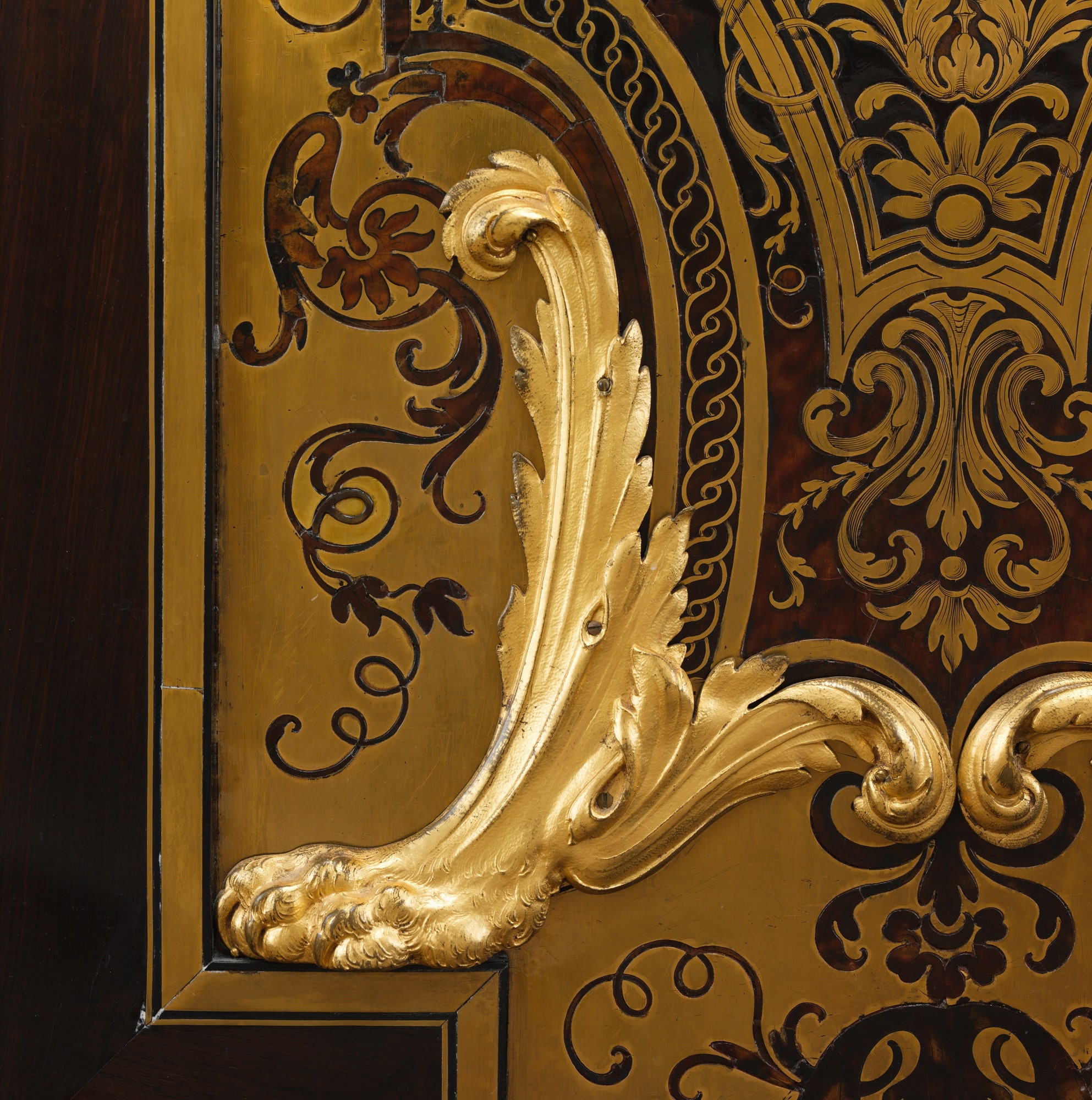
Contrasting sheets could be temporarily joined and cut to one pattern. Once separated, the same cuts supplied two complementary arrangements: brass set into a dark ground and the reverse, a dark design set into brass. The traditional names are première partie and contre-partie. One careful sawn line defines both pictures.
The detail photograph lets the eye follow those fitted edges. It also shows the difference between the flat pattern of marquetry and the projecting bronze mounted over it. The Library's separate artefact record follows this particular cabinet's attribution, suggested companion, workshop economy, dismantling and conservation history; here the object serves one narrower purpose: making the paired-cutting logic visible.
The technique outlives the motif
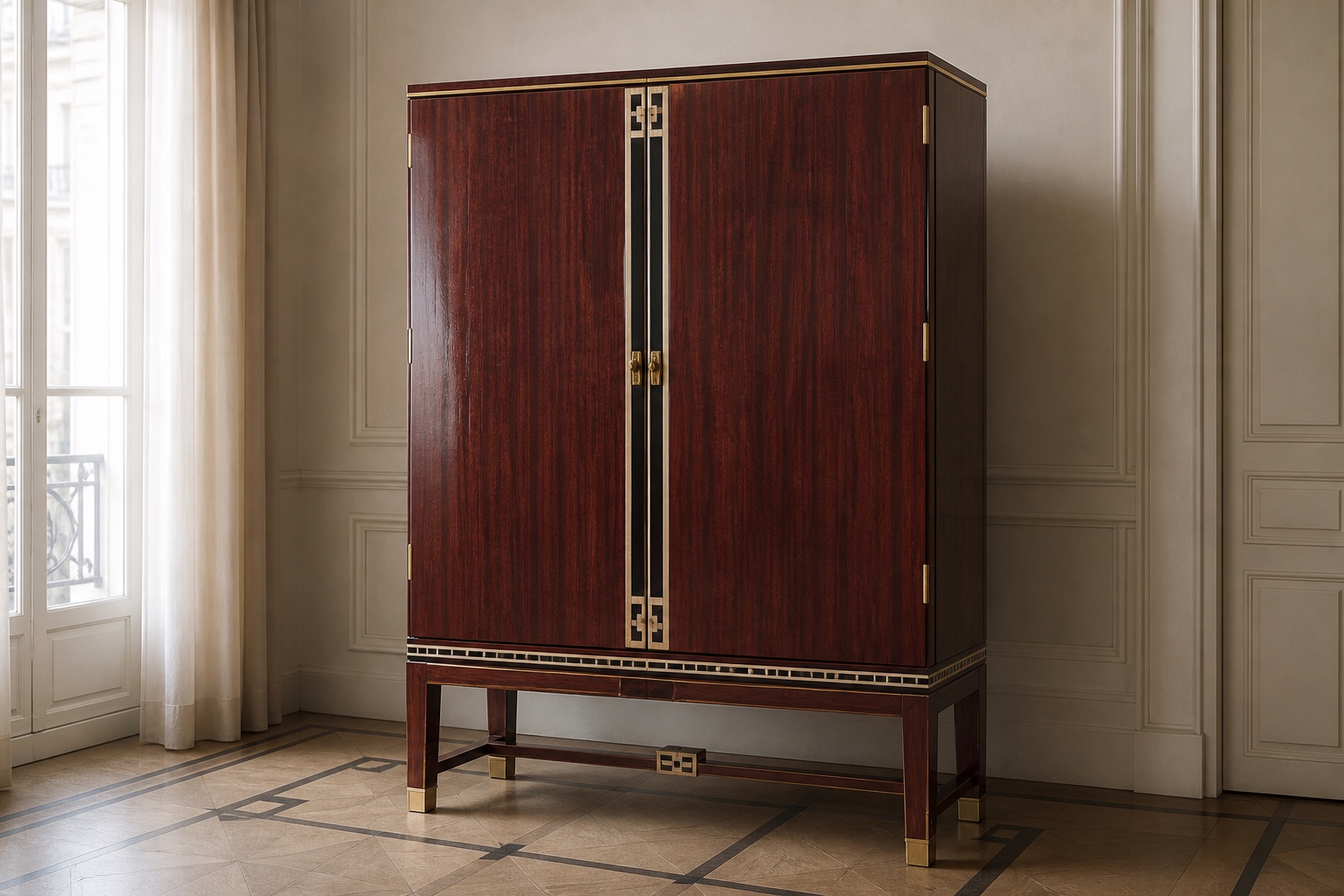
Marquetry did not remain tied to Boulle work or the Baroque. More than two centuries later, Jacques-Émile Ruhlmann used it within a very different visual system. The Musée des Arts Décoratifs records the État rectangle cabinet with amaranth veneer and ivory-and-ebony marquetry.4 The Met separates its 1922 design date from the manufacture of its own example in 1925–26.5
The comparison is useful because the technique survives while its visual job changes. On cabinet 59.108, fitted materials join an architectural body and abundant bronze. On the État cabinet, marquetry works inside the controlled geometry of French Art Deco. Neither object is a universal recipe for how marquetry must be made or look.
A photograph can still teach the eye where to begin. Follow seams, changes in grain direction and borders that cross doors or drawers. Step back to see whether the surface reinforces the proportions of the furniture, then move closer to see where the picture becomes a set of fitted pieces. Marquetry is most interesting at that change of scale: an image from across the room, and a material argument from a few centimetres away.