Why it matters
The État cabinet is useful for more than recognising one piece of French Art Deco furniture. It shows why a design, its first public presentation and a particular surviving object need separate dates.
The Metropolitan Museum of Art identifies Jacques-Émile Ruhlmann as the designer and gives 1922 as the design year. The Musée des Arts Décoratifs records that the first État rectangle cabinet was shown at the 1922 Salon d’Automne.2 1
Those statements build a documented starting point. They do not mean that every cabinet called État was made in 1922, and they do not identify an uncatalogued cabinet by appearance alone. That distinction is the central lesson of this page.
The story
Ruhlmann worked across furniture and interiors, so the État cabinet should not be read as an isolated decorated box. Its controlled outline, veneered surfaces, marquetry and metal fittings belong to a complete decorative language in which the form of a room and the finish of an object were closely considered.
The Musée des Arts Décoratifs catalogues its example as made in Paris around 1922–23. Its record identifies amaranth veneer, ivory and ebony marquetry, and gilt bronze among the materials.1 These details help explain the cabinet’s visual hierarchy. Large surfaces establish the main volume, contrasting inlay directs attention across them, and fittings mark the places where the cabinet is handled or opened.
The first presentation at the Salon d’Automne also matters. An exhibition record tells us when a design entered a documented public setting. It is not the same as a complete workshop ledger, but it is stronger than a date copied from an unattributed sales description.
Dates and object identity
The Met describes its État cabinet as designed in 1922 but manufactured in 1925–26.2 The two dates answer different questions.
- Design date asks when the model or design was developed.
- First presentation asks when a documented version was publicly shown.
- Object date asks when the particular physical cabinet under discussion was made.
The Musée des Arts Décoratifs assigns its own example a date of about 1922–23, while the Met assigns a later manufacture date to its object. 1 2 The records are not in conflict. They describe different museum objects within the history of one design.
This is why a single field labelled “year” is not enough for a furniture model. It can quietly turn the year of conception into the date of every surviving example. PatinaHall keeps those claims separate so a reader can see what each date actually describes.
Look closely
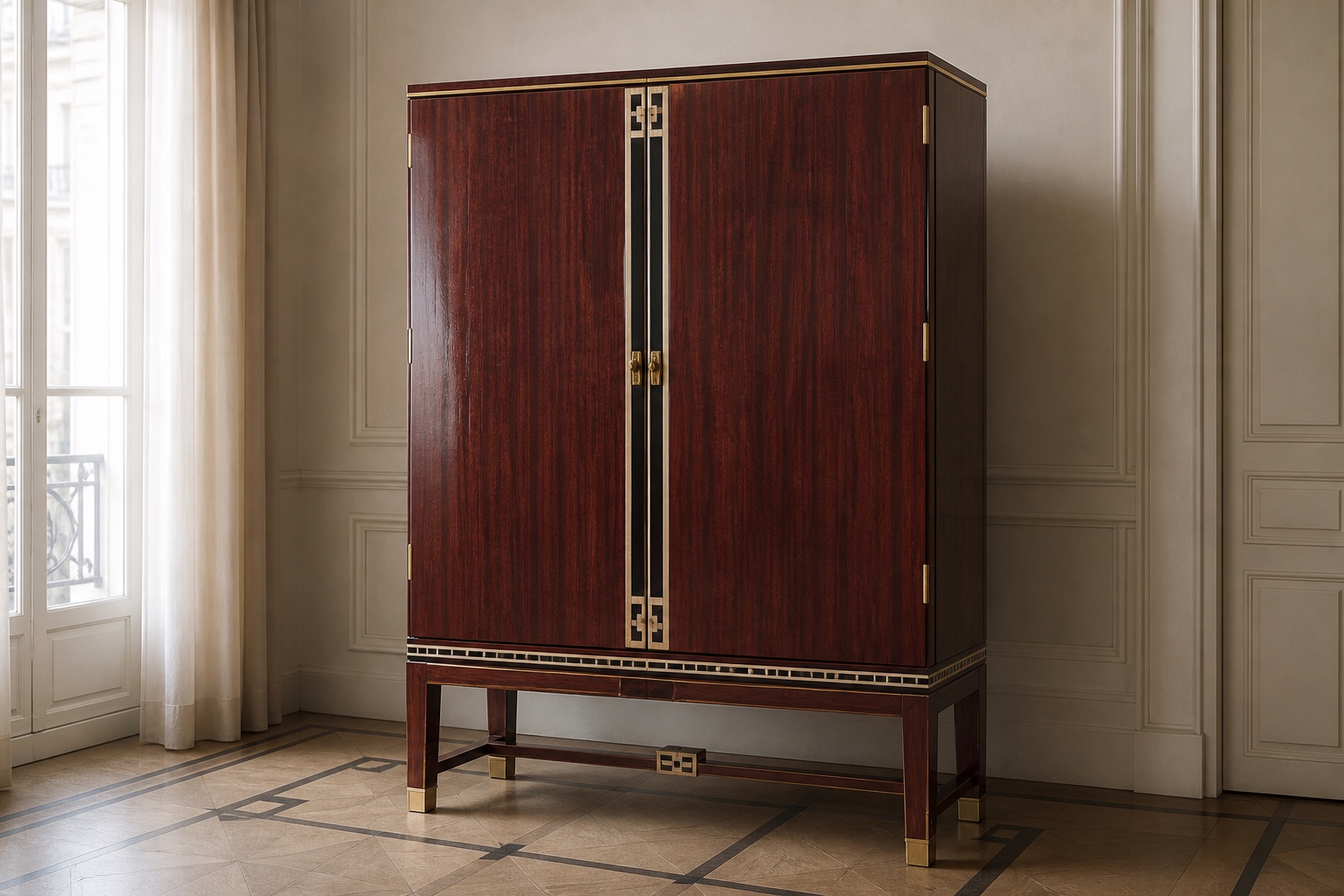
Begin with the whole form. The PatinaHall image above is an editorial reconstruction, not a documentary photograph, so use it to understand the questions rather than to identify an object. Compare the relationship between the main case and its support, the balance of broad surfaces, and the places where fittings interrupt or reinforce the larger geometry.
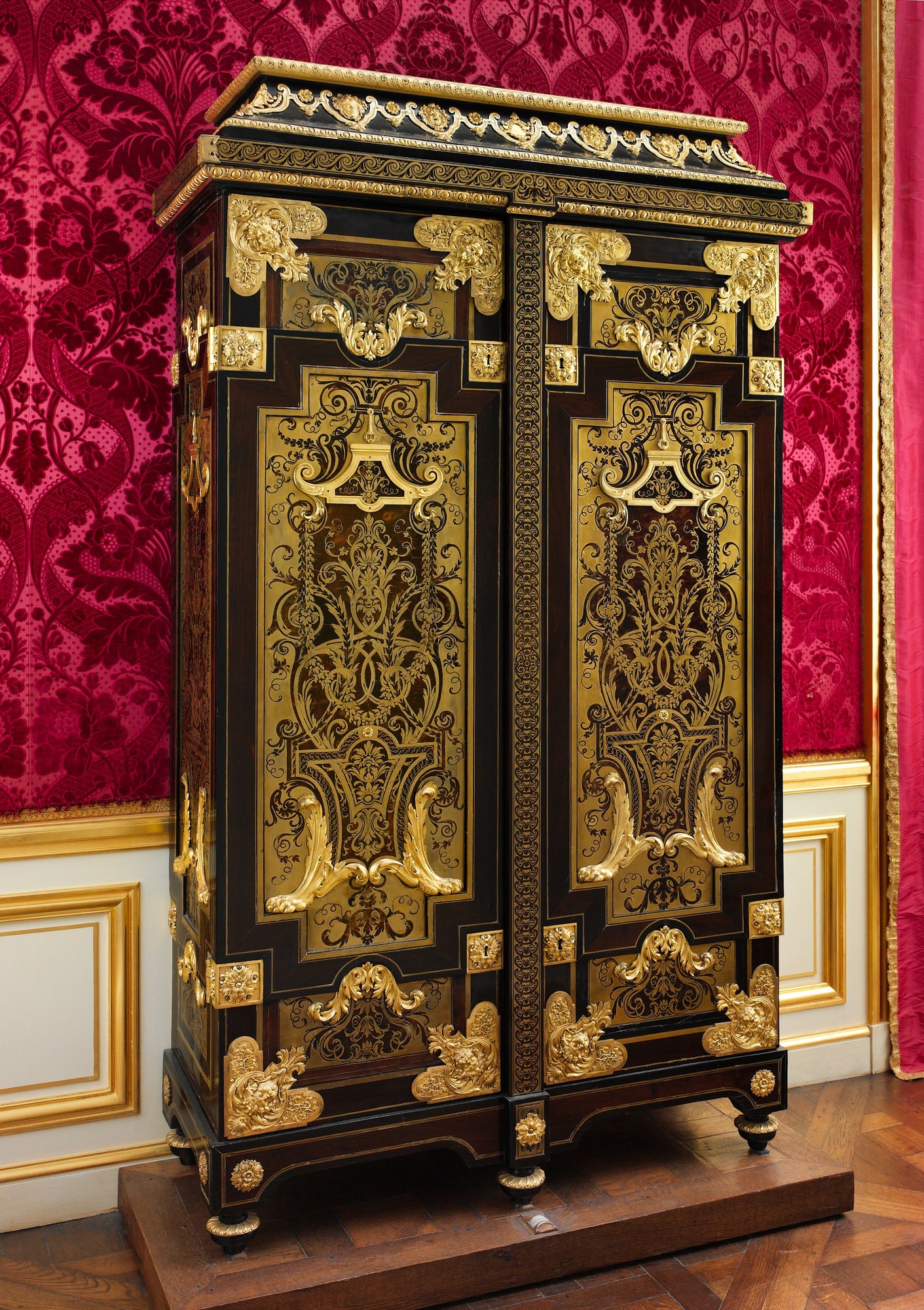
Next, compare broad veneered fields with smaller passages of marquetry. Marquetry is decoration assembled from fitted pieces of contrasting material. The museum record’s material list establishes that the documented MAD cabinet uses ivory and ebony marquetry; a photograph can then help a reader locate where that contrast appears on that object.1
The reconstruction does not reproduce either museum cabinet and cannot show which details are exact. Follow the linked museum records when you need to inspect a documented object, its inventory number or its assigned object date. A later documentary image may replace the reconstruction only after its reuse rights and exact object identity have been reviewed.
Materials and construction
The MAD record names amaranth veneer, ivory and ebony marquetry, and gilt bronze.1 Each term describes a different part of how the documented cabinet is made and read.
Veneer supplies the principal visible timber surface without claiming that the entire case is a solid block of the same wood. Marquetry creates a fitted pattern or image from contrasting pieces. Gilt bronze describes metal elements whose surface and function differ from the timber case.
These materials should not be converted into a generic checklist for authentication. A later cabinet may use similar materials, and a photograph may hide replacements, refinishing or repairs. Conversely, a documented version can differ from another documented object in date or detail. The museum record supports the material description of its own catalogued cabinet; comparison with another object requires evidence for that object.
Historical ivory also needs precise language. Its presence in a museum record is part of the object description. It is not a recommendation to source, replace or trade the material, and this article makes no statement about the legal status of another cabinet.
What the evidence establishes
Together, the two reviewed museum records support a bounded set of claims.
- Jacques-Émile Ruhlmann is identified as the designer.
- The design is dated to 1922.
- The first État rectangle cabinet is documented at the 1922 Salon d’Automne.
- The MAD and Met records describe separate museum objects with their own dates, materials and inventory identities.
- The MAD object record documents marquetry in its catalogued example.
The value of the evidence comes from its scope. An institutional inventory number attaches facts to a particular object. A design date attaches a fact to the model. An exhibition reference attaches a fact to a documented event. Keeping those scopes visible makes the account more useful, not less certain.
What remains uncertain
These two records do not form a complete list of every État cabinet produced. They do not establish every workshop variation, repair history, later copy or route through the market. They also do not prove that a cabinet carrying a familiar name in a sale listing is an example by Ruhlmann.
For another physical cabinet, useful evidence would include its own marks, construction, materials, dimensions, documented ownership and comparison with period records. Even a close visual match should remain an attribution until the evidence for that object supports stronger language.
The records also do not grant image rights. The facts available in a public museum catalogue and the permission to republish its photography are separate questions. PatinaHall can cite the record while keeping the image out of the public article.
Related subjects
This design connects to four distinct Library subjects. Jacques-Émile Ruhlmann is the designer; French Art Deco supplies a broader historical and visual context; France is the place association used by this research chain; and marquetry is the technique named in the museum record.
Those connections become ordinary links only when the related subject has its own reviewed public page. Until then, the evidence map preserves the relationship without creating an empty route or promising an article that does not yet exist.