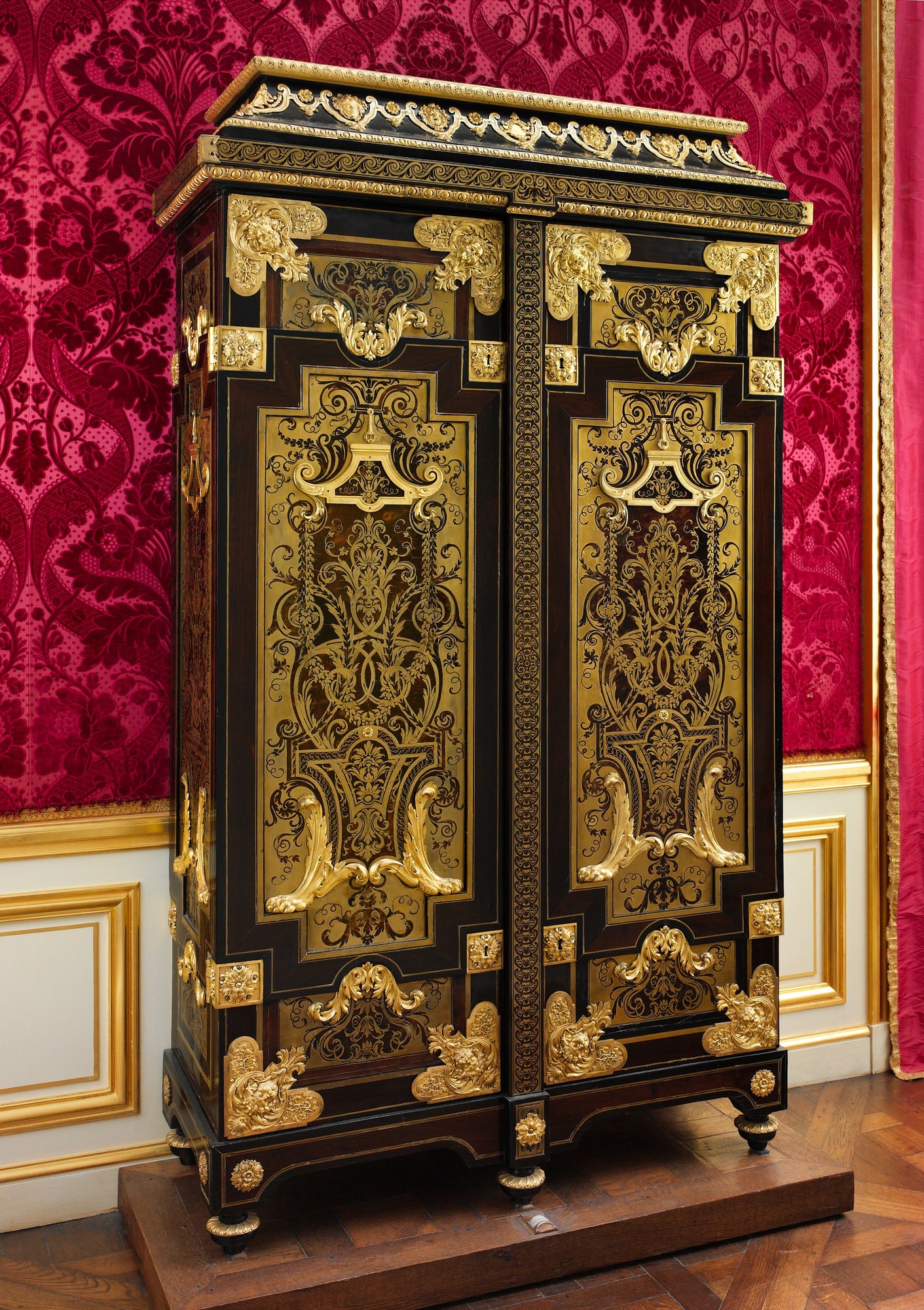
A cabinet built to be noticed
The Metropolitan Museum of Art records this French cabinet as made in Paris around 1700. It stands 233 centimetres high, with an oak carcase beneath ebony, ebonised fruitwood, burl, brass-and-tortoiseshell marquetry and gilt bronze. It does not exactly ask the room for permission.1
How can an object this lavish also be economical? The answer is visible in the cabinet itself. Precious material and careful finishing gather where the eye is most likely to notice them. Reversed marquetry makes one cutting operation serve two surfaces. Less visible areas accept cheaper substitutions, and the enormous case comes apart quickly. Spectacle was the result; calculation was the method.
The V&A describes Baroque design as a union of architecture, sculpture and other visual arts intended to impress the senses, often through rare materials and virtuoso workmanship.2 This cabinet behaves like a small building. Pilaster, frieze, projecting top and sculptural mounts turn two storage doors into a façade for a public room.
The name stays qualified
The Met attributes the cabinet to André-Charles Boulle; it does not record him as a certain maker. That wording matters. Parisian competitors produced related architectural cabinets, and a spectacular surface is not a signature.
The museum points instead to a group of connections. Inlaid patterns correspond with patterns on other pieces associated with Boulle's workshop, while a surviving drawing by Boulle has similarities that strengthen the attribution. The sculptural quality of the mounts also supports the comparison. Together these details make a reasoned attribution, not a name inferred from style alone.1
The object has a biography beyond that attribution. It stands on a modest base, its rounded feet are later, three interior shelves are now lost, and much of the engraved surface decoration has disappeared. The cabinet photographed today is the same museum object, but not a frozen view of the day it left a workshop.
Two pictures, and perhaps a twin
Much of the cabinet's pattern comes from paired cutting. Sheets of contrasting material could be temporarily joined and sawn to one design. When separated, the cut yielded complementary arrangements: brass forms set into a dark ground and dark forms set into brass. These are traditionally called première partie and contre-partie.1
The cabinet uses both. The central door moulding carries brass on tortoiseshell, while most of the exterior is the dark-on-light contre-partie. One demanding cut could therefore produce two usable pictures instead of one picture and a heap of expensive negative shapes.
That logic creates an absence. The Met estimates that contre-partie cost about twenty percent less and suggests that a matching cabinet, decorated mainly in the more expensive première partie, once existed. Object 59.108 is singular in the museum record, yet its surface points towards a companion that has not been identified.
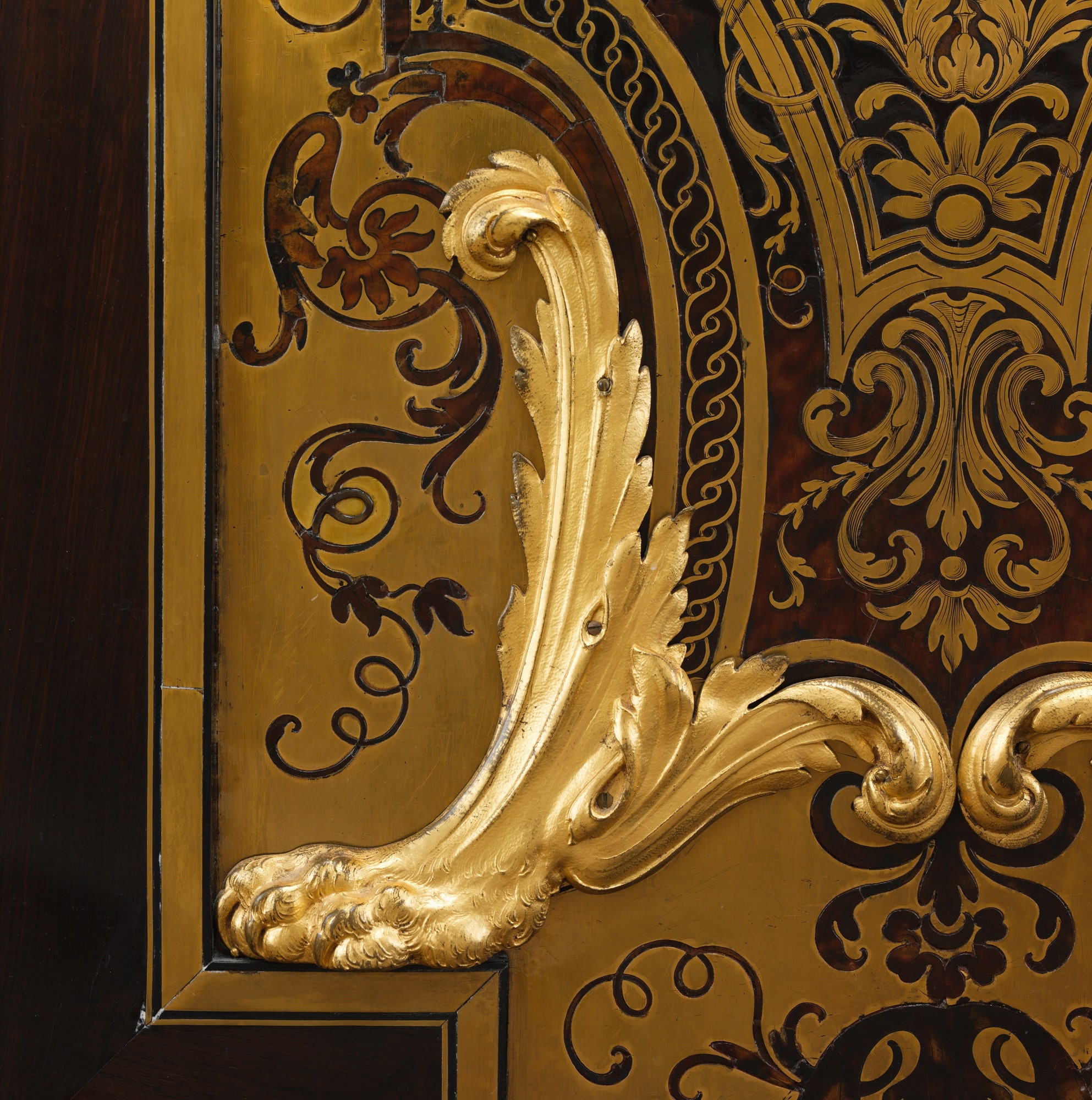
Luxury follows the sightline
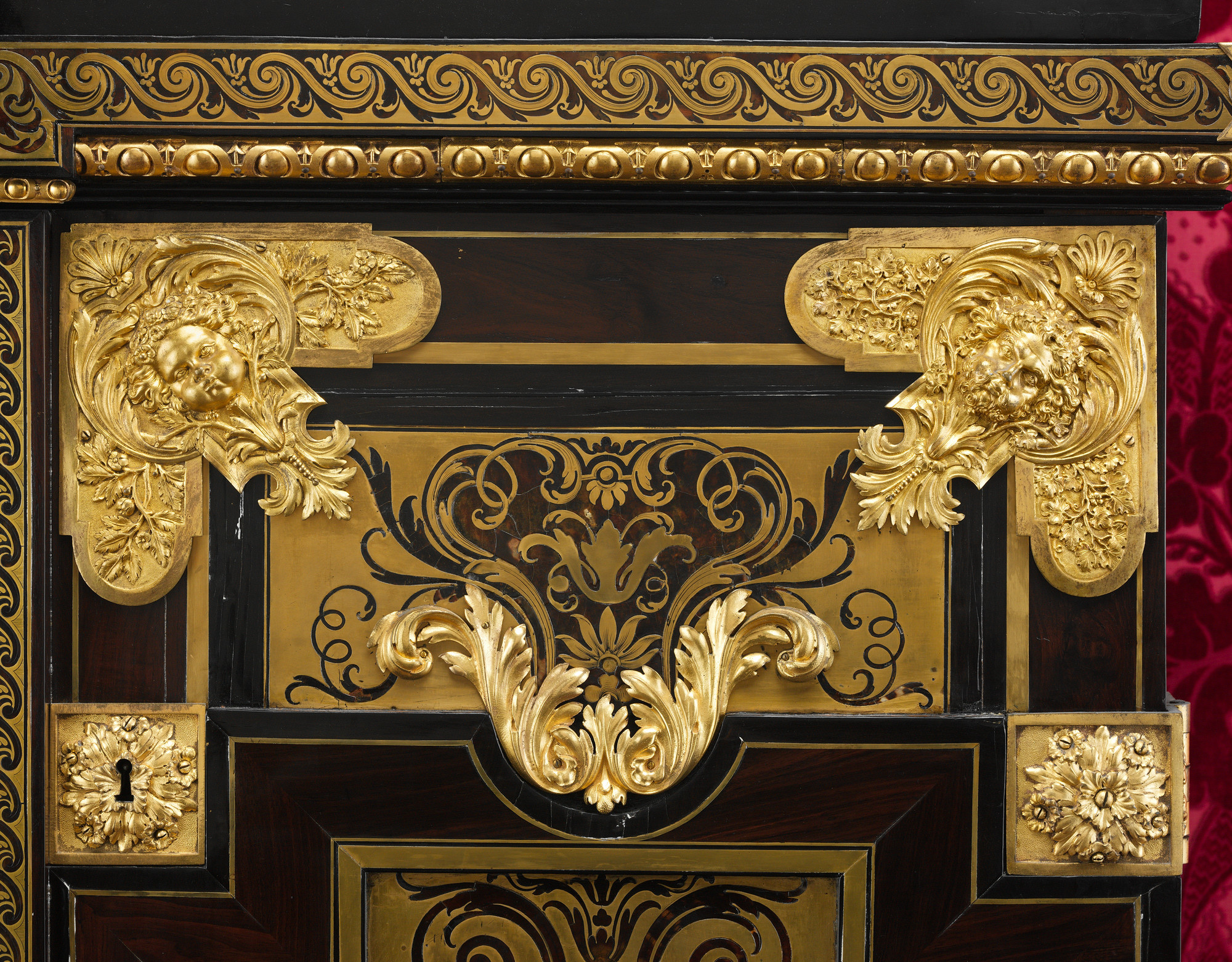
The bronze mounts do not receive uniform treatment. According to the Met, their chiselling and finish improve as they approach eye level. The upper quarter, above the viewer's usual gaze, replaces expensive ebony with local fruitwood darkened to resemble it. Inside the doors, local burl was probably stained to suggest the more valuable tortoiseshell used outside.1
These substitutions show the workshop directing cost rather than spending uniformly. A client meeting the object in a public room would encounter the strongest bronze work, contrasting materials and glittering surface where attention naturally settled. Money spent above that sightline or behind a closed door produced less visible effect.
Look from the whole cabinet to the close view and the hierarchy becomes easier to read. Flat marquetry supplies the continuous pattern; bronze mounts lift faces, scrolls and leaves into relief. Labour intensifies where two-dimensional drawing and three-dimensional ornament meet.
A giant that comes apart quickly
For all its height and visual weight, the cabinet is not one immovable block. The Met reports that it can be dismantled in about fifteen to twenty minutes. That fact changes the meaning of its architecture. The pilasters, frieze, doors, base and top compose a monumental front, while the underlying object remains a constructed piece of furniture that can be taken apart.1
That speed is revealing even without a surviving assembly sequence. Apparent permanence and practical mobility were designed into the same object. A cabinet intended to dominate a room still had to pass through buildings, survive handling and be installed where its owner wanted the performance to begin.
The surface is still moving
The cabinet's materials do not age as one obedient layer. Its oak, veneer and tortoiseshell are organic; the inlaid metal responds differently to changes in its environment. The resulting movement puts stress on the fitted surface. The Met describes this kind of marquetry as constantly working and records a historical expectation that major areas might need restoration once a generation.1
Care can preserve the pattern and alter it at the same time. Repeated smoothing reduced the thickness of the veneers and the depth of their engraved lines; almost all of the cabinet's former engraving is now lost. The present surface therefore records three kinds of work: the original fitting of unlike materials, their continuing physical movement and later attempts to hold the composition together.
That makes object 59.108 more revealing than a generic example of splendour. It shows where a workshop spent, where it saved, how it prepared an enormous object to travel and what centuries of keeping incompatible materials together have changed. The parade cabinet was never only an image. It has always been a working arrangement of matter, money and attention.