Three kinds of work on one cabinet
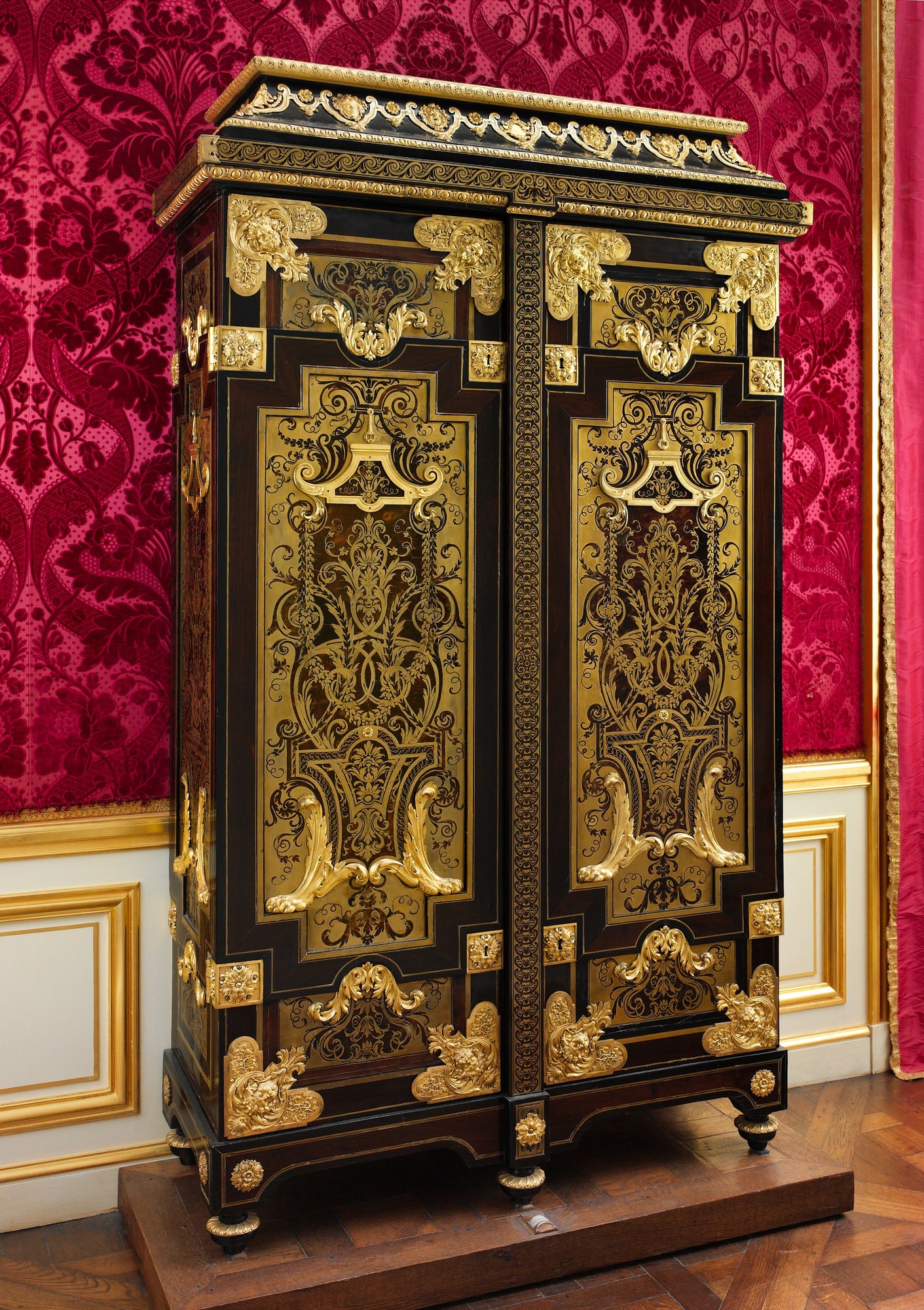
Stand back from the Met cabinet and its dark body and bright ornament read as one rich surface. Move closer and the surface separates. Thin brass and tortoiseshell form flat patterns, while gilt-bronze mounts cast stronger shadows. Beneath both is the wooden furniture that holds everything in place.2
That separation makes the object easier to understand. Marquetry creates a picture or pattern in the plane of the surface. A mount can cross an edge, frame a panel or project towards the viewer. The cabinetmaker still has to provide a body whose doors fit and whose proportions accommodate this additional work.
The overall effect depends on coordination. Treating all the brightness as one kind of decoration loses the difference between an engraved line, an inlaid shape and a three-dimensional metal fitting.
Two patterns from a shared cut
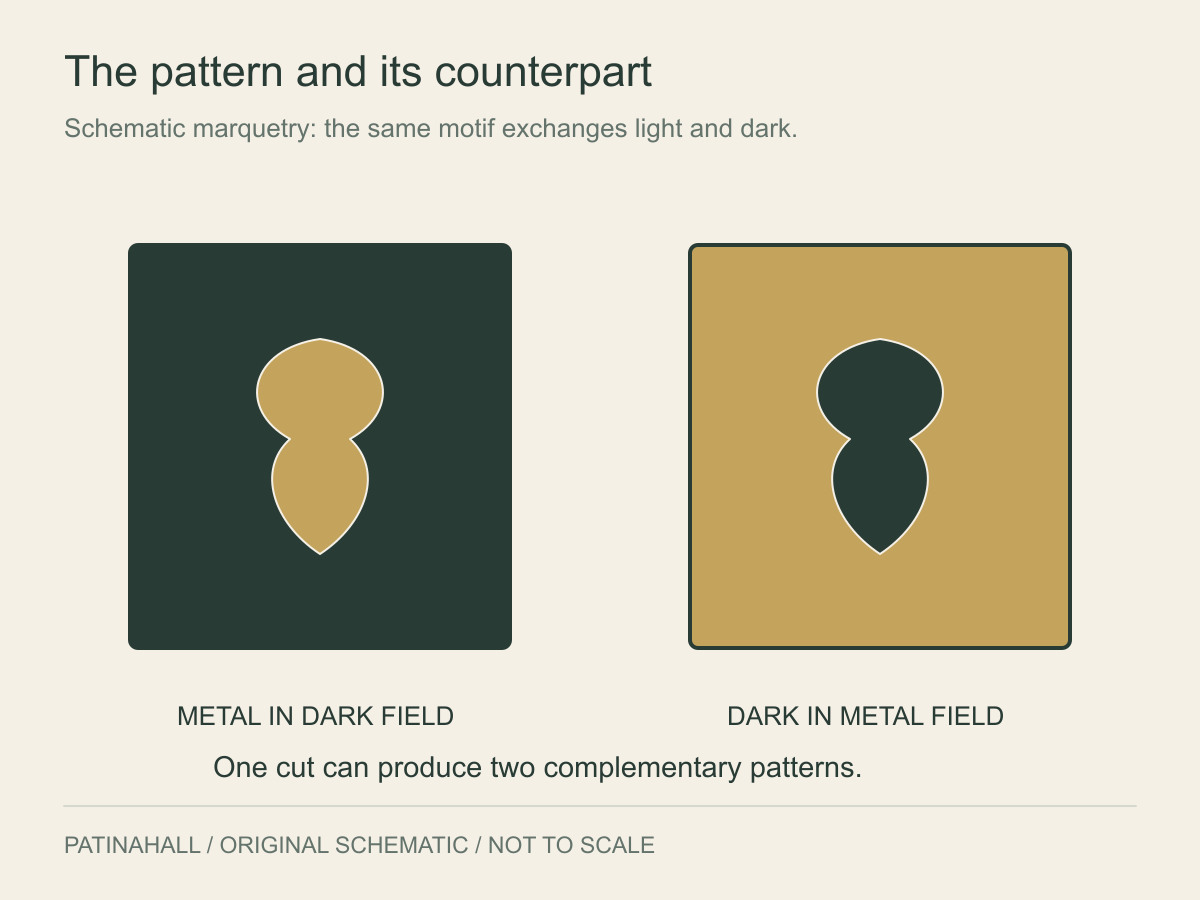
Brass-and-shell marquetry offered a satisfying economy. When contrasting sheets were cut together, their pieces could be exchanged. A light motif in a dark field could have a partner with the colours reversed. The Met’s account explains why this method encouraged furniture made in pairs.2
The original diagram simplifies the principle to a single shape. In one panel the shape is bright and its surroundings dark; in the other, those roles change. The outline belongs to both. Elaborate historical patterns multiply that relationship across many small pieces.
This is why the second pattern is more interesting than an ordinary copy. The same drawing can produce a different visual emphasis. What looked like background becomes foreground, and the eye follows another part of the design.
The workshop that the inventory only partly shows
In October 1715, Boulle transferred his workshop to his sons. The associated inventory records many kinds of wood, including materials for the body of furniture and thin decorative veneers. Yet, as the Wallace Collection points out, it does not list the brass, pewter and tortoiseshell that seem inseparable from his name today.1
An inventory is a document made for a purpose, not a complete tour arranged for a future reader. Its omissions do not prove that the missing materials were absent from the practice. They show why a historian needs the objects as well as the paperwork.
Technical studies add another kind of information by identifying woods in surviving furniture. The Wallace Collection describes unusual coralwood drawers in the chests supplied for the Grand Trianon in 1708–9, including object 14279.2. A material choice could belong to one commission rather than the whole workshop’s output.1
Together, documents and examination bring a complicated workshop into view. The celebrated surface becomes one part of a business concerned with timber, assembly, finishing and the coordination of specialised work.
A surname is not a maker’s mark
The cabinet shown here is attributed to André-Charles Boulle. The museum has grounds for the association, while stopping short of a certain maker credit.
The name also travels beyond that object. A technique can be repeated after its most famous practitioner has died. Looking for brass and shell therefore tells us where to begin an explanation; it cannot finish an attribution.
The richer way to see Boulle furniture is to follow its layers. First the body, then the cut sheets, then the projecting metal. The luxurious surface becomes legible as a sequence of different kinds of work.