Artefact story

Kokon: a chair and table under one skin

Kokon makes a chair and a table read as one new shape by giving them a shared skin. MoMA’s 1999 table-chair offers a particular example of a wider furniture family jointly credited by Droog to Jan Konings and Jurgen Bey.

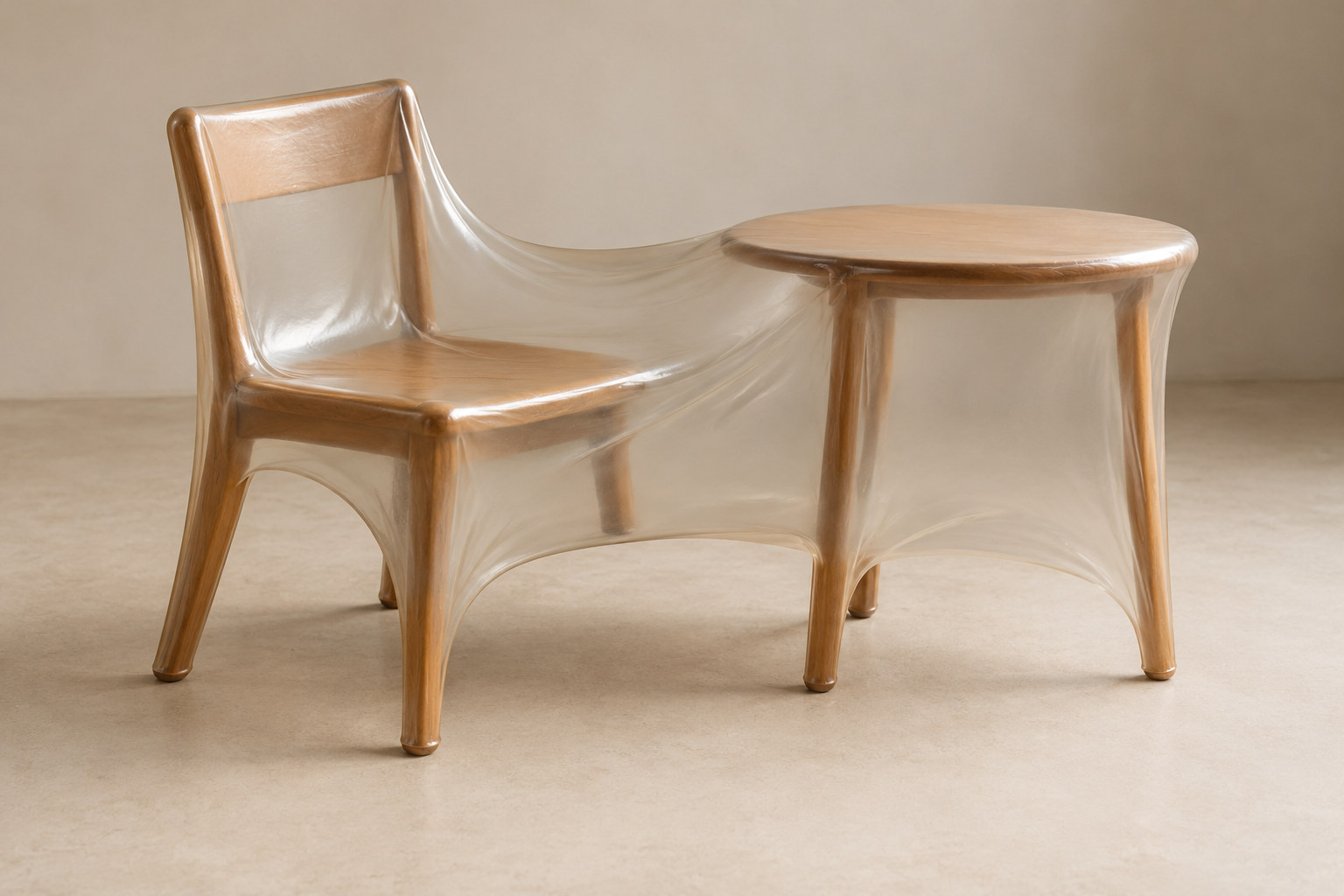
A chair and small table are joined visually by a continuous clear covering.
PatinaHall editorial reconstruction. It is not a documentary photograph. A shared skin brings a chair and table into one outline. The arrangement illustrates the covering idea, rather than reproducing the precise geometry or condition of MoMA’s object.
On this page
Key facts & takeaways

At a glance

Subject
Kokon table-chair, MoMA 836.2018
Entry
Artefact story
Last reviewed
25 October 2026
Object dated
1999documented

Three things to remember

  1. This is the table-chair recorded by MoMA, rather than the double-chair.
  2. Droog credits Jan Konings and Jurgen Bey jointly for the family.
  3. The PVC covering changes how existing furniture reads as a whole.

One skin, two familiar forms

A chair and a table usually announce themselves as separate things. Kokon gives them a shared outer surface, making their combined outline the first thing to notice.

The object here is MoMA's “Kokon” table-chair, numbered 836.2018 and dated 1999. The museum credits Jurgen Bey and describes a PVC-covered table and chair, given by Droog Design.1

Droog's 1997 Kokon family account credits Jan Konings and Jurgen Bey jointly. It describes old wooden furniture enclosed in a shrinking PVC covering, with different combinations giving the idea different forms.2

When the surface joins the objects

The covering changes the scale at which the furniture is easiest to read. Wood grain, joins and differences between pieces ordinarily help the eye find separate parts. A common outer surface puts more emphasis on volume and silhouette.

Droog describes the skin as taut and elastic around the existing frames. The furniture underneath continues to supply the shape, while the covering changes how those shapes meet the eye.2

That makes the transformation an act of connection. The earlier objects supply a structure and recognisable outlines; the new surface asks the viewer to follow them as one figure.
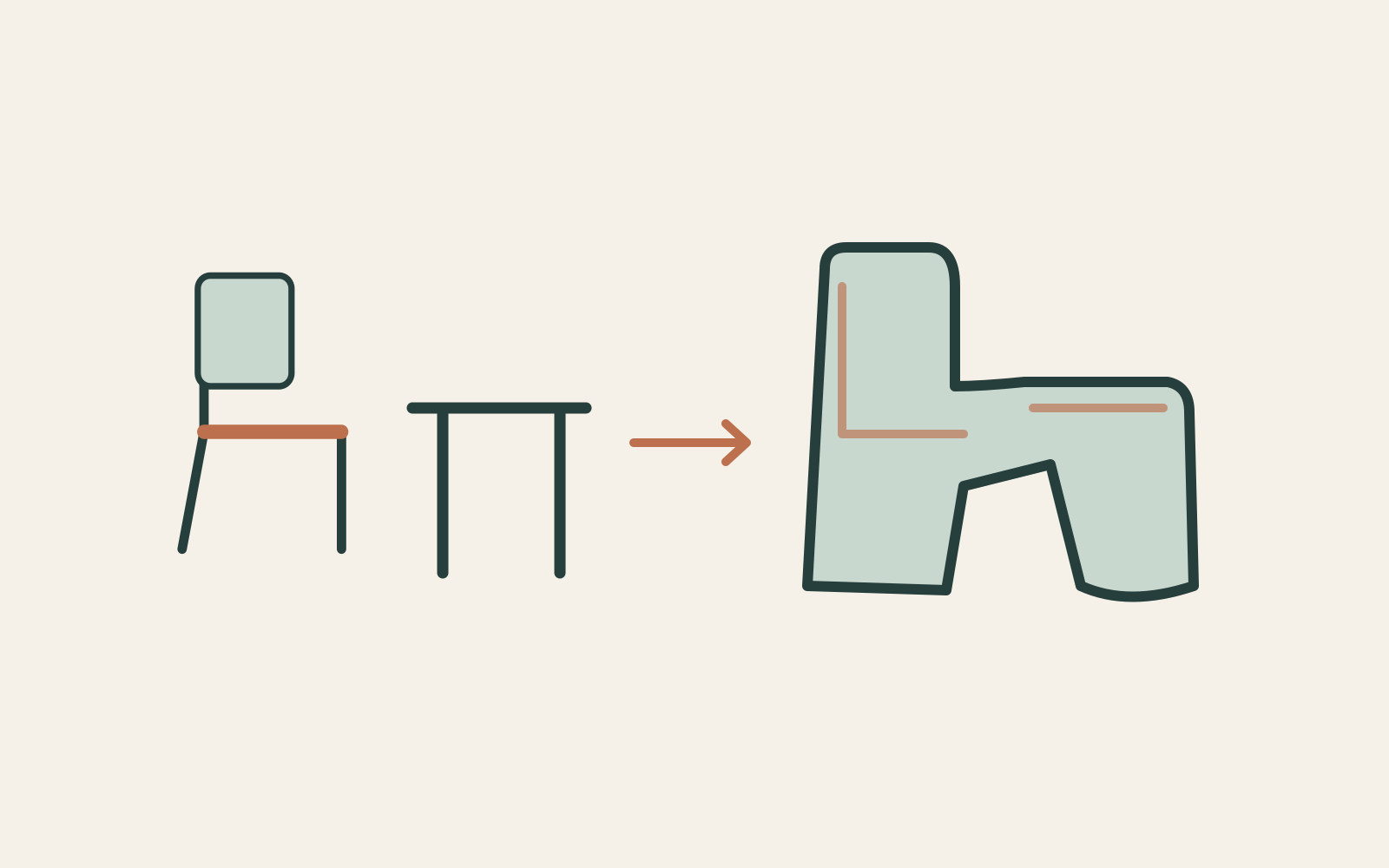
One chair and a table are shown separately and then within a continuous common outline.
A shared outer covering changes how a chair and table are read together. Original PatinaHall schematic, not to scale; it does not reproduce MoMA’s exact object geometry.

Two activities within one outline

A table-chair brings a place to sit and a surface for an activity into the same object. That combination differs from joining two chairs: it connects two kinds of furniture, each carrying a different everyday association.

The shared skin makes their relationship visible before the viewer sorts them back into familiar categories. Its continuous appearance encourages the eye to move across an area where one object might otherwise seem to end.

The chair still suggests a place to sit and the table a surface to use. The covering changes where one seems to end and the other begins.
Research notesEvidence, connections and limits

MoMA’s 1999 object record and Droog’s 1997 family account have different scopes. The table-chair keeps its own identity; joint family credit, other variants and maker credits from different museum objects are not silently merged.

Evidence map

Connected subjects and evidence

Reviewed facts

  • Object dated 1999documented

    MoMA dates table-chair 836.2018 to 1999. Droog's separate account of the family dated 1997 covers several different forms.

    Reviewed 25 October 2026 by PatinaHall editorial.
    • Source 1Object title; 1999; medium; gift credit; accession
    • Source 2Family credit/date and variant list

Reviewed connections

  • Kokon table-chair, MoMA 836.2018attributed toJurgen Beyattributed

    MoMA credits Jurgen Bey for this table-chair. Droog credits Jan Konings and Jurgen Bey jointly for the wider Kokon furniture family.

    Reviewed 25 October 2026 by PatinaHall editorial.
    • Source 1Object title; 1999; medium; gift credit; accession
    • Source 2Family credit/date and variant list
  • Kokon table-chair, MoMA 836.2018uses materialPVC covering of Kokon furnituredocumented

    MoMA describes a PVC-covered table and chair. Droog explains the family's taut skin around old furniture and distinguishes the table-chair from its double-chair form.

    Reviewed 25 October 2026 by PatinaHall editorial.
    • Source 1Object title; 1999; medium; gift credit; accession
    • Source 2Family credit/date and variant list

Research trail

Sources and further reading

  1. MoMA, Kokon table-chair 836.2018The Museum of Modern ArtAccessed 25 October 2026
  2. Droog, Kokon Furniture by Konings & BeyDroogAccessed 25 October 2026

Last reviewed 25 October 2026. Found an error or a stronger primary source? Contact PatinaHall.