Design story

Bone Chair: a structure that follows the work

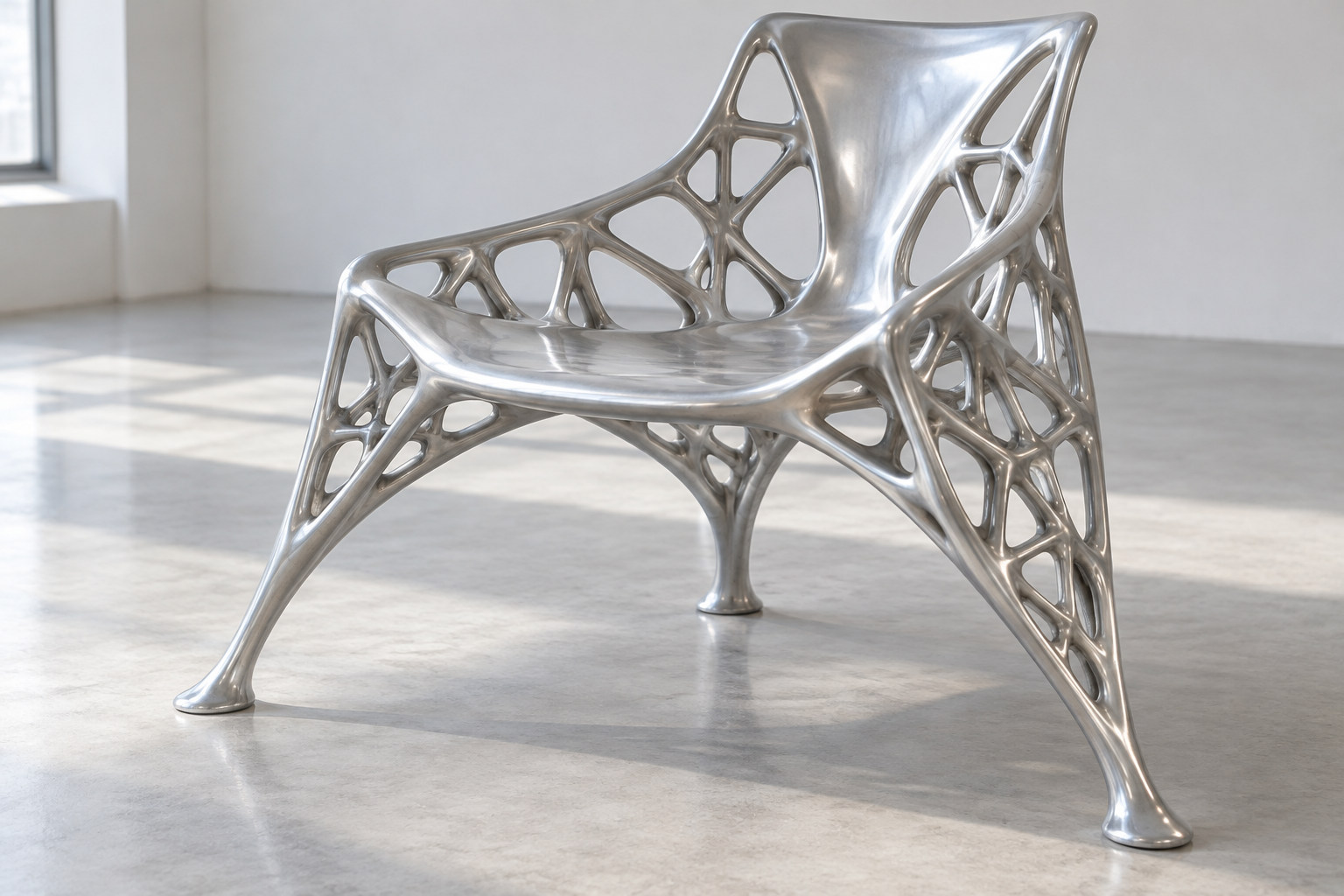
Bone Chair looks as if its support has branched and thickened where it needs to work. That impression points towards a real design process, although the chair did not grow by itself. Computation, decisions about furniture and the work of making a physical object all belong to the story.

Editorial reconstruction of a silvery chair with dense branching side lattices converging onto three floor contacts.
PatinaHall editorial reconstruction. It is not a documentary photograph. A branching metal-like form introduces variation in supporting members. This imagined object is not a simulation result, a verified cast Bone Chair or evidence of structural performance.
On this page
Key facts & takeaways

At a glance

Subject
Bone Chair
Entry
Design story
Last reviewed
23 October 2026
Designed
2006documented

Three things to remember

  1. MoMA dates Bone Chair to 2006.
  2. The design used optimisation software developed for automotive structures.
  3. The Rijksmuseum's paper study is distinct from the cast-aluminium furniture.

The branches follow a problem

Bone Chair looks organic because its structure was developed through a process inspired by growth. Joris Laarman used optimisation software from automotive engineering to explore where material could perform useful structural work. MoMA identifies the resulting aluminium chair with 2006.1

The idea becomes visible in the changing thickness of the supports. Members can gather into a broader junction and then narrow as they move away. The outline suggests a distribution of work rather than a collection of identical sticks joined at fixed angles.

Nature supplied a principle

MoMA explains the biological analogy through bones concentrating mass where stresses demand it. That is different from simply borrowing the appearance of a skeleton. Laarman was interested in using a generative principle to help arrive at a form.1

The distinction gives the reader a useful question. When a piece of furniture resembles nature, is nature supplying a motif, a material or a way of developing the structure? Bone Chair belongs to that last conversation, even though the finished object is made through human choices and production techniques.

No biological comparison settles every question about the furniture. It explains the design process; it is not a load certificate for any particular chair.
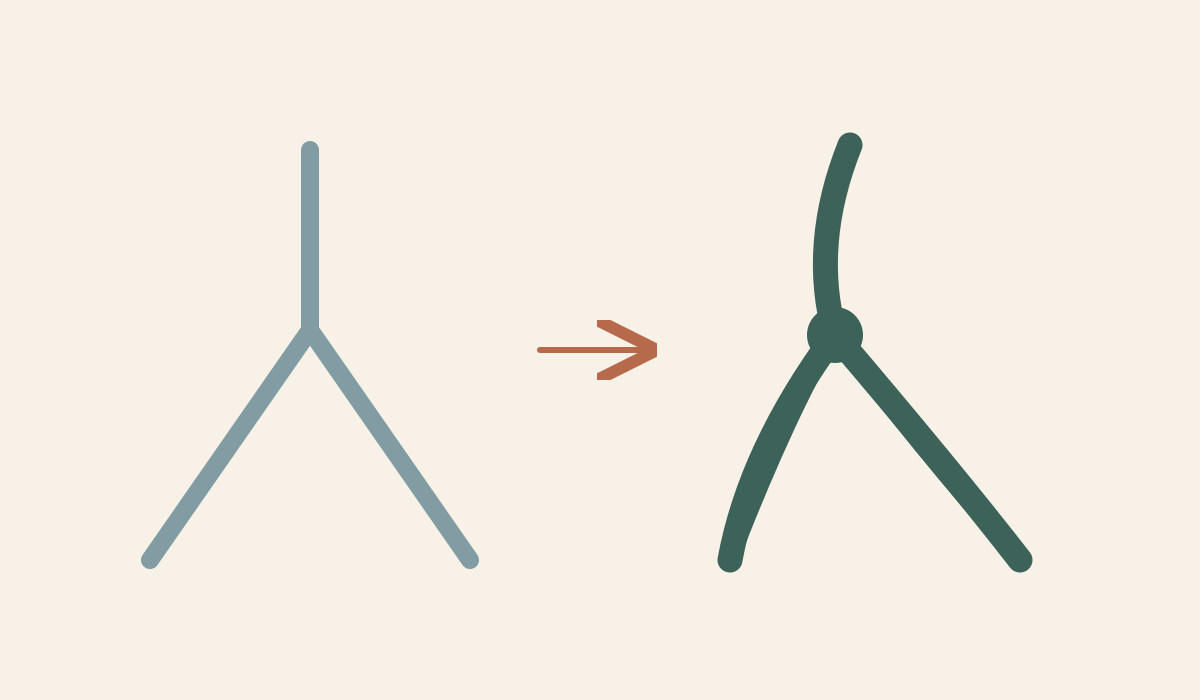
A constant-width framework is compared with a branching support with thicker junctions.
Original PatinaHall schematic, not to scale. Branching members can change thickness where they meet. This conceptual comparison is neither a stress simulation nor a reproduction of the optimisation software.

A paper chair belongs to the story

The Rijksmuseum holds a full-size paper study for Bone Chair. Its layered construction and recorded annotations preserve another stage of the work, before the much thinner cast-aluminium result. A digital process still led to a physical object that could be considered and worked on.2

That study makes an otherwise elusive part of design tangible. A computation does not remove questions of scale, proportion and how the body meets a surface. The paper object belongs to the route between a method and a piece of furniture.

Keep the records separate

Centraal Museum dates its aluminium example to 2007 and records its connection with the Smart Deco project presented in 2006. Its object date and MoMA's design date need not be made identical to tell a coherent history.3

Look once more at a branching junction. It is the visible meeting of a biological analogy, a calculation, a model and a manufacturing decision. The chair's apparently natural outline contains a very particular history of tools.
Research notesEvidence, connections and limits

MoMA's design date, the Rijksmuseum's paper study and Centraal Museum's 2007 object are distinct records. Biological analogy and computational optimisation do not establish the safe load or manufacture date of an unreviewed chair.

Evidence map

Connected subjects and evidence

Reviewed facts

  • Designed 2006documented

    MoMA's design date, the Rijksmuseum's paper study and Centraal Museum's 2007 object are distinct records. Biological analogy and computational optimisation do not establish the safe load or manufacture date of an unreviewed chair.

    Reviewed 23 October 2026 by PatinaHall editorial.
    • Source 1Joris Laarman, Bone Chair, 2006, object 443.2008

Reviewed connections

  • Bone Chairdesigned byJoris Laarmandocumented

    The cited record identifies the designer of this design or coherent project family.

    Reviewed 23 October 2026 by PatinaHall editorial.
    • Source 1Joris Laarman, Bone Chair, 2006, object 443.2008
  • Bone Chairmanufactured byJoris Laarman Studiodocumented

    The source records this production relationship; it does not identify the maker or date of an unreviewed example. Later studio production is not used to date the original design.

    Reviewed 23 October 2026 by PatinaHall editorial.
    • Source 1Joris Laarman, Bone Chair, 2006, object 443.2008

Research trail

Sources and further reading

  1. Joris Laarman, Bone Chair, 2006, object 443.2008The Museum of Modern ArtAccessed 23 October 2026
  2. Paper Bone Chair, object BK-2011-50RijksmuseumAccessed 23 October 2026
  3. Bone chair, object 30239, 2007Centraal Museum UtrechtAccessed 23 October 2026

Last reviewed 23 October 2026. Found an error or a stronger primary source? Contact PatinaHall.