Design story

G Plan Quadrille: the dressing table that could become a desk

Quadrille’s detachable mirror was part of a practical idea: one piece could serve as a bedroom dressing table or a desk. Its open centre and separate drawer groups make that change possible without rebuilding the furniture.

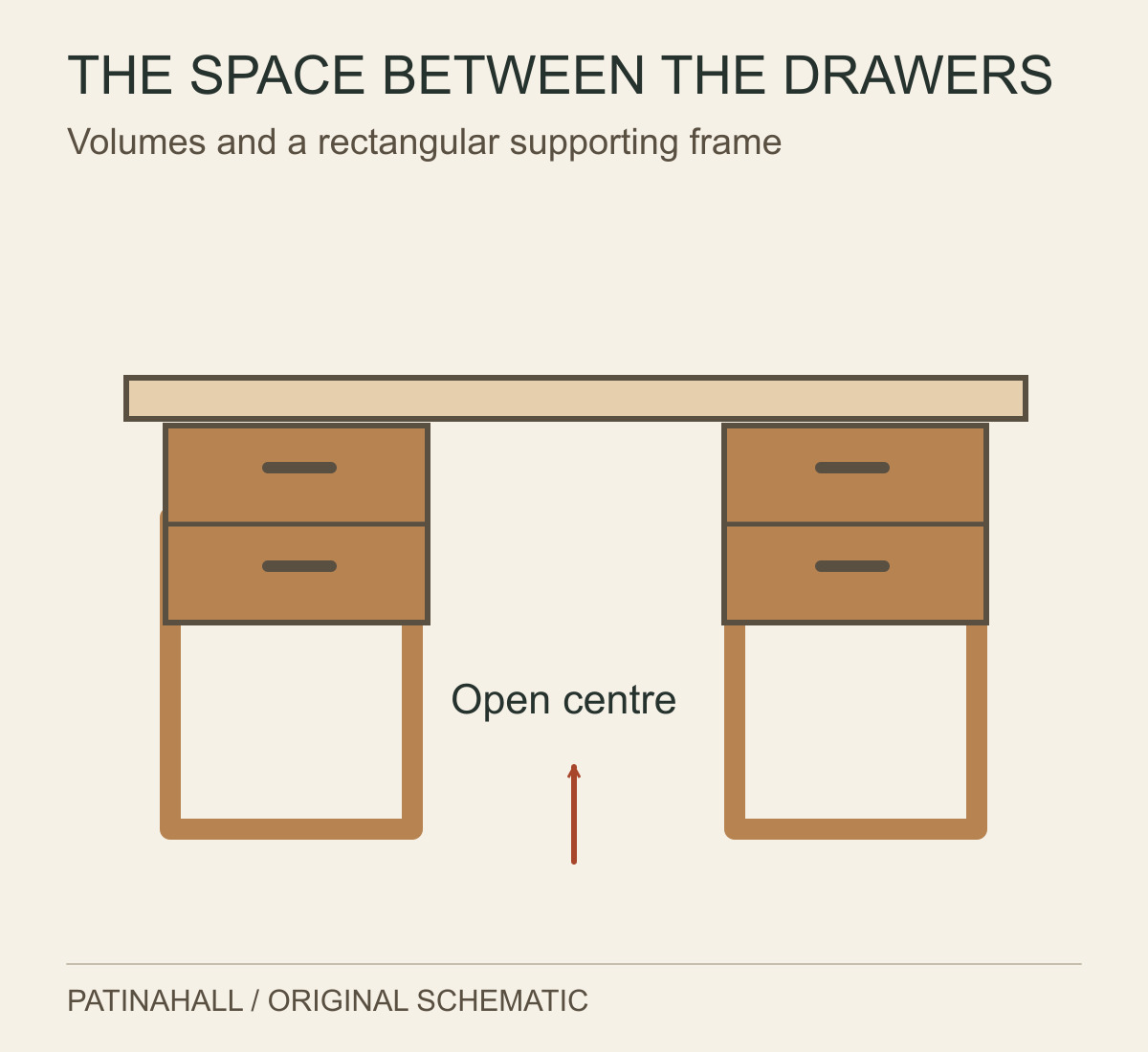
A dressing-table front has two drawer groups and rectangular supports, leaving an open central space beneath a connecting top.
Grouped drawers and an open centre explain the Quadrille dressing-table composition described by the auctioneer. Handle shapes and support geometry are abstracted rather than copied. Original PatinaHall schematic, not to scale.
On this page
Key facts & takeaways

At a glance

Subject
G Plan Quadrille dressing tables
Entry
Design story
Last reviewed
6 September 2026

Three things to remember

  1. G Plan describes desk use as part of the dressing table’s intended flexibility.
  2. A detachable mirror changes the upper outline without rearranging the drawers.
  3. The 1965 collection was designed for pieces to work alone or together.

The mirror was meant to come off

A Quadrille dressing table without its mirror can look like a piece that has lost something. G Plan’s own history offers a more interesting explanation: the design was intended to work both as a bedroom vanity and as a desk in an office or living room. Its adjustable, detachable mirrors were part of that flexibility.2

The change is easy to picture. With a mirror above it, the long top becomes a place to sit and dress. Remove that upright plane and the same surface opens towards the room, ready for paper, a lamp or a book. Its second role was already in the design, rather than invented only by later resale listings.

Drawers suspended around a seated person

The rectangular, sleigh-shaped supports give the piece a clear outline. Between them, the drawer groups leave a central opening for knees. The top appears to float above these separate volumes, so the furniture has a strong shape without becoming a solid block.

One surviving example catalogued by David Duggleby has four drawers and is described as a dressing table or desk. The description is useful because it lets the abstract idea become a particular object: storage at either side, a working surface across the width, and room for someone to sit in the middle.3

The open centre also explains why removing a mirror can work so naturally. The lower half already accommodates the posture of someone writing. The surface and drawers do not need to be rearranged to give that person a place.
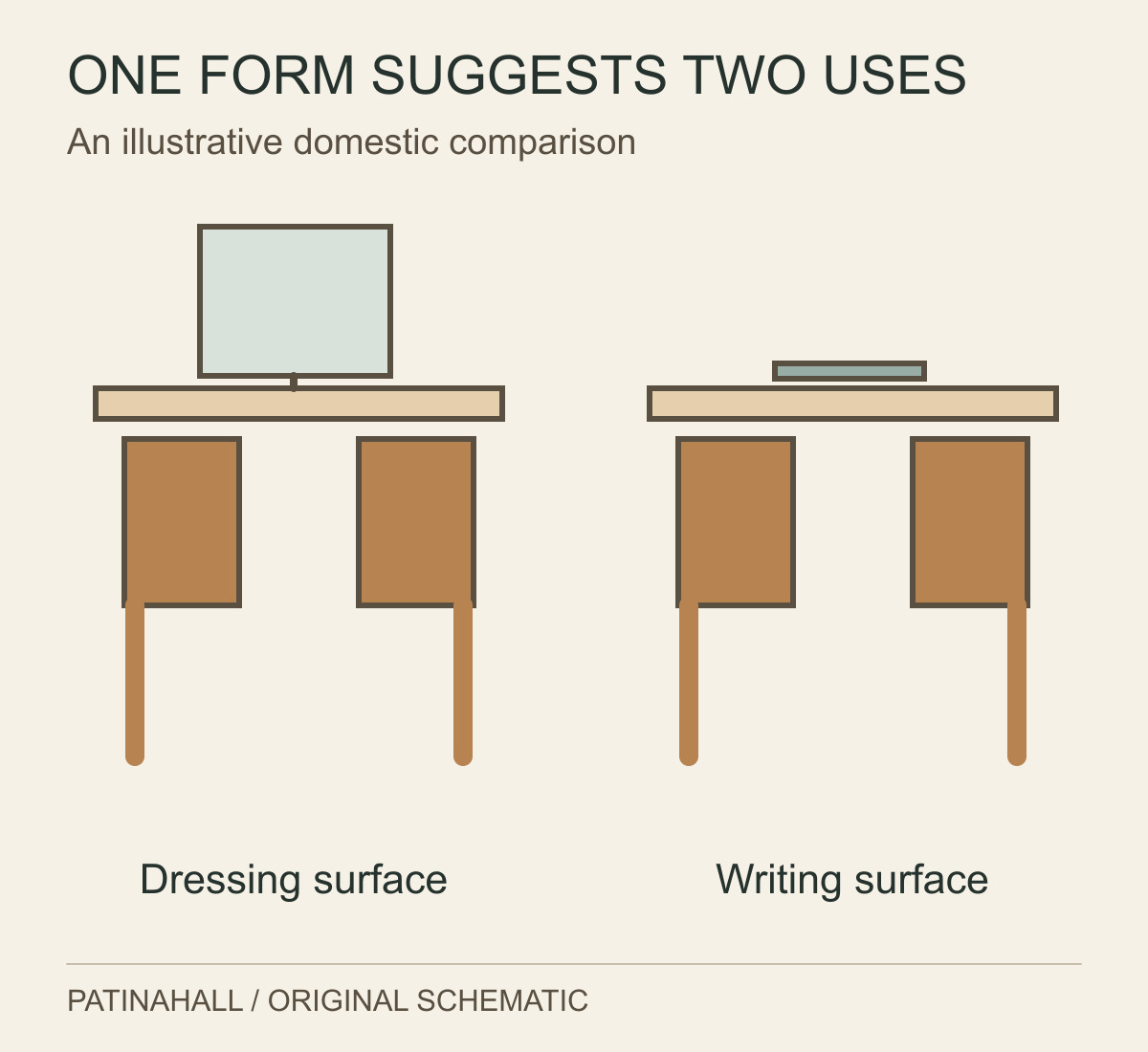
Two simplified drawer tables compare a dressing arrangement with a freestanding mirror and a writing arrangement with a closed notebook.
The auction record’s desk-or-dressing-table wording prompts these two illustrative uses. The mirror and notebook are invented props, not evidence of original supplied fittings. Original PatinaHall schematic, not to scale.

A room assembled from separate pieces

The High Wycombe Furniture Archive records a Quadrille bedroom-furniture folder dated 1965, with the designer given as R. Bennett. G Plan’s retrospective also places the range in 1965 and describes Scandinavian influence.12

The maker says the collection was conceived so pieces could stand alone or work together. That helps explain the dressing table’s finished, self-contained appearance. It belongs to a furniture range, but it does not need the whole matching room to make sense.

Quadrille’s most useful historical detail is therefore a small act of removal. The detachable mirror changes what happens above the drawers while the open base continues to suit a seated person. The familiar dressing table contains a second room’s worth of possibilities in its existing shape.

Research notesEvidence, connections and limits

G Plan’s retrospective supplies the dual-purpose design account. The High Wycombe archive’s indexed 1965 folder names R. Bennett; G Plan spells the surname Bennet. Neither establishes the precise history, dimensions or original fittings of an individual surviving example.

Evidence map

Connected subjects and evidence

Reviewed connections

  • G Plan Quadrille dressing tablesdesigned byR. Bennettdocumented

    High Wycombe Furniture Archive documents R. Bennett in the designed by role for G Plan Quadrille dressing tables. This relation describes the design family, not the origin of an individual secondhand object. The archive search record identifies R. Bennett and E. Gomme/G Plan; the full asset viewer was unavailable. The independent auction record corroborates the R Bennett attribution and G Plan name.

    Reviewed 6 September 2026 by PatinaHall editorial.
    • Source 1Design, material or production account; scope described in the evidence note
  • G Plan Quadrille dressing tablesmanufactured byE. Gomme Ltddocumented

    High Wycombe Furniture Archive documents E. Gomme in the manufactured by role for G Plan Quadrille dressing tables. This relation describes the design family, not the origin of an individual secondhand object. The archive search record identifies R. Bennett and E. Gomme/G Plan; the full asset viewer was unavailable. The independent auction record corroborates the R Bennett attribution and G Plan name.

    Reviewed 6 September 2026 by PatinaHall editorial.
    • Source 1Design, material or production account; scope described in the evidence note

Research trail

Sources and further reading

  1. Quadrille bedroom furniture, GF11: G Plan New Models Folder 1965High Wycombe Furniture ArchiveAccessed 6 September 2026
  2. Quadrille: a dressing table designed for more than one roomG PlanAccessed 6 September 2026
  3. R Bennett for G Plan: Quadrille desk or dressing table, lot 144637David Duggleby AuctioneersAccessed 6 September 2026

Last reviewed 6 September 2026. Found an error or a stronger primary source? Contact PatinaHall.