The gap makes the shape
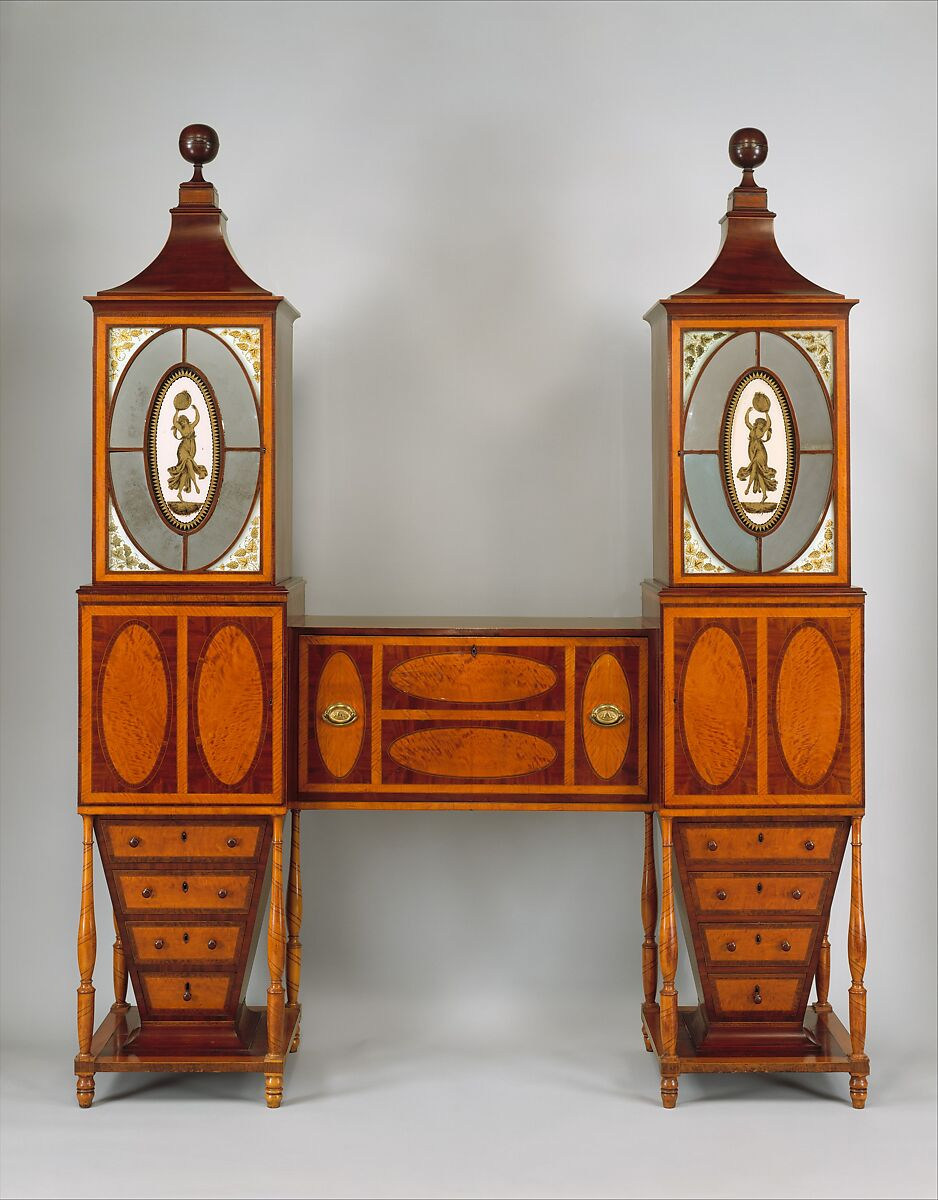
Most tall bookcases build a wall. This one leaves a conspicuous opening. Two glazed towers stand apart, connected partway up by a desk. Seen from the front, the empty space below that bridge helps the entire piece read as an enormous letter H.
The silhouette belongs to a Baltimore desk and bookcase made about 1811, now at the Met. At more than 2.3 metres high and 1.8 metres wide, it has the presence of a small piece of architecture. Mahogany is joined by satinwood, maple, cedar and decorated glass in the museum’s materials record.1
The opening is worth looking at before any of the ornament. Cover it with your hand in the photograph and the composition becomes a much more ordinary block. Reveal it and the towers regain their improbable independence.
Someone changed the printed proposal
The design has a paper ancestor: plate 38 of Thomas Sheraton’s 1803 Cabinet Dictionary, called the Sister’s Cylinder Bookcase. The Baltimore maker retained the two towers and connecting desk but changed Sheraton’s cylindrical writing section to a rectangular fall front.1
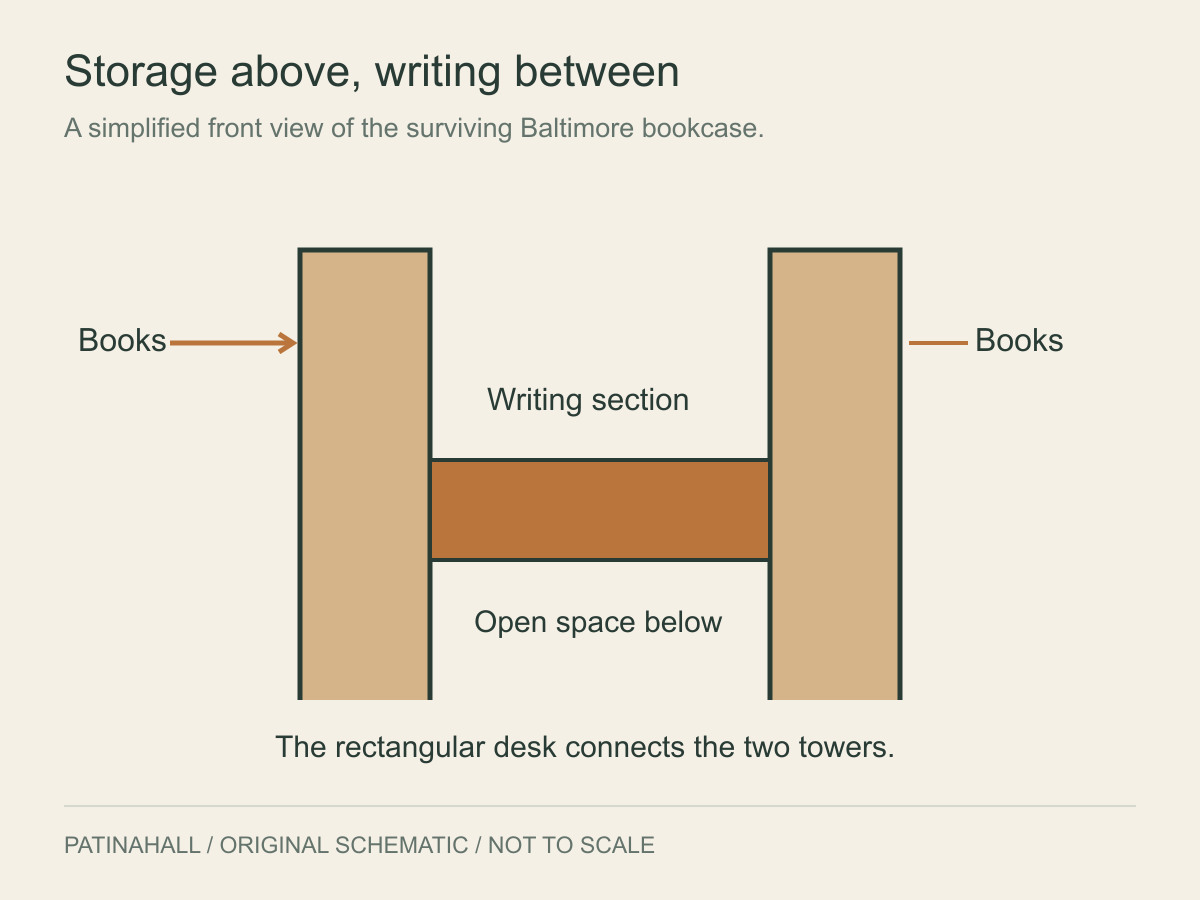
It is a consequential alteration. The straight-edged panel makes a firm crossbar between the towers. The schematic below strips away the ornament to show how the two bookcases and writing section establish the H.
The Met’s 1970 acquisition account identifies further departures, including the upper finish of the towers. It also draws attention to the glass decoration as a way of breaking up their tall surfaces.2
A published design, then, supplied a structure for further decisions. This object lets us see adaptation taking place in a finished piece. Sheraton’s name survives on the book, while the cabinetmaker who worked through these changes remains unnamed in the collection record.
Glass puts another surface inside the surface
The doors combine glazing with decorated areas that catch the eye before it reaches the shelves behind. The museum identifies the technique as verre églomisé, decoration applied to the reverse of glass. From the front, the viewer encounters the smooth glass face before the ornament beneath it.1
Cooper Hewitt’s discussion of personalised furniture explains how reverse-painted and gilded glass could bring a conspicuous decorative accent to furniture, including individual associations. Its examples provide context for the technique rather than a workshop attribution for this bookcase.3
In the photograph, the effect is a layered kind of looking: reflections on the glass, ornament within the door and depth behind it. The towers no longer read simply as storage boxes. Their fronts hold the attention even before a book has been selected.
A marriage is recorded; a maker is not
The inscription refers to the marriage of Roswell Lyman Colt and Margaret Oliver, daughter of Baltimore merchant Robert Oliver. The museum’s account links that family event to the decoration; the inscription alone does not tell us exactly when the cabinet was commissioned or delivered.2
There are quieter signatures of place, too. Follow the turned legs and a pair of inlaid lines spirals around them. The Met relates that detail to other Baltimore furniture.1
The piece rewards these changes of distance. Across a room, it is the extravagant H. Closer up, glass, lettering and narrow lines of inlay offer more personal information. Closest of all, the unanswered question remains the person who turned a printed proposal into this particular, wonderfully unlikely bookcase.