The front is on the other side
Imagine looking through a window at a drawing held against the far side. The glass remains between you and the marks. In verre églomisé, that relationship is built into the object: the decorator works on the reverse, and the finished design is seen through the glass.
Corning Museum of Glass gives a precise definition. Gold or silver leaf is applied to the back, engraved to make the design and protected behind. The image may therefore depend on both the metal that remains and the areas removed from it.1
This reverses an ordinary expectation about decorated furniture. A carved rail presents its worked face directly. Here, the visible outer surface can stay smooth while the work belongs to its far side.
The glass also becomes part of the appearance. Its reflections occupy one plane, while the decoration lies behind them. The eye meets both, especially when the light changes across a panel.
A picture made in a different order
Reverse work asks the maker to think from the viewer’s direction. A detail placed closest to the glass is in front of whatever is added behind it. In painted examples, building a background first would obscure marks subsequently applied to its back.
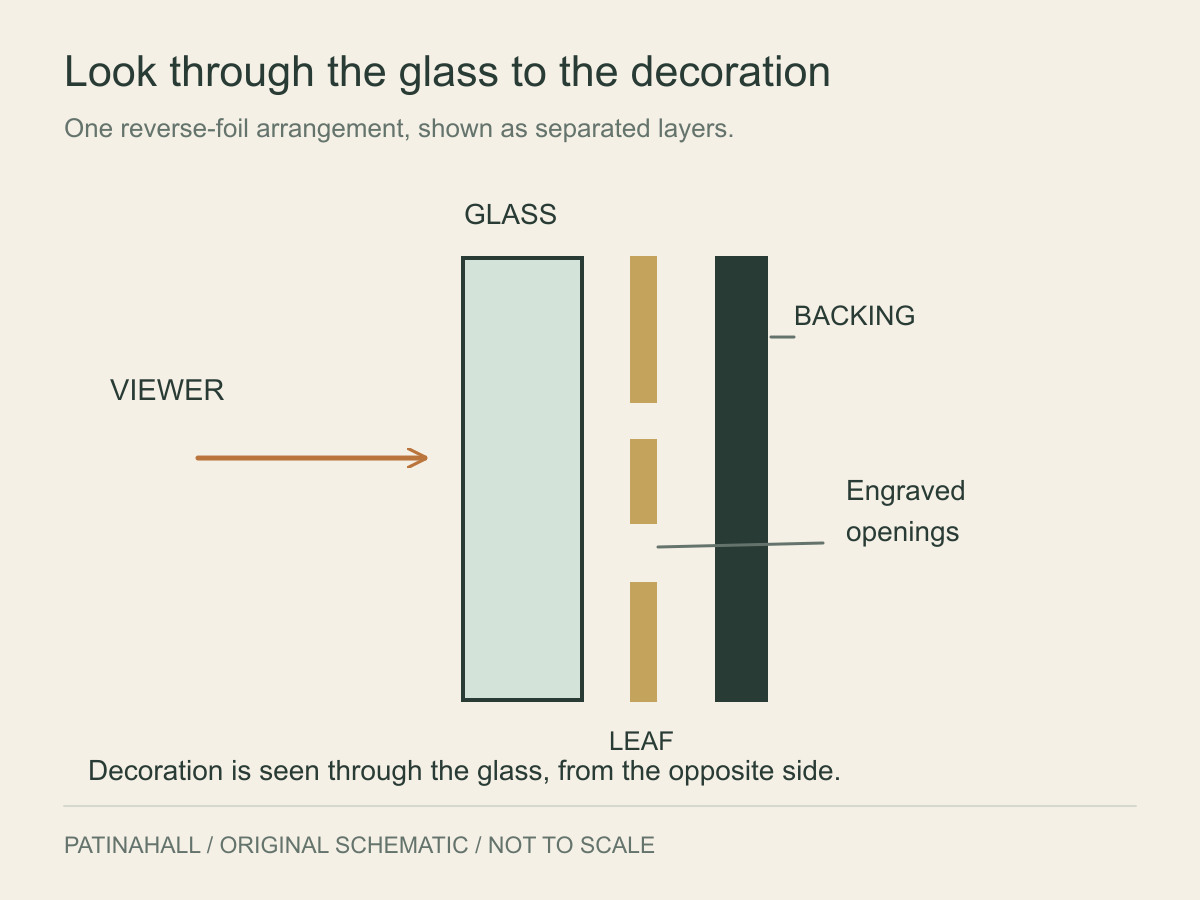
An engraved metal-leaf design answers the problem differently: the decorator removes material to articulate the image. The original schematic shows that relationship between glass, foil and backing. It isolates the principle so that the decorative surface becomes easier to read.
Museum usage is not always equally narrow. Cooper Hewitt uses verre églomisé when discussing the reverse-painted glass in an English armchair’s back. Its account emphasises the unusual combination of a personalised image and a chair intended to be seen within a formal room.2
The distinction matters because similar visual effects can come from different processes. A glass panel alone does not tell us whether the image was painted, engraved in metal leaf or made through a combination of work.
Furniture that announces its owner
The Cooper Hewitt chair carries family insignia in its central back panel. The article connects it with a larger suite made for Nicholas Leke, fourth Earl of Scarsdale. The glossy image makes ownership part of the chair’s most visible surface.2
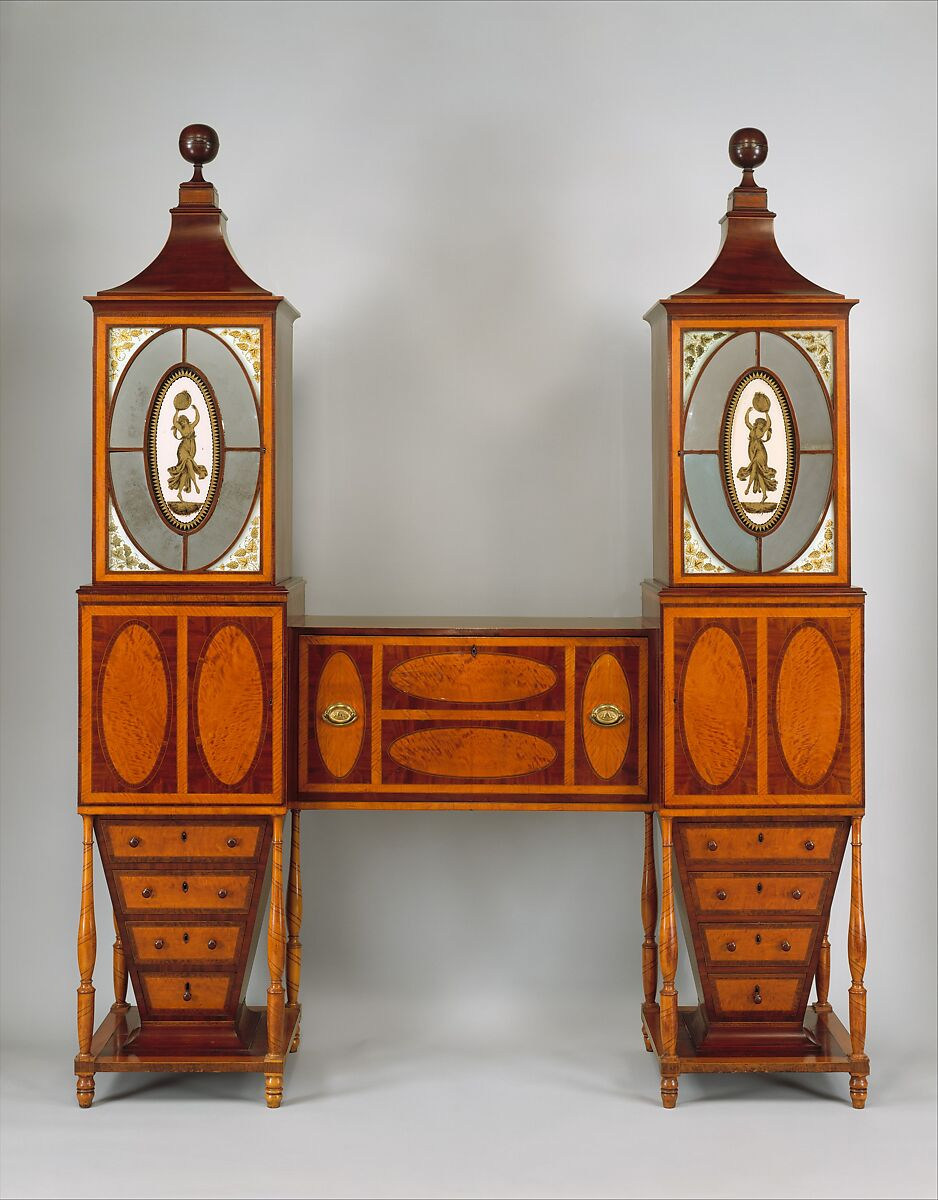
A Baltimore desk and bookcase at the Met offers another setting. Dated about 1811, it is catalogued with verre églomisé alongside mahogany, ebony and other materials. Bright glass decoration punctuates a much larger wooden composition.3
These objects place the technique where it can meet a person’s gaze: in the back of a chair or among the divisions of a cabinet. The small panel has a different presence from the timber around it, attracting attention through reflection as well as imagery.
A name later than the idea
The term comes from the French framer Jean-Baptiste Glomy. Corning notes that the decorated-glass technique predates him by centuries. The name records a later association rather than the invention of every picture made on the reverse of glass.1
That long history is easier to enter through the surface itself. Find the reflection, then find the image behind it. Two things that seemed to occupy the same place begin to separate, and a polished panel reveals the back-to-front thinking that made it.