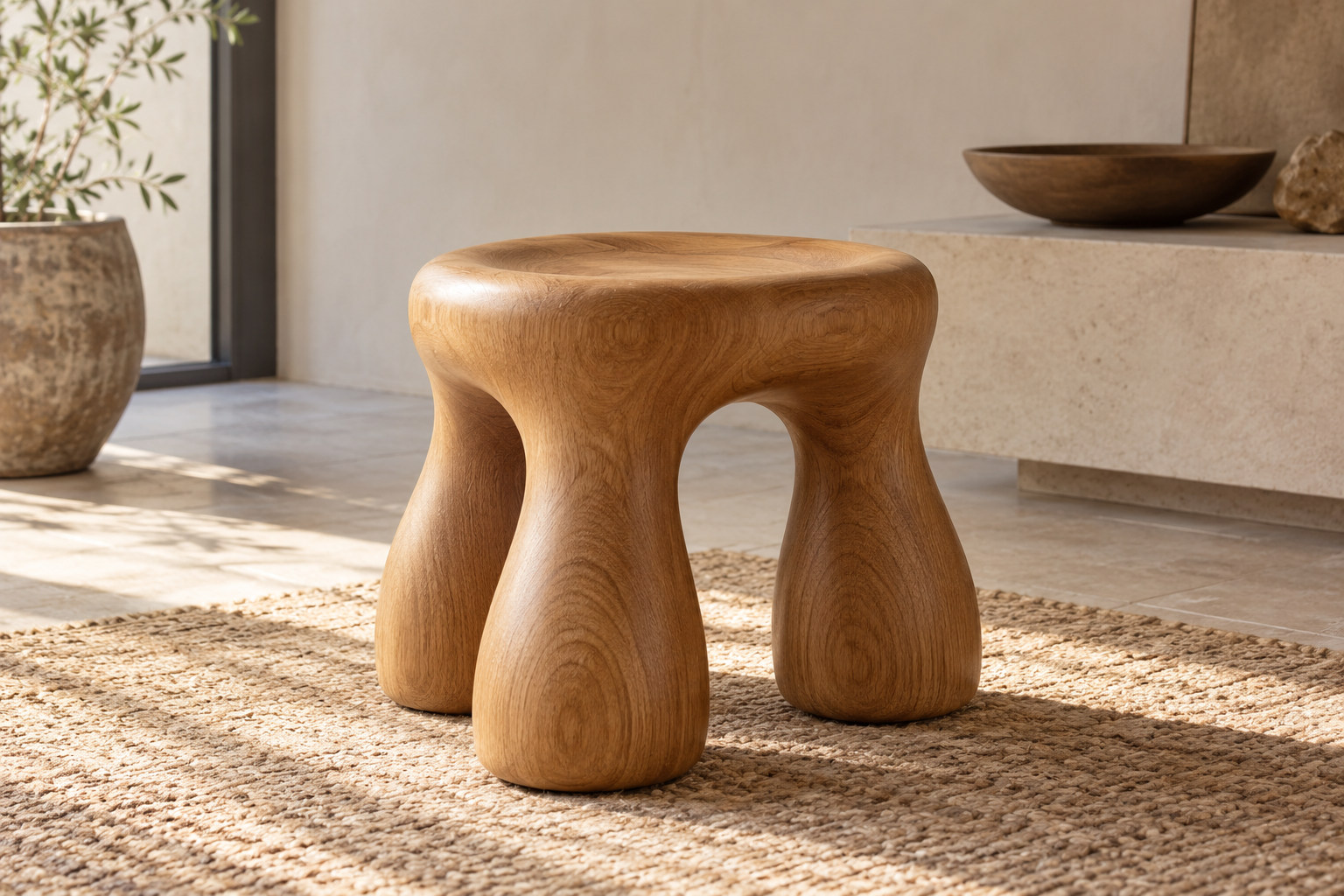
Wood begins to look muscular
A conventional stool often introduces itself in parts: a top, supports, perhaps a rail joining them. Tonus asks the eye to follow a continuous volume instead. Its bulges and narrower passages suggest tension and relaxation, even while the material remains wood.
Bakker’s studio identifies the 2011 wooden design as solid oak and gives a compact 540 × 360 × 340 mm specification. It also names Rutger Graas as producer. These fields bring a deliberately unusual form back into the concrete world of a material, dimensions and a maker.1
The muscular reading is useful because it describes a relationship between shapes. A broad volume seems to gather strength before it narrows.
A junction becomes a transition
With separate pieces, the eye can stop at a meeting: this rail ends here; that support begins there. A rounded transition encourages it to keep moving. The surface carries the change of direction without making the boundary its main event.
That changes how the stool occupies a room. It can be recognised as a small seat, but it also reads as a volume with its own posture. The spaces around and below it become part of understanding the mass.
Oak adds another layer to that reading. Its visible grain belongs to timber, while the outline invites comparison with a body. The interest lies in seeing both at once, without having to settle on only one association.
The designer does not erase the maker
Homo Faber’s account of the Tonus Family identifies Rutger Graas as the craftsperson and describes wax-finished oak stools with an animal-like, muscular impression. It separately credits the design to Bakker.2
That division is worth keeping visible. The continuity one sees in the object does not mean that conception and making are the same task. A highly particular surface still has to be realised in a particular material by someone with the necessary skill.
Particles Gallery’s catalogue lists wooden, bronze and urushi Tonus works separately. The recurring name therefore leads to a family of material decisions, rather than giving permission to describe every version as if it were identical.3
A small pause before sitting
Tonus offers a simple change in the way to look at furniture. Instead of counting the parts first, follow where the volume thickens, turns and thins. Then notice how the timber’s character remains visible through that movement.
The seat’s use is familiar. Its form makes recognition take a little longer, and that short pause gives the wood and the making room to be noticed.