Designer profile

Willem Hendrik Gispen: between the workshop and the series

A company name can become so familiar that the person behind it disappears. Willem Hendrik Gispen’s work is easier to understand when the founder, the workshop and the later business are kept in view together. A personal wooden commission and a tubular chair reveal different kinds of making within that history.

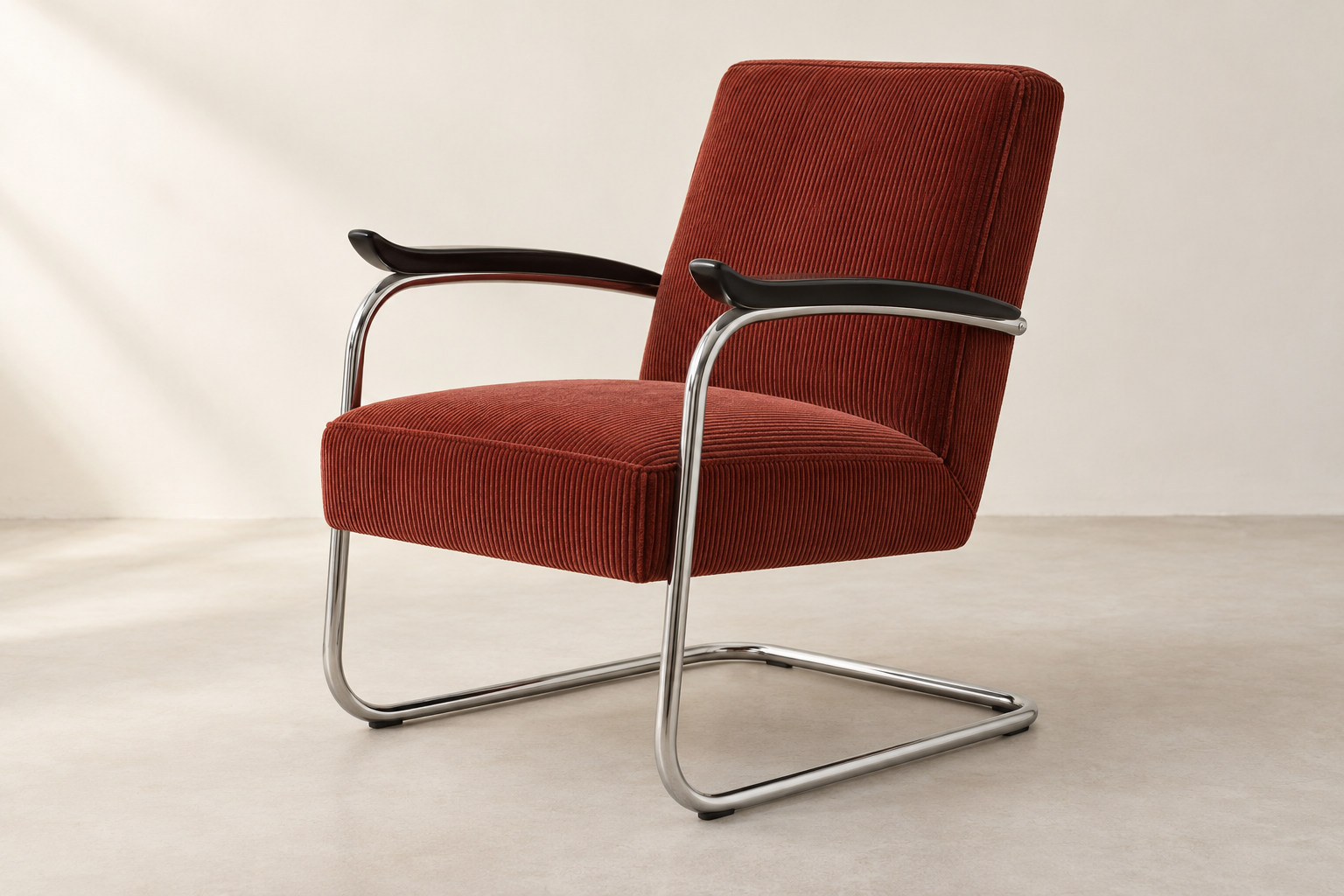
Editorial reconstruction of an upholstered armchair held by a bright tubular metal frame with an open cantilevered side.
PatinaHall editorial reconstruction. It is not a documentary photograph. The open metal outline and upholstered body explain different visual jobs. This invented chair is not a documentary example of model 412, its plating, upholstery or mechanical condition.
On this page
Key facts & takeaways

At a glance

Subject
Willem Hendrik Gispen
Entry
Designer profile
Last reviewed
23 October 2026

Three things to remember

  1. Gispen founded his metalworking business in 1916.
  2. His work included personal commissions as well as serial furniture.
  3. The heritage includes many designers and should not all be attributed to its founder.

A business is part of the design

Willem Hendrik Gispen's career connects individual objects with the business that could make them. His foundation records that he established Gispen & Co in Rotterdam in 1916 after work involving architectural drawing and decorative metalwork. The later tubular furniture grew within a practice concerned with materials, commissions and production.1

The factory is therefore part of the historical explanation. A design has to meet people, tools and an organisation before it can become a series of objects. The company name and the founder's authorship are related facts, but they are not interchangeable credits.

A wooden cradle complicates the shorthand

Museum Boijmans Van Beuningen records an oak cradle Gispen designed for his own children in 1918. Its conservation history describes dried glue, loose or missing components, and work to stabilise and clean the object.2

The cradle puts a particular household inside a career often introduced through industrial metal furniture. It also makes construction visible across time. A joint that once held has a later condition; keeping the object requires understanding that change rather than merely admiring its outline.

This is a documented individual commission. It should not become a convenient stand-in for the circumstances of every object the company produced.

A cradle-like wooden form and an open tubular chair stand in two separate fields.
Original PatinaHall schematic, not to scale. An individual wooden commission and a tubular production idea belong to different circumstances in one career. The objects here are symbolic outlines.

A series has several kinds of author

The Gispen heritage foundation preserves work by the founder and by later designers, including Wim Rietveld and André Cordemeyer. Its scope is the history of a company and its interiors, not a claim that its founder designed everything carrying the name. 3

That distinction changes how a chair is read. The model, designer, production business and particular surviving example each have their own identity. A good history keeps the connections between them without letting one familiar name absorb all the others.

Between a hand and a production run

The foundation identifies furniture and lighting among Gispen's important work. Across those objects, a component has to satisfy a particular use while belonging to a repeatable process. 1

Look again at a long armrest beside a thin metal tube. Each has a material, a shape and a job. The workshop and the production series meet at that small scale, where an industrial object still has to make sense to the person placing a hand on it.

Research notesEvidence, connections and limits

The founder, company and later designers are separate identities. The museum cradle is a documented individual commission, while the industrial furniture represents other production circumstances; neither stands for every product made by Gispen.

Evidence map

Connected subjects and evidence

Reviewed connections

  • Gispen 412designed byWillem Hendrik Gispendocumented

    The cited record identifies the designer of this design or coherent project family.

    Reviewed 23 October 2026 by PatinaHall editorial.
  • Willem Hendrik Gispencollaborated withGispendocumented

    The source documents the designer working with this organisation; it is not a national-origin or employment-date inference.

    Reviewed 23 October 2026 by PatinaHall editorial.
    • Source 1Willem Hendrik Gispen, 1890–1981

Research trail

Sources and further reading

  1. Willem Hendrik Gispen, 1890–1981Stichting Gispen CollectieAccessed 23 October 2026
  2. Conservering en restauratie: Wieg van W.H. GispenMuseum Boijmans Van BeuningenAccessed 23 October 2026
  3. Stichting Erfgoed GispenMijn GelderlandAccessed 23 October 2026
  4. 412, object V 1061 a (KN&V)Museum Boijmans Van BeuningenAccessed 23 October 2026

Last reviewed 23 October 2026. Found an error or a stronger primary source? Contact PatinaHall.