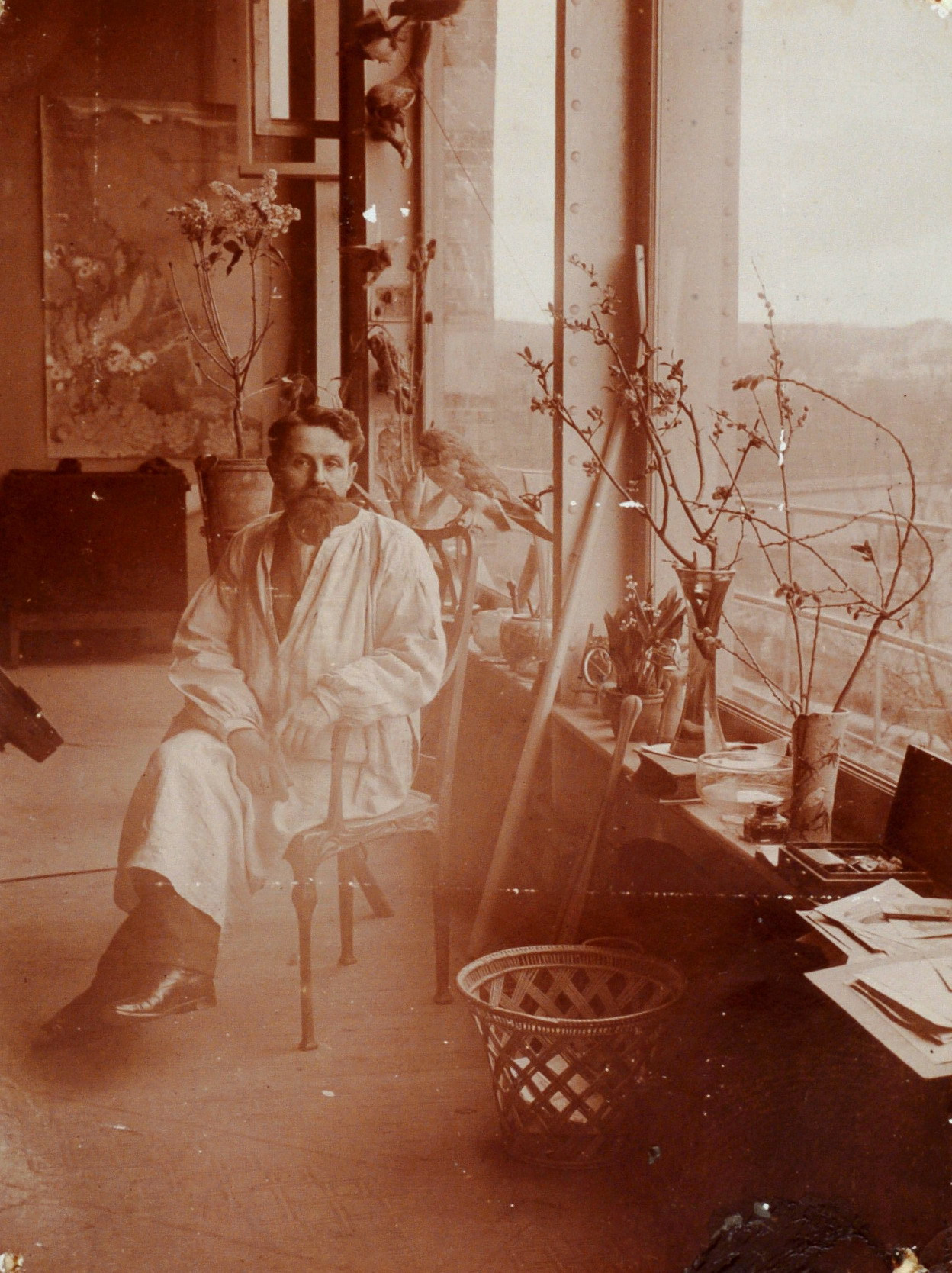
Branches beside the drawing board
The workshop photograph brings Majorelle into a room full of things to look at. Majorelle sits close to the window. Branches rise from containers beside him; larger arrangements and furniture occupy the room around him. The Musée de l’École de Nancy dates the image to 1899/1901 and identifies the setting as the factory’s decoration workshop on rue du Vieil Aître.4
We cannot recover a particular design session from this scene. We can see that looking at plants and making furniture were activities close enough to share a room. Nature was available at the scale of a twig as well as the scale of a tree.
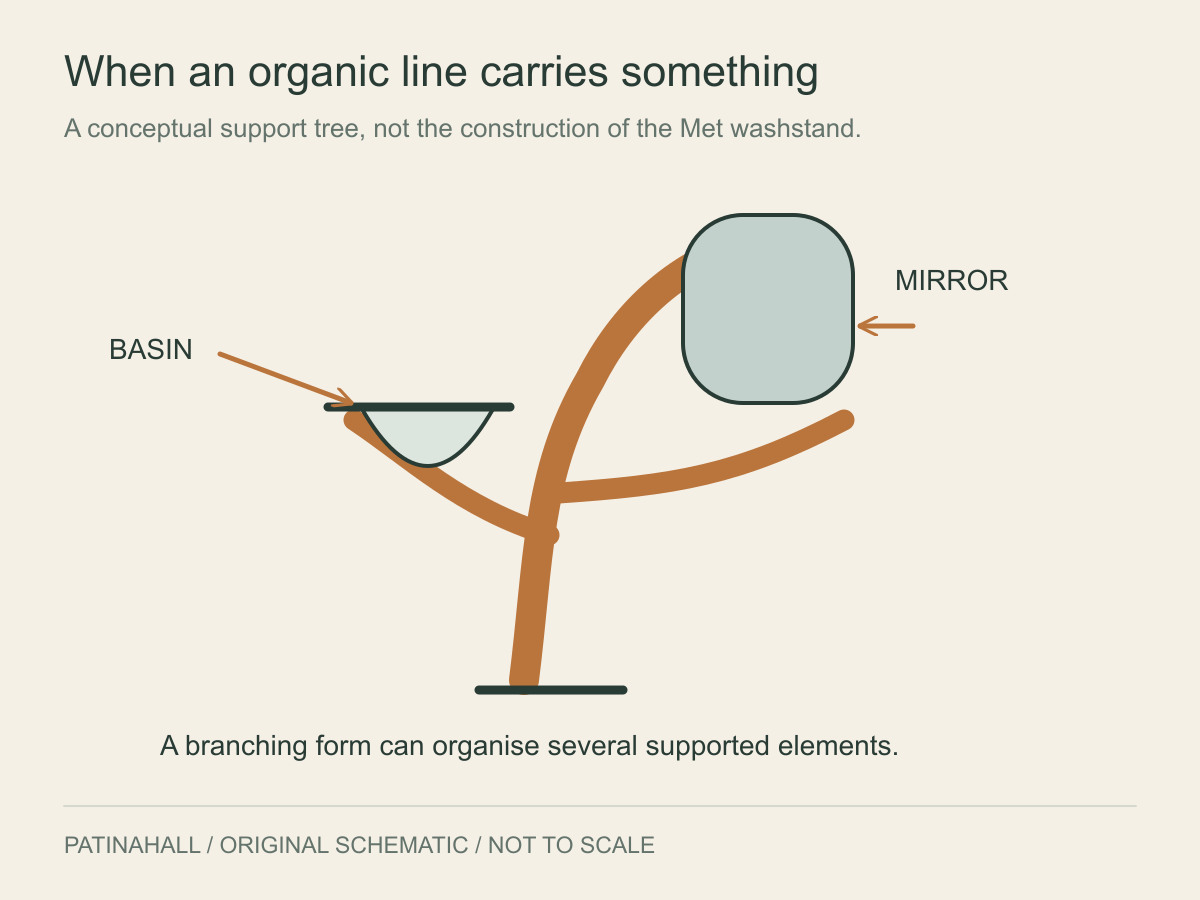
That distinction matters. A leaf can supply an outline for a fitting. A whole plant can suggest how several parts grow out of a common support. The second possibility changes the furniture’s form, not simply the pattern on its surface.
A tree with running water
The Met’s Dressing Table with Sink, made in 1900–1910, combines mahogany, ebony and oak with bronze, mirror glass, marble, ceramic and nickel-plated brass. The list tells us that this is more complicated than a wooden vanity with a mirror attached.1
The museum’s published account identifies a commission for the collector Eugène Corbin. It draws attention to the way the structure branches outwards from its lower mass, bringing modern plumbing into an organic composition. Leaf-and-berry handles supply a smaller scale of natural reference.2
There is a pleasing tension here. Running water belongs to a modern domestic system; the furniture surrounding it borrows the appearance of growth. The basin, mirror and working surface still need support and connection. Majorelle made those requirements part of a strong visual form.
The result asks us to follow an object in two directions: downwards, to understand what carries what, and outwards, to see how one element opens into another.
Where one workshop met another
A lamp in the same museum offers a different combination. Its record names both Louis Majorelle and Daum Frères and lists glass, iron and gold leaf. The object brings a glassmaking concern into the furniture designer’s world.3
Joint credit is not a footnote to the object’s success. It explains how the effect could be made. Metal can establish a narrow supporting line; glass can spread, colour or soften the light around it. Their different capacities are what make the collaboration interesting.
The same lesson applies to an elaborate piece of furniture. A single name on a museum label can gather together a design and the work of many specialised hands. Looking only for the designer’s personal touch can hide that larger achievement.
Follow the line until it has a job
The workshop photograph invites a useful experiment in looking. Find a natural shape, then ask what it becomes when it enters a piece of furniture. Is it an image, a handle, a joint or a support?
Majorelle’s strongest transformations make the answer visible. The curve is doing something. The tree-like dressing table still has to hold a basin and a mirror, and that obligation gives its branching form a reason to exist.