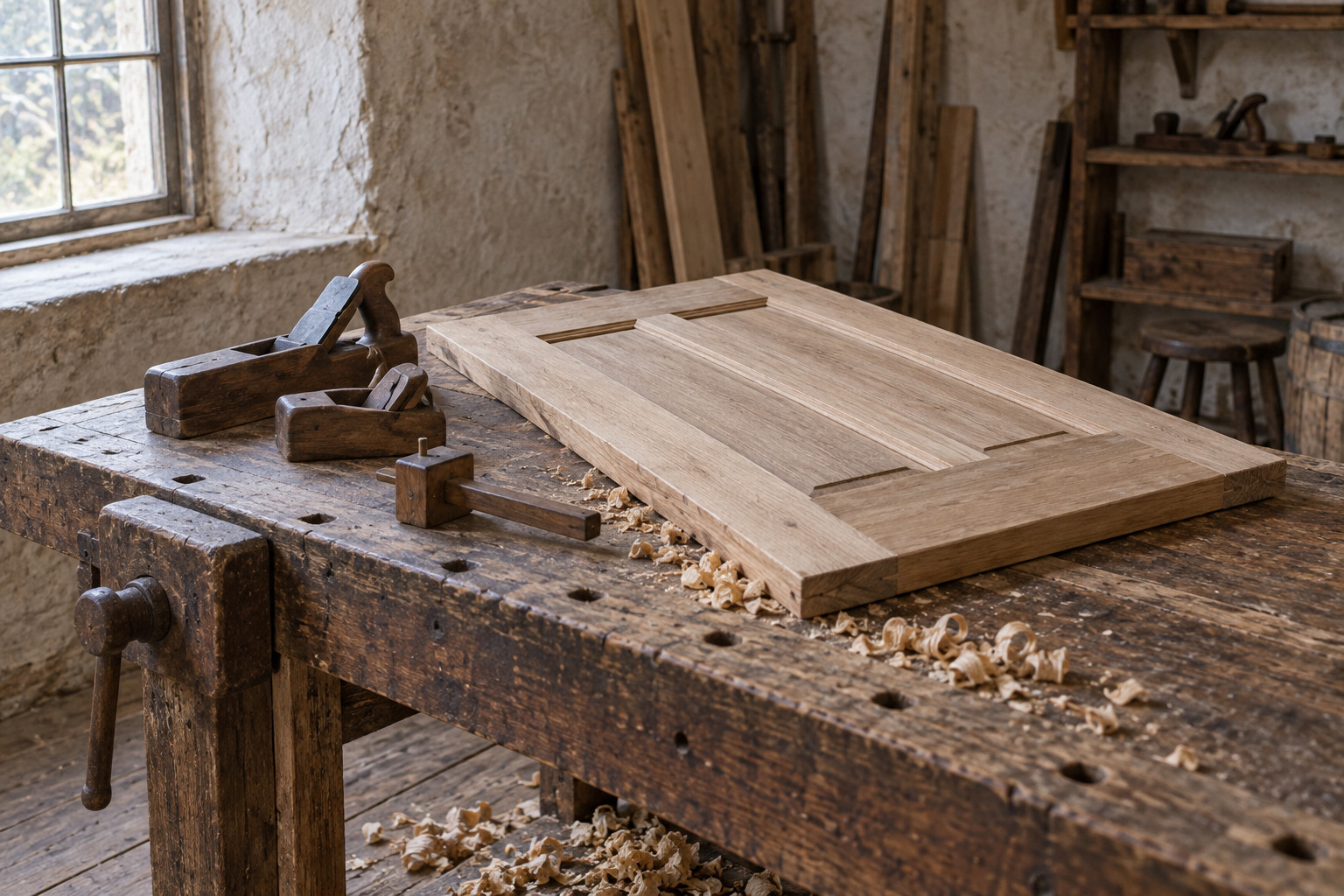
Furniture and architecture shared a bench
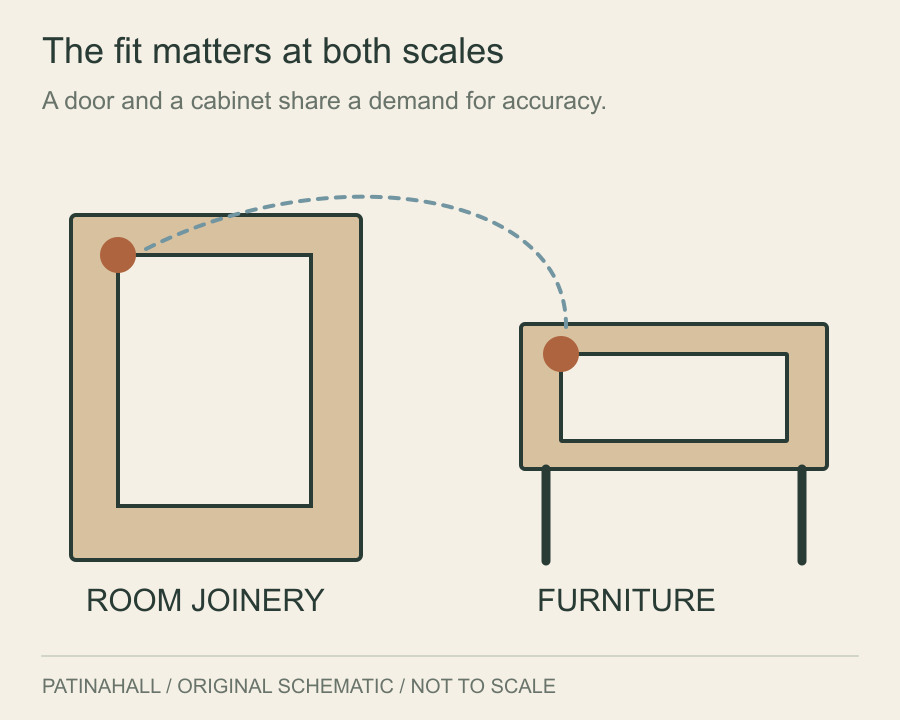
A door that closes neatly and a drawer that runs smoothly demand related kinds of attention. Parts must fit. Surfaces must be worked accurately. A small error at the bench may become a daily irritation in the room.
Monticello’s joinery produced architectural fittings as well as furniture. The Foundation distinguishes this work from rougher building carpentry and records a workshop involving both free and enslaved craftspeople. Doors, windows and cornices belonged to the same working world as cabinets and tables.2
Hemmings entered that world through training. After earlier work as an out-carpenter, he apprenticed in the joinery at seventeen and developed his skills alongside the Irish-born joiner James Dinsmore. By 1809 he was leading the shop. His work also extended to the interior woodwork at Poplar Forest.1
A letter brings the work back into view
In August 1825, Hemmings wrote from Poplar Forest to Septimia Anne Randolph. His letter concerns the terrace, its dimensions, gutters and the problem of obtaining materials from a distance. The finished building had not yet become a seamless whole; it was still a sequence of tasks and dependencies.3
That practical voice matters. It puts a named worker into the account as someone describing the work, rather than appearing only as a name attached to somebody else’s possessions. A measurement or a delayed delivery may seem less dramatic than a masterpiece. Both tell us that construction was organised by people making decisions in particular circumstances.
The letter cannot tell us everything he thought. It does let us hear what he chose to report about the job in front of him.
The desk that did not survive
One of Hemmings’s recorded pieces was a lap desk made for Ellen Wayles Randolph Coolidge. It was lost in a shipwreck while being sent to her in 1825. Jefferson subsequently gave her the portable desk associated with the writing of the Declaration of Independence.4
These were two different objects, made by different people. The surviving 1776 desk was the work of Benjamin Randolph. Hemmings’s gift does not become that famous object simply because the two are connected by a family story.
The loss also exposes a limit of furniture history. Surviving objects are only a portion of the work once made. Correspondence can preserve a commission even when there is no cabinet or writing surface left to photograph.
A name changes the room
Hemmings was freed under Jefferson’s will in 1826. His earlier expertise had been developed and exercised while he was enslaved; skill and responsibility did not remove that condition.1
Knowing his name changes the way a polished interior can be read. A fitted panel becomes evidence of labour, training and judgement. The room still has an owner’s history, but it also has a maker’s history, and the second deserves to remain visible.