The bands tell you where the surface turns
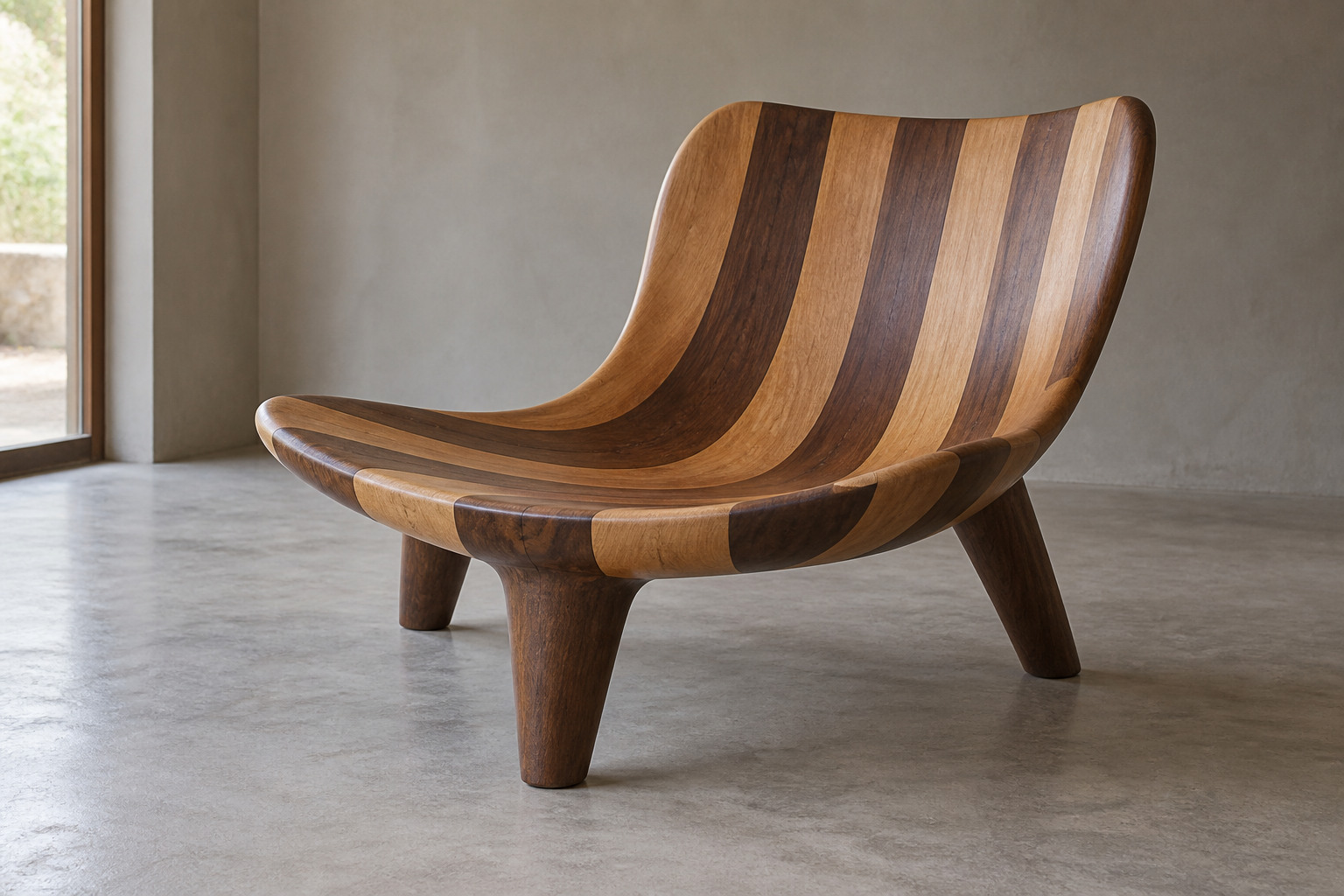
The chair is low and broad. Its seat gathers the body while the back opens out above it. Three supports lift the wooden form clear of the floor, leaving air beneath the mass.
At LACMA, the recorded materials are pau marfim and angelim pedra. Their contrasting tones make the successive strips easy to follow. The eye reads each change of direction through the bands, rather as contour lines help explain a landscape.1
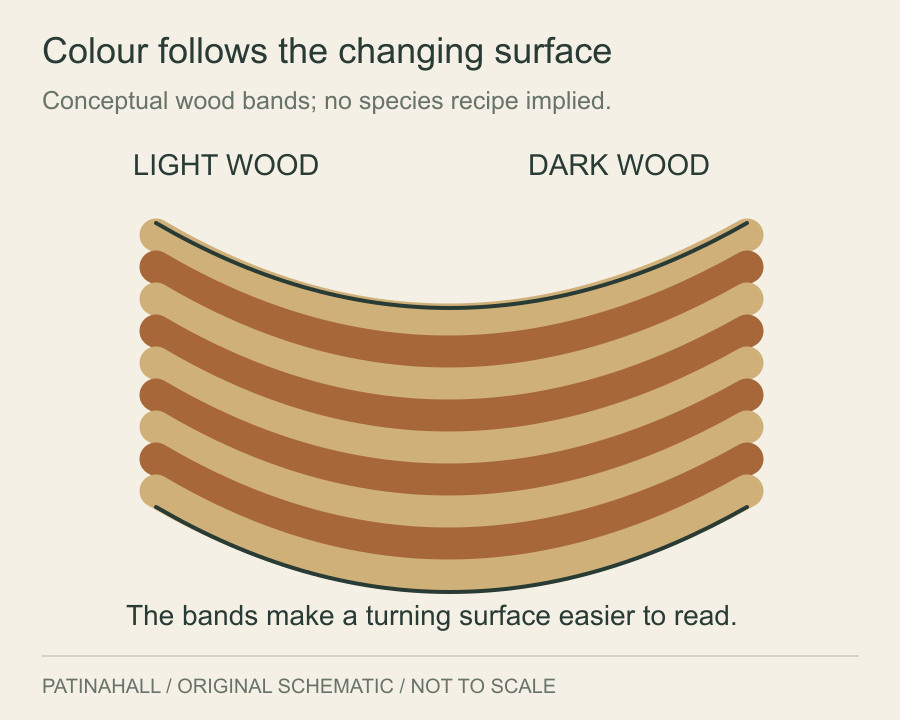
This is a useful distinction between decoration and construction. The colours please us, but they also show what the chair is doing. A curve that might be hard to judge in one dark material becomes visible through the repeated changes of tone.
A family of chairs, not one recipe
Tenreiro developed the Three-legged Chair around 1947. Surviving examples need not have precisely the same palette. Carpenters Workshop Gallery describes versions using between two and five woods; its five-wood example combines imbuia, peroba, pau-marfim, roxinho and mogno.
The gallery’s account draws attention to the difficulty of shaping dense hardwoods and bringing the contrasting strips into the final form. That is a long way from simply painting stripes on a finished chair. Colour, workmanship and geometry have to be considered together.2
The variation is part of the pleasure of looking. One example may read through a strong light-dark contrast; another offers a more complicated rhythm. The recognisable design survives those differences because its proportions and continuous wooden surface hold the composition together.
The skills were already there
Tenreiro grew up in a family of carpenters in Portugal and later established his working life in Rio de Janeiro. Casa Zalszupin’s curatorial account connects his craft training with technical drawing, artistic study and employment in furniture companies producing historical styles.
The modern work did not appear because he had forgotten those skills. It gave them a different direction. The same account identifies Poltrona Leve, from 1942, as a turning point in his own understanding of his furniture practice.3
That background helps explain why the Three-legged Chair can feel both carefully worked and unusually free. The shape asks a great deal of the material, yet the surface lets the effort recede into a clear visual idea.
When the furniture leaves the floor
From the end of the 1960s, Tenreiro devoted himself more fully to art. His reliefs brought repeated elements, colour, open spaces and shadows into compositions on the wall. Casa Zalszupin’s exhibition placed these works alongside the furniture, inviting a conversation between them.3
Return to the chair after looking at a relief and the stripes feel different. They are no longer merely a handsome choice of timber. They are one way an artist-maker made repetition produce movement—and persuaded a substantial wooden object to seem almost buoyant.