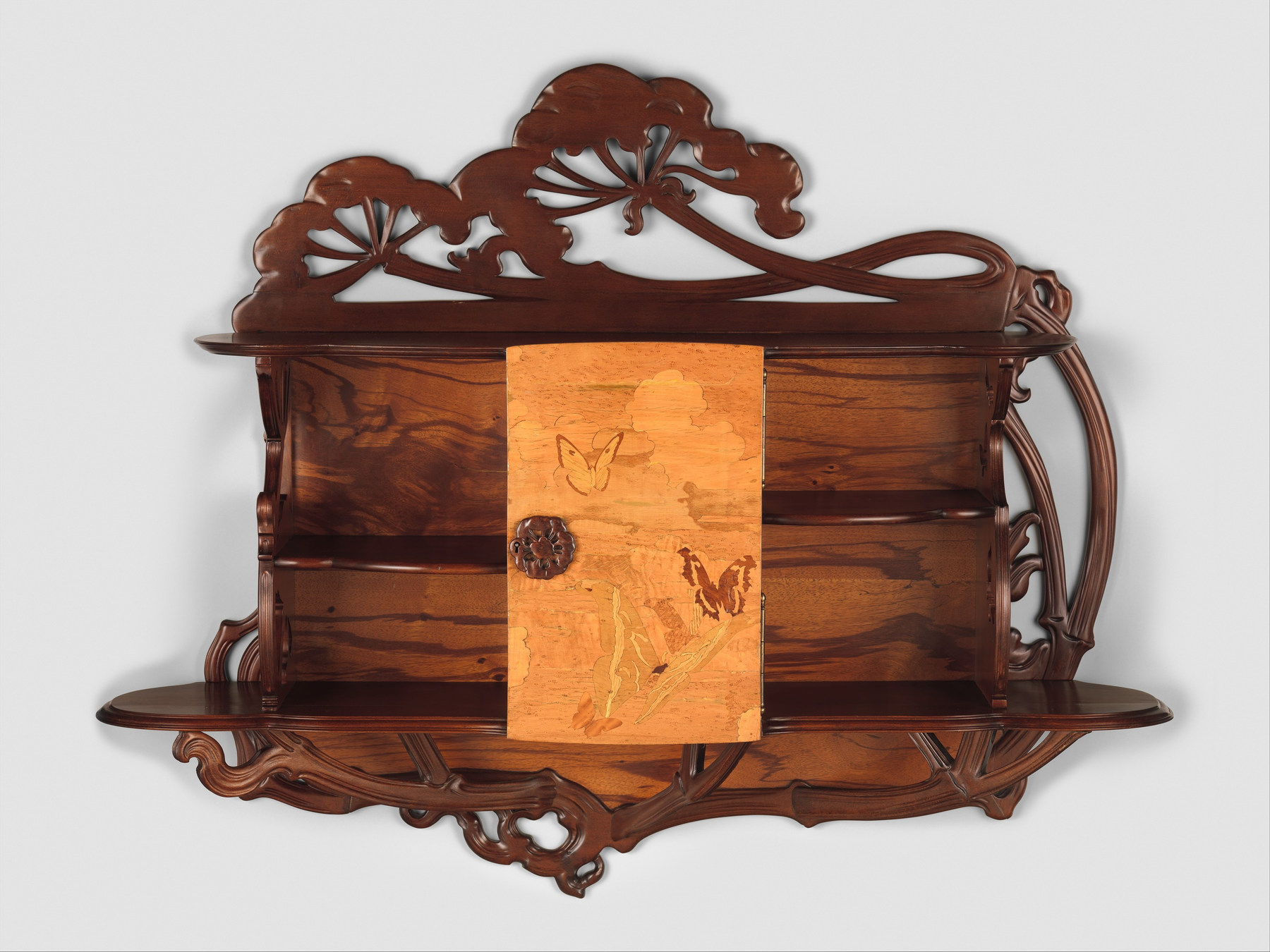
A plant can stay flat or enter the outline
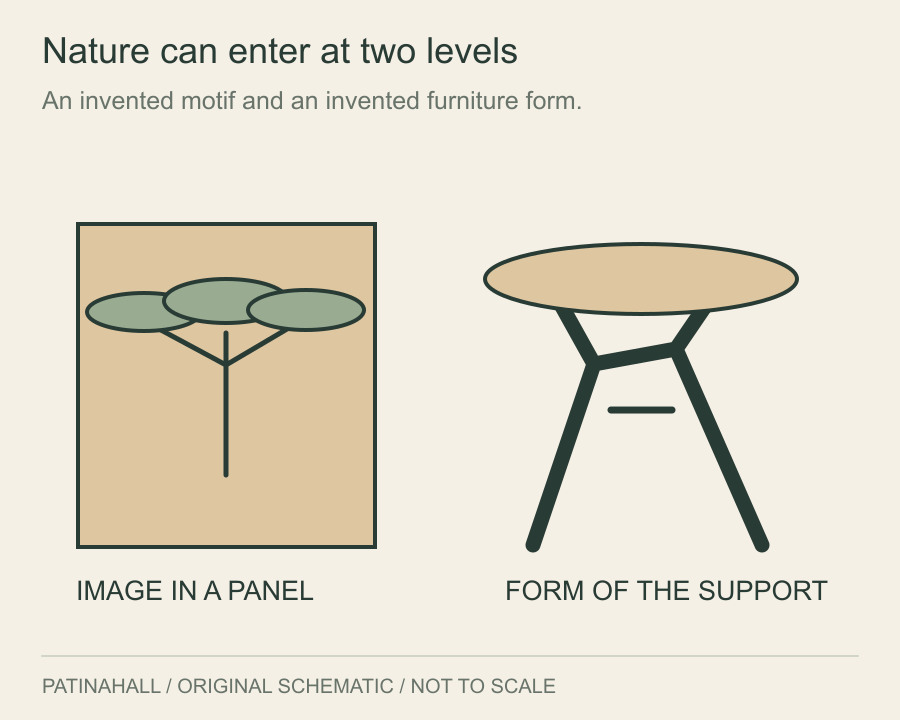
There is a useful difference between putting a flower on a cabinet and allowing a plant to influence the cabinet’s shape. The first can leave the underlying box unchanged. The second begins to alter the edges, supports and spaces between parts.
The Musée de l’École de Nancy describes both tendencies in Gallé’s furniture: natural subjects in marquetry and nature informing the forms themselves. Its wider collection places these experiments among interiors designed for dining, sleeping, reading and work.2
The distinction gives the eye a simple task. First locate the botanical image. Then follow the surrounding woodwork and ask where the plant’s line continues beyond the picture.
The cabinet carries more than one kind of wood
The Met’s Ombellifères cabinet, dated around 1900, has a beech case and carved elements. Its recorded materials also include zebrano veneer and several woods in the door decoration, among them maple, chestnut, satinwood and walnut.1
Those differences make a picture possible without relying solely on paint. A pale piece can stand out against a dark neighbour; grain can add direction within the chosen outline. The wood supplies both the material of the furniture and part of the image on its face.
Look closely at the boundary of a stem or leaf. The shape belongs to the maker’s arrangement, while variations within it come from the material. Neither works entirely alone.
The stem becomes a way of thinking about support
The Nancy museum’s educational study describes a Gallé stand of 1902–03 with two levels and four supports shaped around the idea of an umbel. The spreading plant form helps organise the relationship between upright members and broader horizontal surfaces.3
This is a different use of nature from a flat floral panel. A stem branches; a piece of furniture must connect narrow supports to a wider top. The analogy gives the designer a family of lines and junctions to investigate.
It does not mean a wooden cabinet works exactly like a living plant. The interest lies in how observation can offer another way to draw the meeting between parts.
A room could become botanical without becoming a garden
Gallé was one participant in a wider Nancy furniture culture. The museum distinguishes his work from that of Majorelle, Vallin and other makers, and notes how naturalistic furniture also reached more modest customers through catalogues.2
The range matters because there was no single formula for bringing nature indoors. One maker might concentrate on a decorated panel, another on a curving frame or a coordinated room.
With Gallé, start at the smallest visible leaf and follow its direction outward. At some point, the image and the furniture begin to share a line. That is where the botanical subject becomes especially rewarding to look at.