Designer profile

Eileen Gray: making space for a private life

A screen can divide a room without deciding its future permanently. Eileen Gray’s lacquered blocks turn on slender rods, changing what can be seen through them. That adjustable boundary leads into her interiors, where privacy and companionship could exist only a few steps apart.

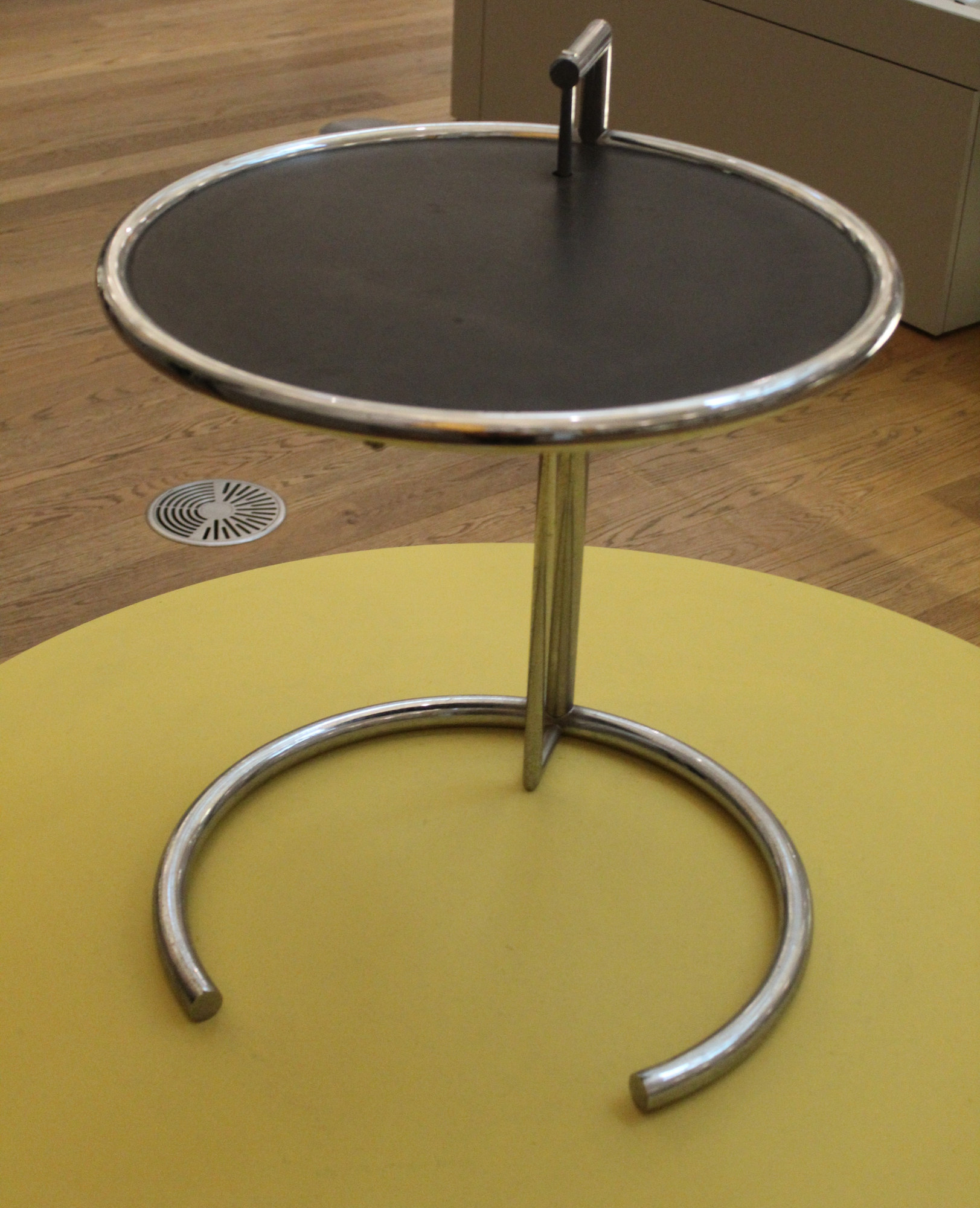
A later E-1027 Adjustable Table with a dark circular top, chrome tubular frame, open ring base and offset height-adjustment upright.
A later Aram-manufactured E-1027 table at Manchester Art Gallery, not Gray's original house object. Photograph by 14GTR, CC0.
On this page
Key facts & takeaways

At a glance

Subject
Eileen Gray
Entry
Designer profile
Last reviewed
11 September 2026

Three things to remember

  1. Turning a screen panel changes both the view and the boundary.
  2. Gray’s lacquer work developed through sustained craft training.
  3. E-1027 combines shared space with carefully arranged private routines.

A wall that can admit a glimpse

The blocks in Gray’s screen do not form an ordinary solid wall. Seven horizontal rows are threaded onto thin vertical rods. Individual panels can pivot, letting darkness, reflection and glimpses of the space beyond enter the composition.

MoMA dates its example to 1922 and relates it to a larger screen developed for Suzanne Talbot’s apartment, commissioned by Juliette Mathieu-Lévy. It is furniture that occupies space like architecture while retaining the possibility of movement.1

Imagine its effect beside a chair. Turn some panels towards the light and their surfaces become more prominent. Turn them away and the gaps matter more. The person on the other side has not moved, yet the relationship between the two places has changed.
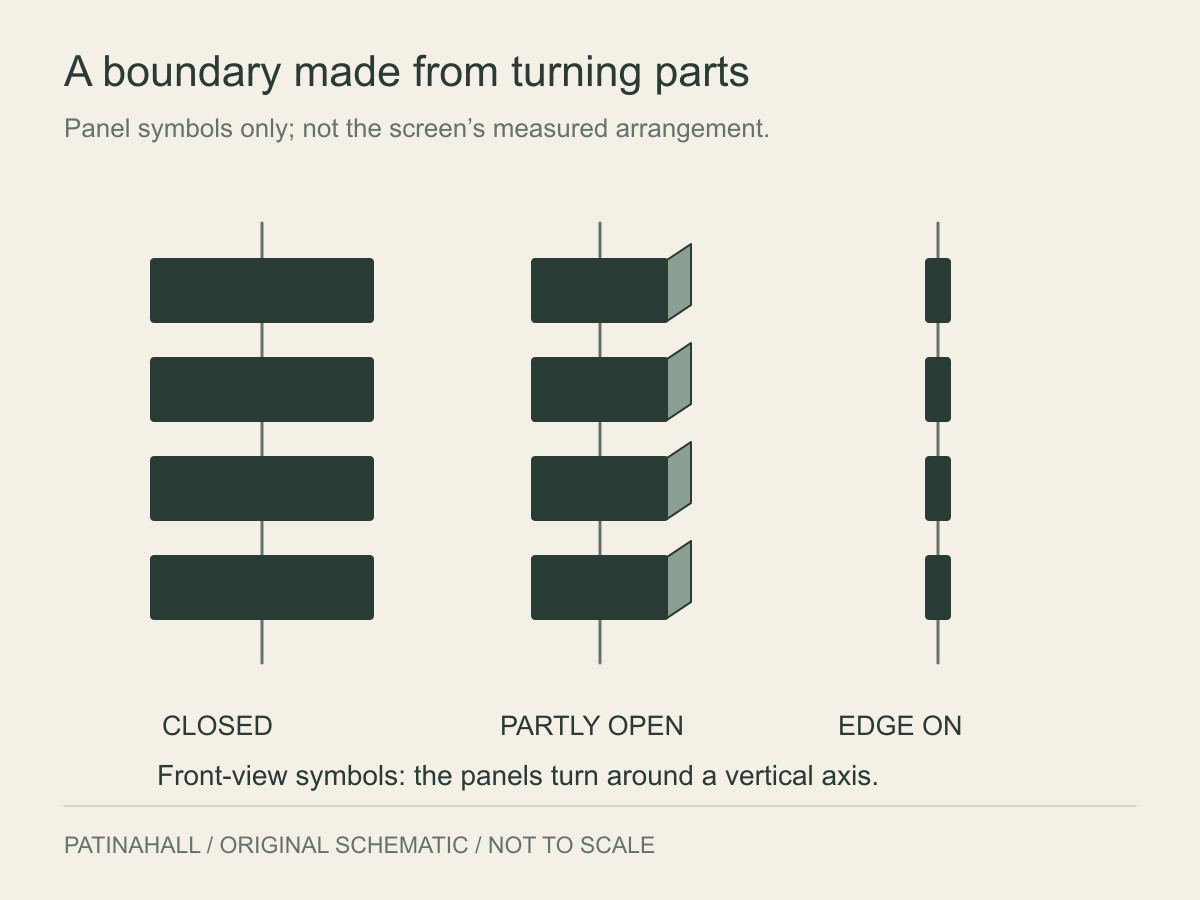
Three front-view panel symbols show broad closed faces becoming narrower as they turn around vertical rods.
Original PatinaHall schematic, not to scale: turning a panel changes how much of its face and the space beyond can be seen. The drawing simplifies the screen’s arrangement.

Learning what a surface could do

The screen’s lacquer is central to that effect. It gives each block a dark, concentrated presence, making the small interruptions between them particularly noticeable. The precision of the finish belongs to a long process of learning and making.

The V&A records Gray studying with the Japanese lacquer worker Seizo Sugawara in Paris by 1906. That training preceded the opening of her gallery in 1922. Her later move towards tubular metal and architectural interiors did not begin with an indifference to craft; it followed close involvement with demanding surface work.2

This makes the familiar division between luxurious early furniture and austere modern furniture less satisfying. Both can require exact attention to the way a hand, an eye or a body meets an object. The materials change, but small decisions continue to matter.

The house makes room for withdrawal

At Villa E-1027, designed with Jean Badovici and built in 1927–29, Gray considered how ordinary activities could coexist within a compact home. The Cap Moderne account describes direct outdoor access from bedrooms, adaptable furnishings and carefully concealed service functions, including a shower screened within the living area.3

A shared room has to accommodate more than a collective photograph. Someone may want to read while another person moves through it. A guest needs a place to sleep and a degree of independence. A small surface close to a chair can save a journey across the room.

Seen in this context, the adjustable table in the opening photograph belongs to a larger way of thinking. The useful object approaches the person, while partitions and routes help people avoid being continually exposed to one another.

Privacy is something a room does

A floor plan can label a space private without making it pleasant to inhabit. A view through a doorway, a route to the outside or the position of a movable screen can make a greater difference than the label.

Gray’s work gives those modest decisions physical form. Return to the screen and turn one block in your imagination. The room remains the same size. What it allows its occupants to do has changed.

Research notesEvidence, connections and limits

MoMA’s 1922 screen and the earlier apartment version are distinct objects. The E-1027 account concerns Gray and Jean Badovici’s 1927–29 villa; surviving and restored furnishings should not all be treated as untouched originals.

Evidence map

Connected subjects and evidence

Reviewed connections

  • Adjustable Table E-1027designed byEileen Graydocumented

    MoMA and Bilbao Museoa identify Eileen Gray as the designer of Adjustable Table E-1027.

    Reviewed 28 August 2026 by PatinaHall editorial.
  • Eileen Gray block screendesigned byEileen Graydocumented

    The design is represented by the 1922 screen; not a claim about the manufacture date of later licensed screens.

    Reviewed 11 September 2026 by PatinaHall editorial.
    • Source 1Object record and collection label
  • Eileen Graycollaborated withSeizo Sugawaradocumented

    V&A records Gray’s training with lacquer craftsman Sugawara by 1906.

    Reviewed 11 September 2026 by PatinaHall editorial.

Research trail

Sources and further reading

  1. Screen, 1922, 476.1978Museum of Modern ArtAccessed 11 September 2026
  2. Eileen Gray: avant-garde designerVictoria and Albert MuseumAccessed 11 September 2026
  3. Cap Moderne: press dossier, April 2015Cap ModerneAccessed 11 September 2026
  4. Eileen Gray. Adjustable Table. Designed 1927 (this example 1976)The Museum of Modern ArtAccessed 28 August 2026
  5. Adjustable Table E1027Bilbao MuseoaAccessed 28 August 2026
  6. E1027 table by Eileen Gray, Manchester Art Gallery 01Wikimedia CommonsAccessed 28 August 2026

Last reviewed 11 September 2026. Found an error or a stronger primary source? Contact PatinaHall.