The missing piece does the work
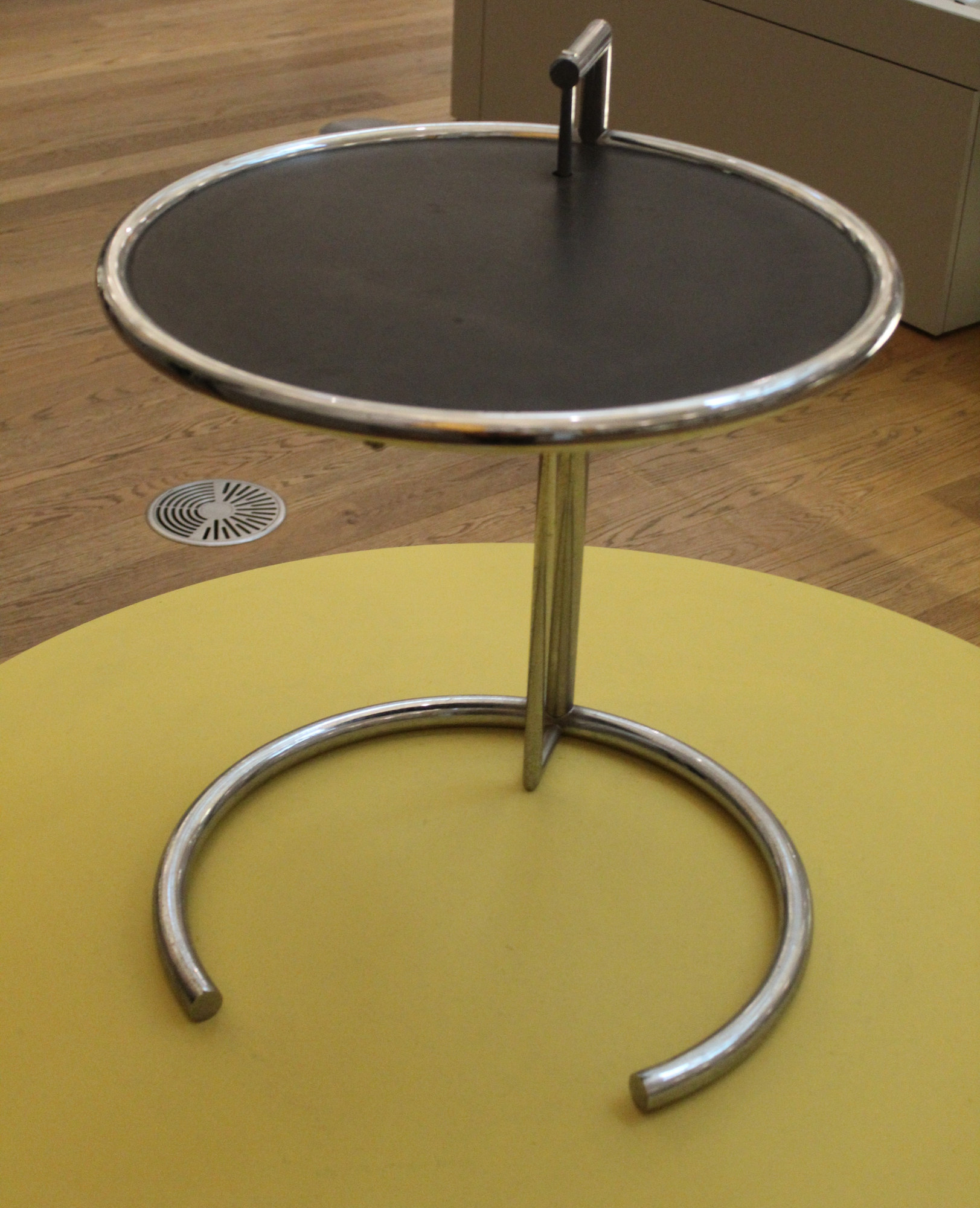
The most useful part of Eileen Gray's circular table is the part that is not there. Its tubular base almost closes into a ring, then stops. That opening allows the base to move under a bed instead of colliding with it, while the top advances over the mattress and towards the person using it. A complete circle might look tidier. It would also be considerably less cooperative.
This was not an abstract possibility invented after the table became famous. MoMA's Gray catalogue reproduces the table in the guest bedroom at Villa E-1027 and explains that it could slide under the bed, with the top adjusted for breakfast there. Bilbao Museoa describes the same design as usable while seated, as a side table or beside a bed.3 2
The gap therefore changes the table's relationship to other furniture. Four legs would reserve four points on the floor. A closed pedestal would claim a solid centre. Gray's open ring occupies a stable arc but leaves an entrance. The table does not ask the body to come to it; it finds a route towards the body.
Height is part of the design
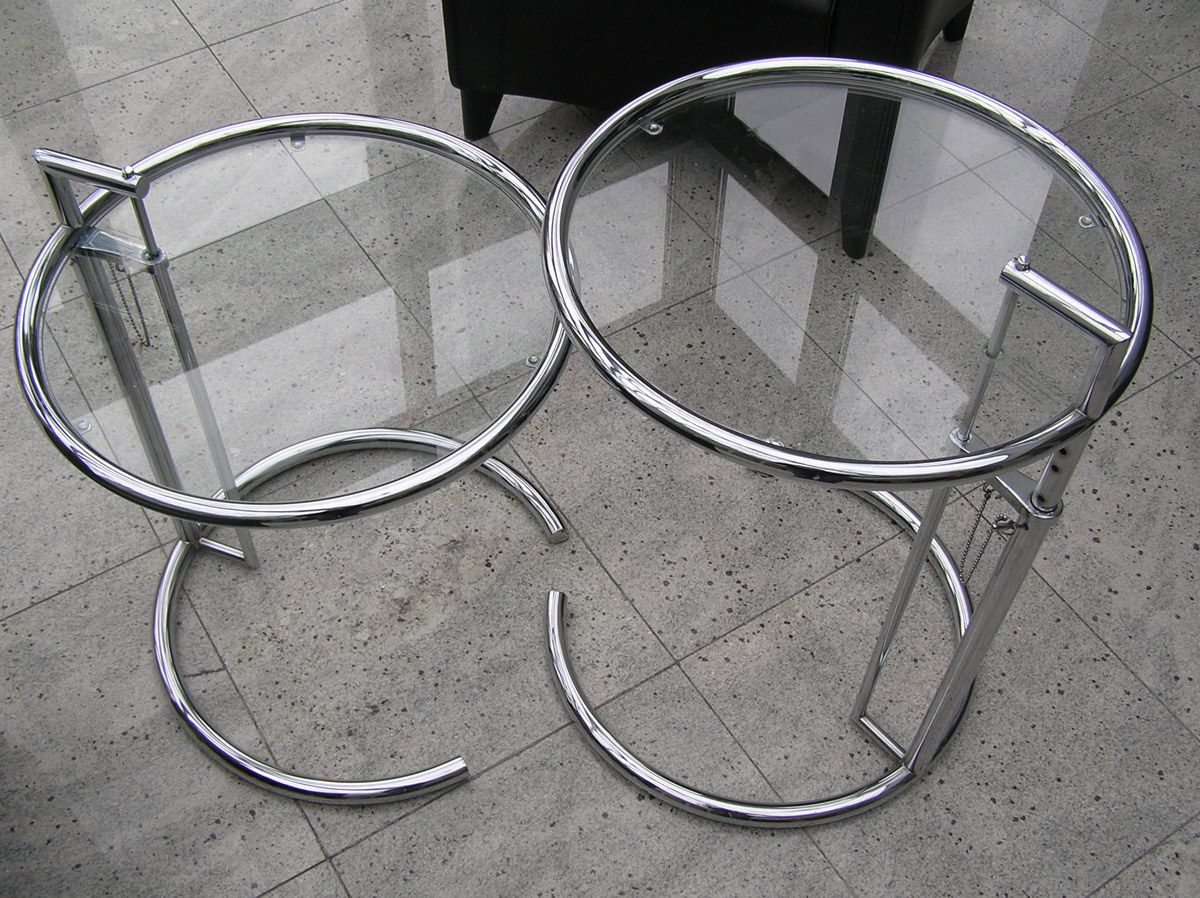
Approach solves only half the problem. Beds, armchairs and upright seats put people at different heights, so the surface must also move vertically. Bilbao's object account describes two telescopic axles: one passes through the top, while a thicker one sits outside its circular frame. A line of holes and a small metal pin set the chosen height. The chain keeps that pin attached, which is an admirably practical response to the long history of tiny useful things wandering off.2
Nothing is disguised. The paired uprights, holes, pin and chain remain part of the silhouette. The table looks mechanical because it is mechanical. Its shining frame is not merely the visual shorthand of the machine age; it contains the actual adjustment.
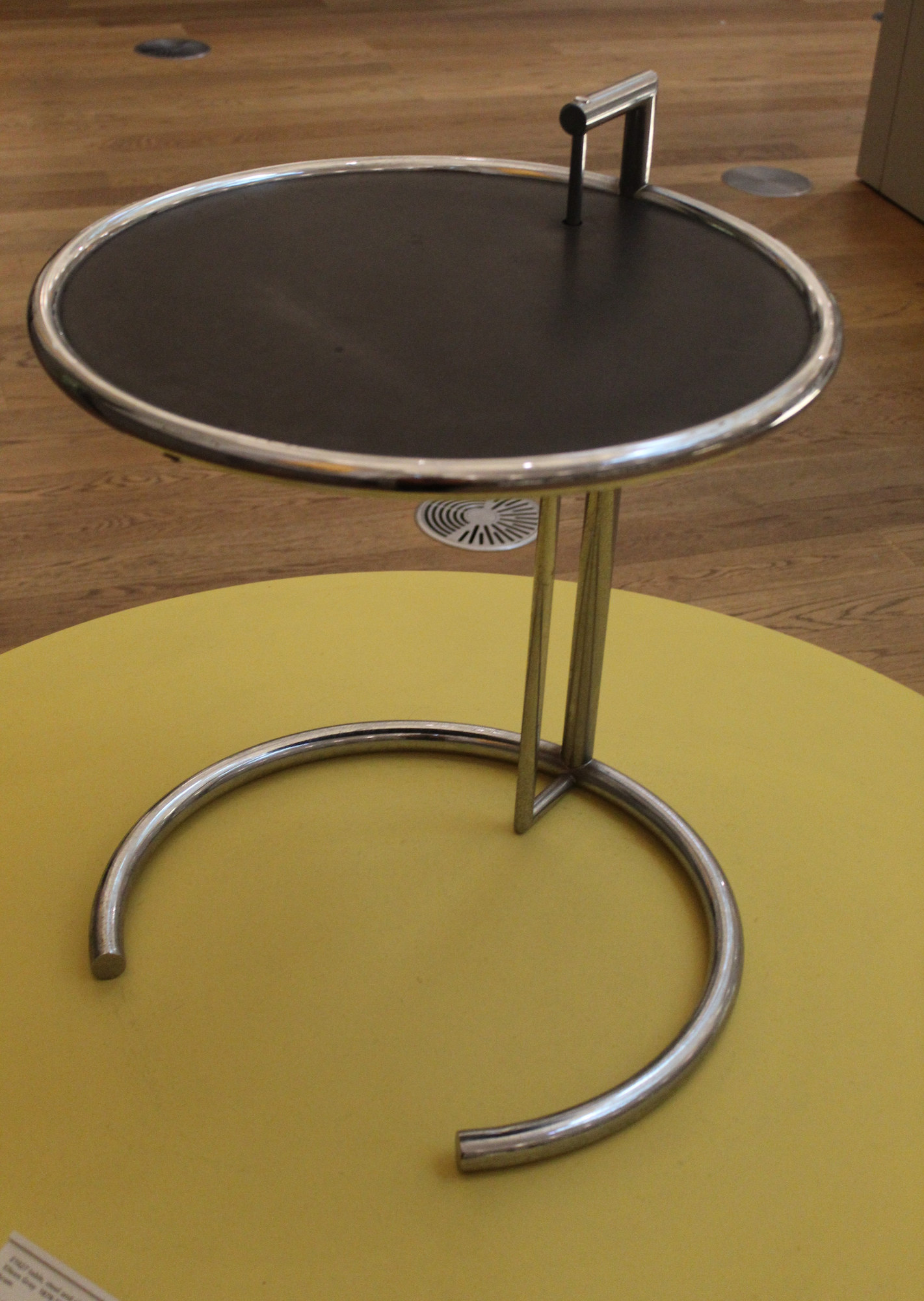
MoMA records a range from 54 to 93 centimetres for its own example, made by Aram Designs in 1976. That large range helps explain how substantially the surface can change position, but it belongs to that recorded object and should not be treated as a specification for every version ever made. 1
A table designed with a room
Gray designed the table in 1927 for E-1027, the compact seaside house she created with Jean Badovici at Roquebrune-Cap-Martin. Cap Moderne describes a house in which fixed and mobile furnishings accompany particular activities: storage is fitted into limited space, a reading surface can swing away and the circular bedside table changes height by its small chain. 4
That context matters because the table is often isolated against a white background, where it can look like a perfect steel-and-glass emblem. In the room, its purpose is less ceremonial. It negotiates between floor, mattress, chair and hand. The circular top avoids a projecting corner near the bed; the open base finds space below; the upright changes reach above.
Gray was not making a miniature building and then placing it inside a larger one. She was resolving the untidy junctions that architecture leaves behind: the last half-metre between a reclining person and a cup, book or plate.
Steel that behaves like a line
Chrome-plated tubular steel gives that negotiation a clear outline. The tube curves into the base, rises in paired verticals and circles the top without becoming a heavy mass. Glass in many later examples allows the mechanism and floor to remain visible through the surface. MoMA lists chrome-plated tubular steel, sheet steel and glass for its 1976 table; Bilbao records steel and glass for its museum example.1 2
The geometry is easy to remember: circle, gap, two uprights, another circle. Yet each shape has work to do. The lower arc stabilises. The absent segment admits an obstruction. The uprights guide vertical movement. The upper ring protects and supports the top. Reduction here does not mean removing function; it means making several functions legible with very few parts.
The design is older than the tables in these photographs
The three photographs on this page show later manufactured examples. They are useful because the open base, offset supports and adjustment frame can be seen clearly, but none is presented as the table that stood in Villa E-1027 in the late 1920s. MoMA makes the same distinction explicit in its collection record: the design is dated 1927, while its particular Aram Designs example dates to 1976.1
This is not a footnote to the story. Repeatable furniture lives on two clocks. The design records the durable arrangement of parts and intentions. Each physical table records a manufacture date, maker, materials, condition and life of its own. A familiar gap and circular top can suggest the E-1027 design; they cannot by themselves prove when or by whom an example was made.
What the gap teaches
The Adjustable Table endures because its formal trick and its practical trick are the same. The incomplete circle is instantly recognisable, but it is not a logo applied to an ordinary side table. It is the means by which the table moves closer. The visible mechanism gives the object character, but it is also the means by which the surface changes height.
Gray made flexibility tangible. Instead of asking one fixed table to suit an ideal posture, she allowed furniture to acknowledge that people sit, recline, read, eat and reach from different positions. Nearly a century later, the little table still offers a useful design lesson: sometimes the decisive feature is not another component. It is a carefully chosen absence.


