A window is part of the loom
A blind has an awkward job. Close it completely and the room loses the daylight you wanted; leave it open and the window may become a sheet of glare. Dorothy Liebes approached that problem through the weave itself. Reeds, coloured yarn and reflective strips could make a screen with depth, texture and carefully distributed openings. Cooper Hewitt describes her woven blinds as a way to modulate light while preserving a connection to the view.1
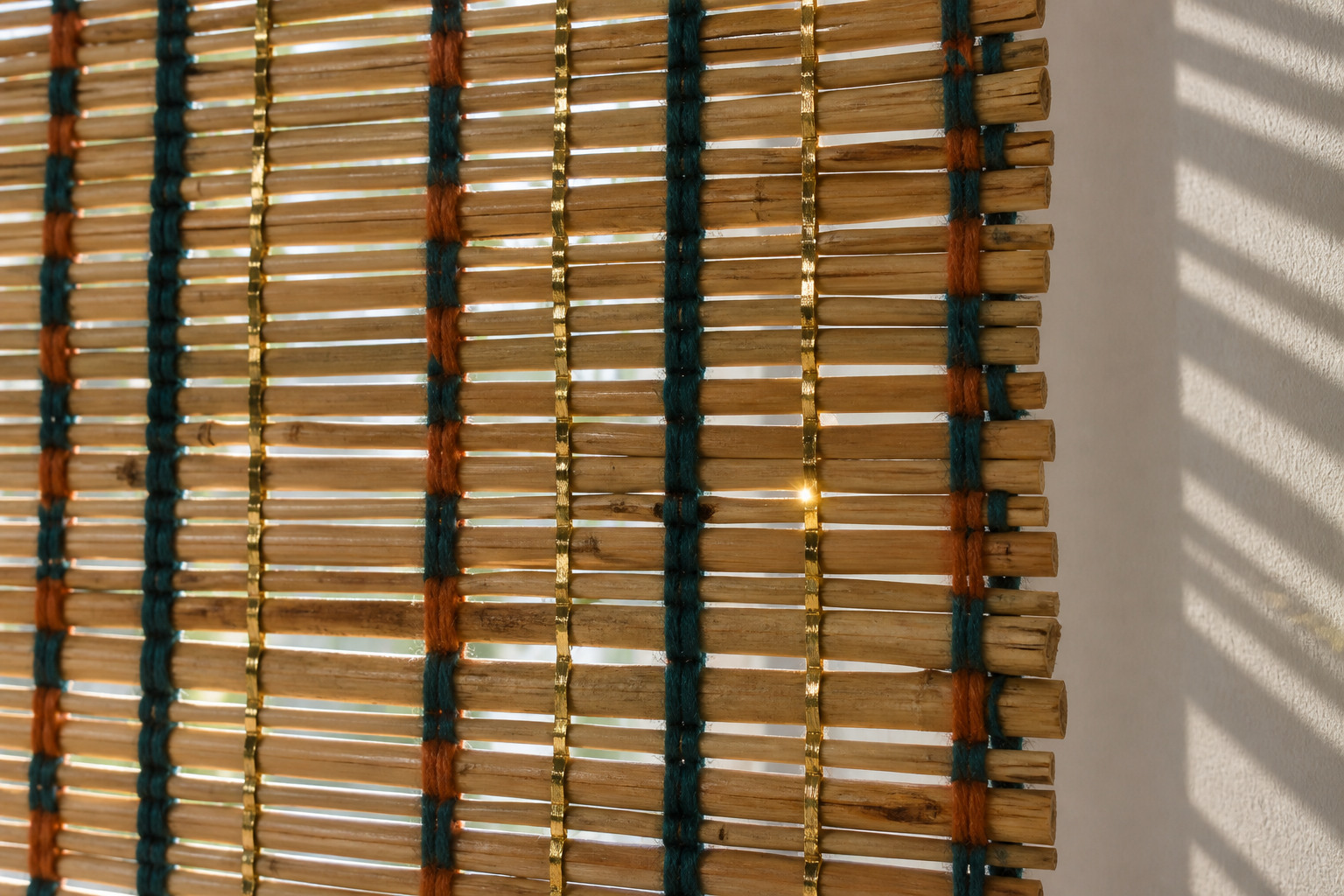
Look across such a weave rather than at its outline. A thick reed interrupts the light. A gap admits it. A bright thread catches light on the room side. Those three small events can happen within a few centimetres of one another. The result is a surface that changes as you walk past it, even though nobody has touched a cord.
The Met preserves a window-blind sample from about 1955 whose materials include wood, plastic, assorted yarns and Lurex: aluminium foil coated in plastic. Its catalogue reads like the contents of several different workshops brought to the same loom.5
What the glitter was doing
Metallic yarn can sound like a finishing flourish, something added after the useful decisions. In Liebes’s textiles it helped determine how the surface behaved. Cooper Hewitt’s exhibition places glitter among her working tools: a means of bringing movement and luminosity into woven cloth.2
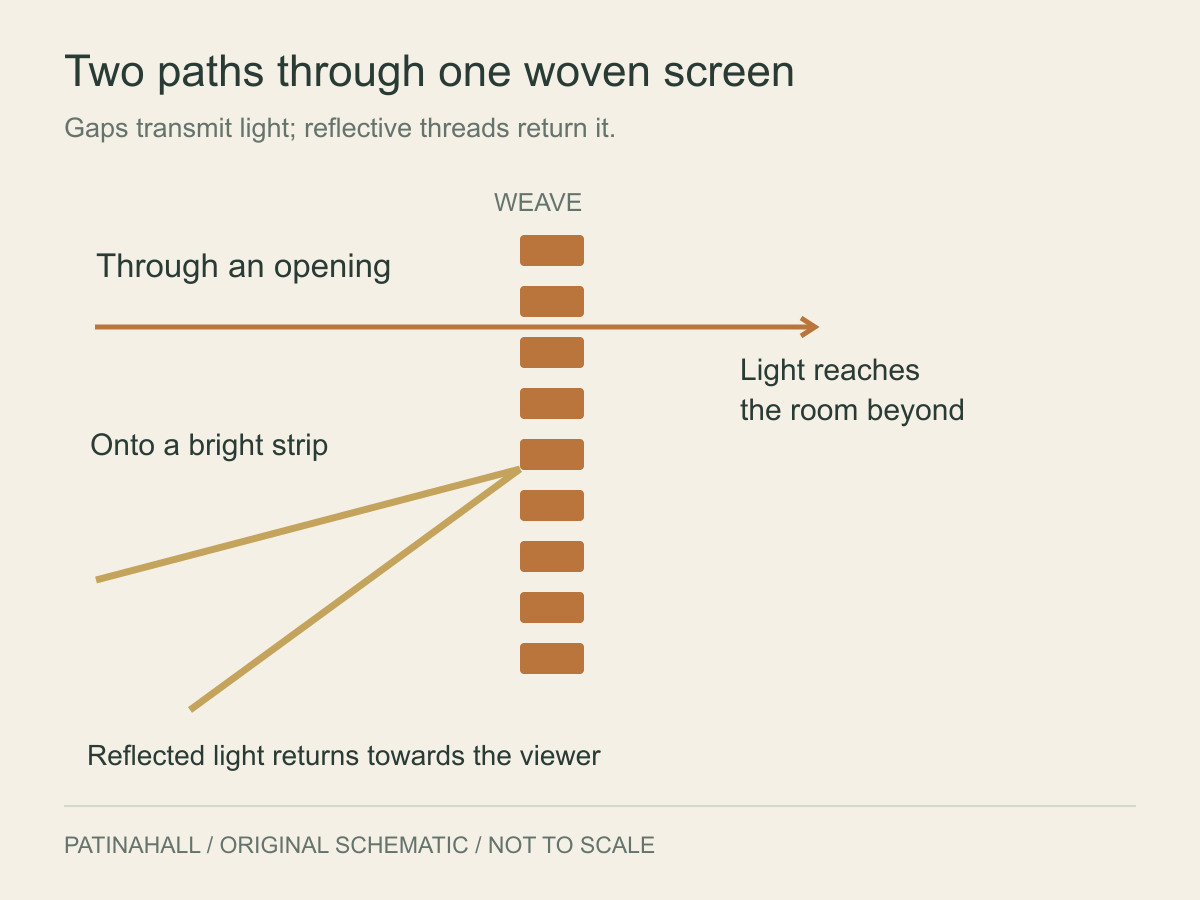
There is a useful distinction here. Light passing through an opening illuminates what is behind the screen. Light reflected by a metallic strip makes the screen itself appear brighter. A single textile can do both. The schematic below separates the two paths; the opening illustration imagines a material combination, without copying a surviving Liebes sample.
This also explains why a flat photograph can undersell a textile. A picture fixes the light and the viewpoint. In a room, a reflective thread that looks quiet from one chair may flash when someone stands up. The furniture arrangement becomes part of the experience of the weave.
A sample could travel into industry
Liebes worked with Dobeckmun, the company behind Lurex, as a consultant from 1946 to 1961. According to Cooper Hewitt’s material history, she helped expand the possibilities of the metallic yarn beyond its familiar gold and silver appearance, exploring colour and different forms of the material.3
That relationship matters because a handwoven experiment could become more than a one-off commission. It could show a manufacturer what its fibres might do, or suggest a combination that another production process could develop. The Smithsonian’s account of her career connects the work of her studio with consultancy for companies including DuPont Textile Fibers.4
The studio and the factory therefore belong in the same story. There were ideas to test at the loom, people to weave them, clients with rooms to furnish and businesses deciding which materials to make available. Calling the finished textile simply a personal expression misses much of that exchange.
Look at the shadow as well
The next time you look at a woven screen, let your eye leave the fabric. See what it does to the wall, floor or furniture nearby. Are the openings producing hard lines or scattered patches? Does the weave feel dense from across the room and unexpectedly open at close range?
Liebes’s blinds invite that wider view. Their subject extends beyond the rectangle hanging at the window: a chair moves into softer light, a bright thread answers a polished surface, and the afternoon gradually redraws the room.