Start with the space around it
A chair occupies a room twice. Its body takes up actual floor space, and its outline takes up space in our view. Those two things need not feel equally substantial.
Boeri’s furniture rewards looking at both. An upholstered volume can be generous without needing a separate wooden skeleton. A transparent object can retain a full seat and back while allowing the wall, floor and neighbouring furniture to remain visible. The question is how an object participates in an inhabited space, rather than whether it belongs to a recognisable matching style.
Her work as an architect made the relationship between people and their surroundings an everyday concern. Arflex’s account of Bobo connects her design approach with function and the psychological experience of domestic space.1
A seat without the hidden frame
Designed in 1967, Bobo uses a single body of polyurethane foam. There is no rigid internal structure around which separate upholstery has to be built. The shape itself becomes the seat.
That construction changes what we see. A conventional armchair often announces legs, arms, cushions and back as separate parts. Bobo reads as a continuous upholstered mass. Its rounded profile feels closer to a shaped landscape than to a timber frame dressed in fabric.
This apparent simplicity still depends on decisions about material, proportion and support. Removing a frame does not remove design work. It relocates that work into the foam body and the relationship between its different surfaces.1
The chair you can see through
Ghost, developed with Tomu Katayanagi for FIAM in 1987, takes a different route. Its glass surface bends into the places normally occupied by a chair’s back, seat and arms. Reflections and edges reveal the shape; much of the room remains visible through it.
The Quirinale’s collection account describes this tension between occupying space and appearing insubstantial. It is a helpful way to look at the chair: follow an edge, then look through the surface it bounds.2
Making the form required collaboration with glass specialists. FIAM’s account preserves both designers’ names and the role of founder Vittorio Livi in developing the project. The chair’s light appearance is inseparable from demanding work with a heavy, resistant material.3
Two ways to make room
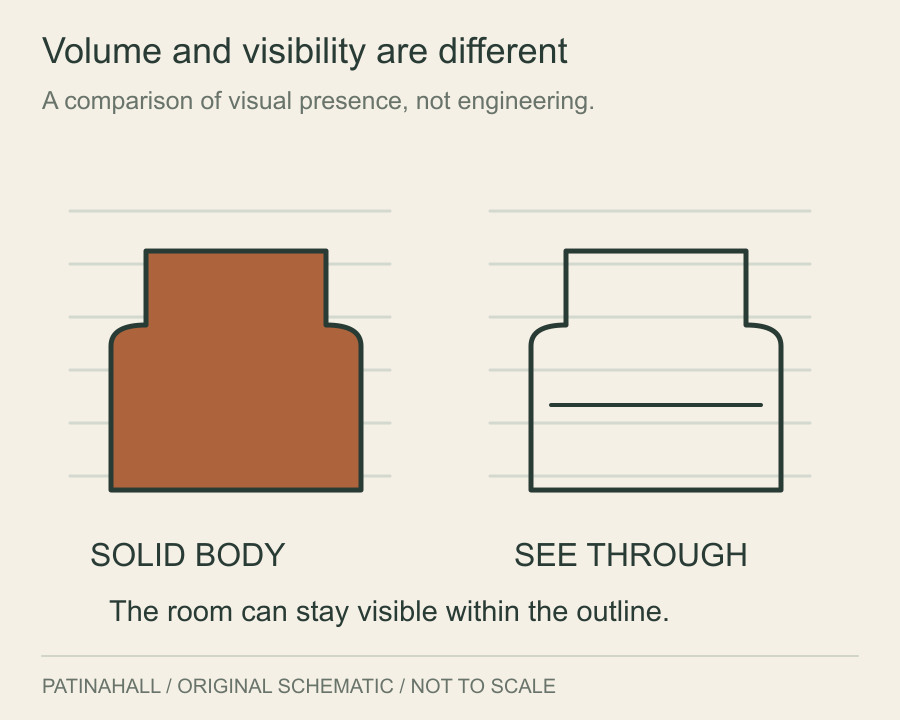
Put the two ideas beside each other and the contrast becomes productive. Bobo gathers the seat into one soft volume. Ghost lets the eye pass through an equally definite object.
Neither solution makes the room irrelevant. The foam body establishes a strong place to settle; the glass chair draws the surrounding space into its appearance. Boeri’s work encourages us to look beyond the outline of a chair and notice the conversation it has with everything around it.
