The chair sent upstairs
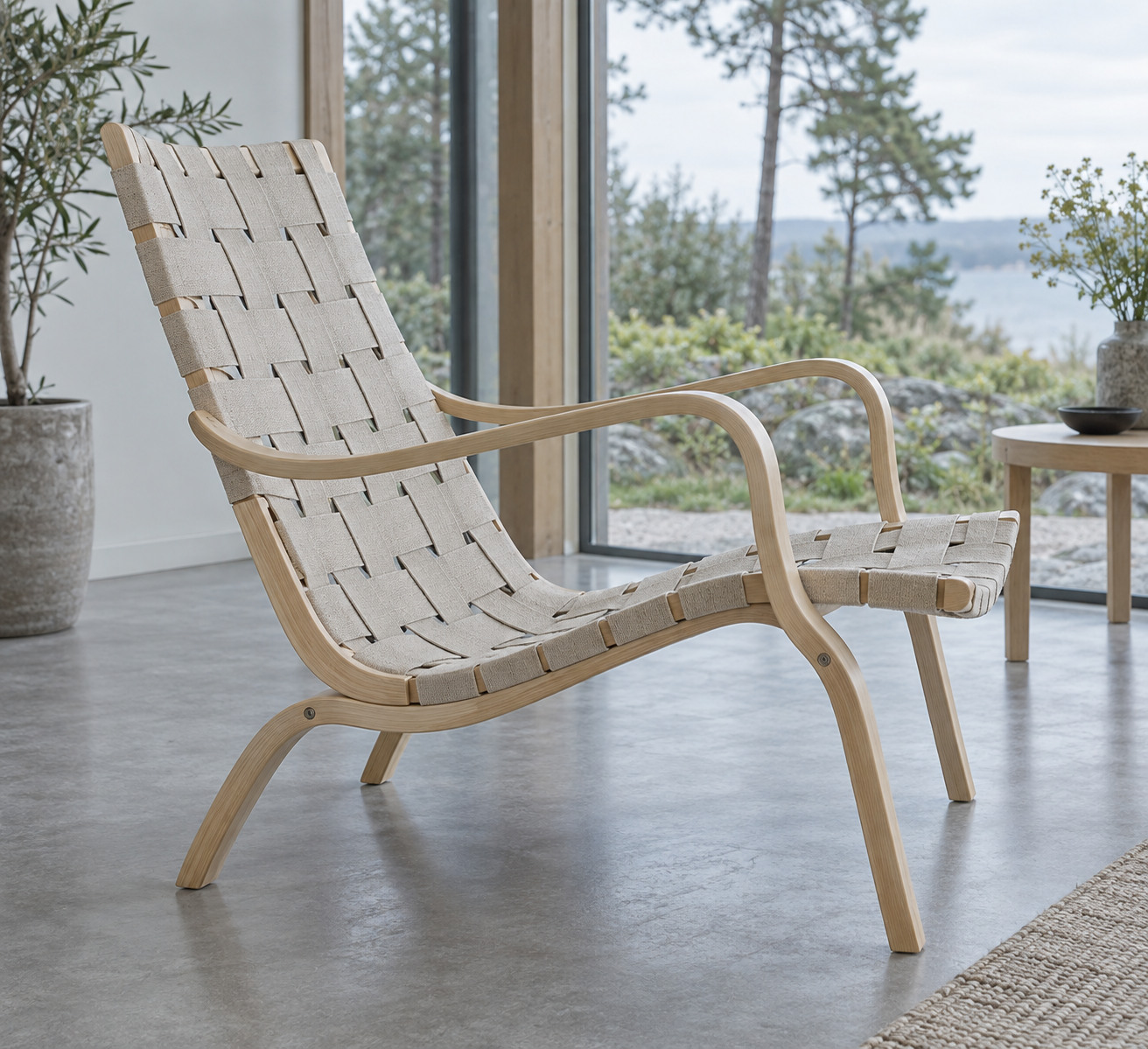
In 1931 Mathsson designed a chair for the hospital in Värnamo. It became known as Gräshoppan, the Grasshopper. Möbeldesignmuseum recounts an unpromising reception: the nurses disliked it and the chairs went into the attic. Recognition in exhibitions later helped change their fortunes.1
It is a useful story because it interrupts the easy version of design history in which a good idea is immediately recognised. An unfamiliar chair still has to persuade the people who encounter it. A shape that looks convincing in an exhibition can be surprising in an ordinary institution.
Mathsson had grown up with cabinetmaking in his father’s workshop. His experiments did not remove craft from furniture. They redirected it towards the changing relationship between a frame and a body.
The seat is a surface under tension
A conventional upholstered chair often hides much of its support inside a thick volume. In Mathsson’s webbed seating, the surface spanning the frame is easier to read. The strips cross one another, turn around the edges and carry the sitter over open space.
The curved side members establish a profile. The webbing supplies a more yielding surface between them. These elements have different jobs: the frame controls the overall form, while the spanning material makes contact with the body. Their contrast helps explain why the chair can look light without being merely a thin outline.
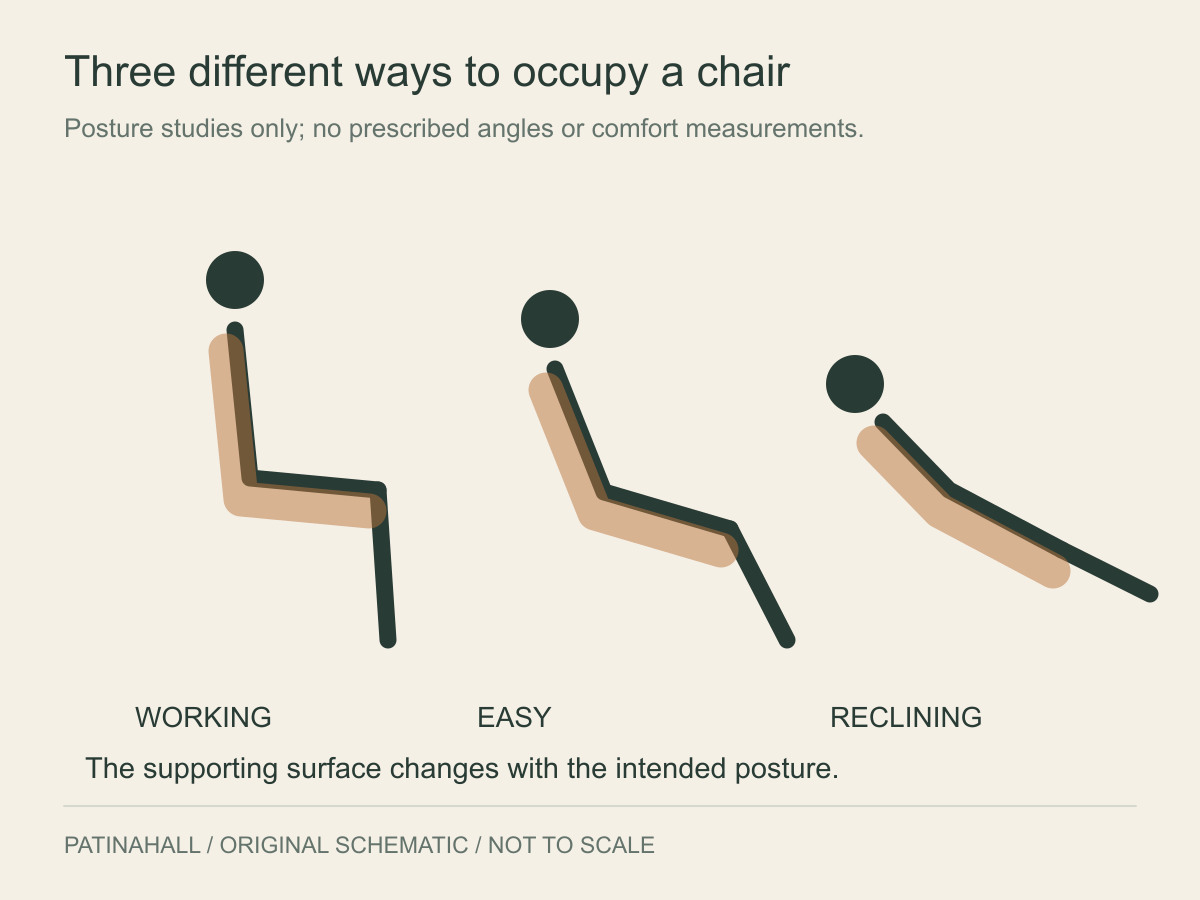
Bard Graduate Center’s exhibition grouped his work around chairs for working, easy sitting and reclining. That distinction is more useful than imagining a single ideal posture. The person leaning towards a task and the person stretching out to rest ask different things of the furniture.2
The chair carries its room with it
A reclining seat changes where the occupant looks. Lower the body and the window, sill and horizon acquire different proportions. Give the chair a deep footprint and the surrounding floor has to accommodate it.
Mathsson also designed buildings with extensive glazing and close connections to their surroundings. Bard’s exhibition presented that architecture alongside the furniture. The pairing helps us understand the chair as a position in space rather than a product cut out against a blank background.2
A photograph dated to the 1950s shows Mathsson at home on a Pernilla 3. The historical scene brings a celebrated form back into the ordinary act of occupying a room. It is a different kind of evidence from a catalogue view: the furniture has someone in it.3
A shape that waits for someone
An empty webbed chair contains a suggestion of posture. The slope of its back, the depth of its seat and the rise under the knees all point towards a body that is temporarily absent.
That makes these chairs rewarding to look at even before sitting down. Follow the frame from the floor towards the back and it stops reading as decoration. It becomes a drawing of support, carried out in wood and woven material. The person completes the picture.
