The shelf that begins with empty floor
Royal System is easy to describe as wall shelving and easy to underestimate for exactly that reason. Poul Cadovius did not merely remove the legs from a bookcase. He split storage into rails, hangers, shelves and boxes, then made their relationships adjustable. The wall became infrastructure; the furniture became an arrangement rather than a fixed cabinet.
dk3, the system's current licensed manufacturer, dates the design to 1948 and calls it one of the earliest wall-mounted furniture systems. 1 Dansk Biografisk Leksikon describes the more radical consequence: Royal broke with floor-standing furniture, used the room more efficiently and allowed buyers to compose individual elements. 2 The clear floor is therefore not incidental. It is the largest component you cannot order.
Break the cabinet into verbs
A conventional cabinet arrives as a noun. Its sides, back, shelves and legs declare one volume and one intended place. Royal System behaves more like a set of verbs: support, hang, store, display, move. The vertical rail supports; the metal bracket hangs; a shelf displays; a box stores. Change their order and the system remains itself.
dk3 describes a compact construction of wall-mounted timber rails, shelves carried on metal hangers and cabinets that can be included in different combinations.1 No outer carcass is needed to bind the whole composition. Instead, repeated attachment points let separate pieces share a structural rhythm.
This changes how the eye reads storage. We no longer begin at a cabinet's outer edge and work inward. We begin with intervals: rail to rail, shelf to shelf, cabinet to floor. Empty space is measured and useful because another element might occupy it later.
The rail is a vertical sentence
In a front view, the rails look almost modest enough to disappear. Yet they set the grammar. Their regular fixing positions determine where hangers can land, while their vertical direction lets the arrangement expand upwards rather than grow new feet across the room.
The metal hangers are the punctuation between infrastructure and object. A shelf does not appear to dissolve into the wall; its thin support remains visible, explaining how the horizontal plane belongs to the vertical rail. A suspended drawer cabinet makes the logic even clearer. The box stops above the floor, so its weight appears to travel through hardware into the rail and wall rather than through legs.
Cadovius was trained as an upholsterer and saddler, and Dansk Biografisk Leksikon records that he established his first company in 1945 before moving into furniture production in the early 1950s.2 Royal System's intelligence can be read in that practical sequence of connections. It is not a wall decorated with shelves; it is a designed path for load, adjustment and use.
A 1948 design and an early-1950s business
Two dates describe different moments. dk3 identifies 1948 as the design year. 1 Dansk Biografisk Leksikon places Cadovius's furniture production and the Royal system's commercial growth from the early 1950s, with demand especially strong abroad.2 The records do not need to be made identical. One dates the design; the other describes the business becoming substantial.
dk3 says Royal System was produced in Cadovius's own Danish factories during the 1950s and 1960s and licensed in more than thirty countries. 1 That is a current manufacturer's historical account, so it is attributed as such. It nevertheless helps explain why a system mattered internationally. A fixed bookcase exports one silhouette. Royal exports a grammar that can be recomposed against many walls.
The company even advertised the number of possible combinations in the millions, according to dk3.1 The exact total is less interesting than the ambition behind it: furniture could be sold not as one perfect final arrangement, but as permission to revise the room.
Exporting a system instead of a silhouette
Modularity is sometimes presented as an abstract virtue, but Royal makes its use concrete. A household can add a shelf without replacing a cabinet. A work surface can enter an existing bay. Storage can move upwards and return floor area to circulation. The product is not infinitely adaptable—the rails, hangings and dimensions impose real rules—but those rules produce many credible compositions.
This is why the system remains recognisable when two installations share few components. The identity lies less in a heroic outline than in the recurring relationship between rail and hanger. A three-bay arrangement and a narrow single bay can belong to the same design language even when their shelves, boxes and gaps tell different stories.
That flexibility also makes evidence discipline essential. A name continuing for decades does not guarantee that every bracket from every period fits every rail. dk3 explicitly distinguishes its current production and notes a compatibility boundary in the system's later history.1 That fact belongs to the manufacturer's current account; it is not a shortcut for assessing an unidentified vintage installation.
Royal System is not every Cadovius system
Cadovius kept developing the wall. dk3's designer history separates the 1948 Royal System from System Ultra of 1957 and System Cado of 1960. 3 Those names describe related thinking across a designer's career, not convenient synonyms for one universal collection.
A period trademark record gives the later CADO name a useful documentary anchor. It records an application by Royal System, Poul Cadovius's firm, in March 1960 and registration in January 1961 for shelving among other goods. 4 The record does not turn the 1948 Royal System into System Cado. It shows a later mark appearing within the same business history.
This distinction matters because modular furniture encourages optimistic mixing. Similar timber, repeated holes and familiar brass or steel details can make separate families look compatible in a photograph. Historical kinship is not mechanical interchangeability. For practical inspection, measurement and installation questions, use our guide to buying a vintage wall system; this Library story keeps its attention on the design idea.
One arrangement, not the final answer
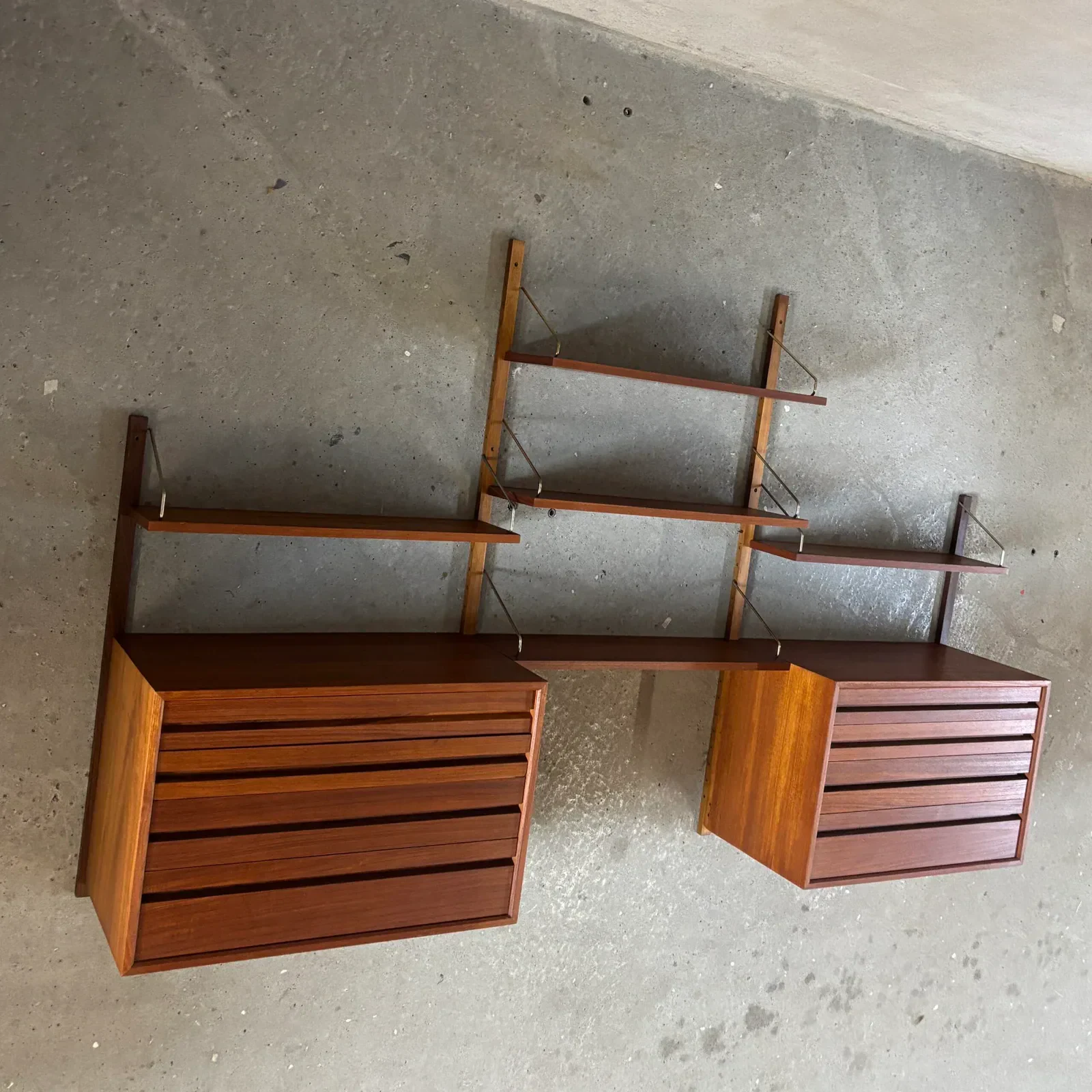
The current PatinaHall listing shows a seller-described three-bay Royal System with four vertical rails, open shelves and two suspended drawer boxes. 5 It is a particularly clear visual lesson because the concrete wall remains visible between components and the floor passes uninterrupted beneath the cabinets.
The listing is not an independent authentication record. Its attribution, date, timber, restoration, dimensions, completeness and compatibility remain seller claims about the offered set. The photograph can show how this arrangement looks and how its visible parts relate; it cannot establish the history of another wall system.
Royal's most enduring achievement is not any one attractive composition. It is the decision to leave composition unfinished—to design a dependable set of relationships and trust the room to change. For another Danish answer to the problem of occupied space, read about the Portex chair. Portex compresses finished chairs for the journey; Royal System lets furniture keep negotiating with the room after it arrives.