The export problem hiding in a dining chair
Portex is a chair shaped by the journey between factory and table. Peter Hvidt and Orla Mølgaard-Nielsen made it stackable, but refused the usual visual announcement: no folding frame, no conspicuous hooks and no silhouette that looks incomplete until another twenty chairs arrive. A single Portex can pass as a composed wooden dining chair. Put several together and the quieter piece of design—the space reserved for the next chair—becomes visible.
Lex places Portex among the partnership's early breakthroughs and describes it as industrially made, export-oriented and space-saving, with packaging and transport kept firmly in view.1 That context changes the question we ask of the chair. Its stack is not a bonus trick added after the form was settled. The movement of furniture through the world helped settle the form.
A chair that travelled whole
Furniture can become smaller for transport in several ways. It can fold. It can be dismantled. Or it can remain complete and borrow empty space from an identical neighbour. Portex takes the third route.
Danish Design Review's detailed account of the Portex armchair and range says that a desk in the same export programme had removable legs packed within its body, while the chair remained assembled.4 That distinction is important. A knock-down desk asks somebody at the far end of the journey to reconstruct it. The chair instead leaves the factory as a finished piece and becomes compact only when another chair enters its geometry.
The designers' problem was therefore unusually strict. The chair had to bear the disorder of ordinary use, retain dependable joints and stack without looking as though stacking were its sole occupation. It needed to be sociable at a dining table and disciplined in a storeroom—two rooms that rarely agree on a dress code.
Stacking without advertising it
Many stacking chairs make their repeatability visible from across a hall. Their legs splay for clearance, frames loop around one another, or backs carry obvious handholds. Portex is more discreet. The rear posts and broad back still produce a familiar dining-chair outline; the nesting logic is moved downwards, where it can work without dominating the first impression.
Danish Design Review reports that the designers deliberately chose stacking over a folding or detachable solution because it allowed the chair to remain factory finished. Its analysis also notes the familiar problem that stacking chairs tend to look unmistakably stackable.4 Portex's wit lies in accepting the practical category while declining its costume.
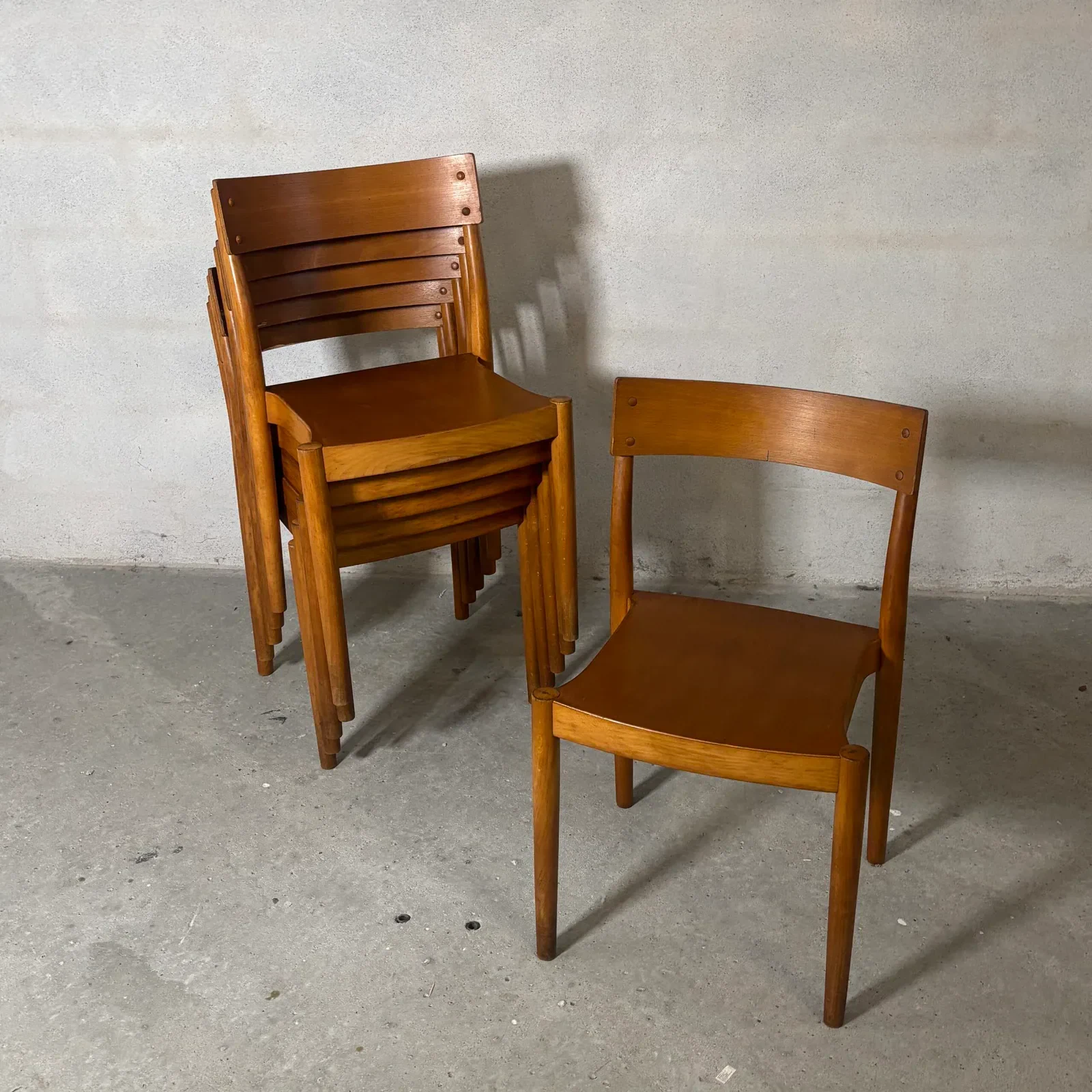
The currently seller-listed set makes that concealment easy to read. 6 One chair stands forward like an individual; several behind it compress into a rising sequence. The photograph does not prove who made those particular chairs, but it records the visual event that matters here: ordinary chair first, packing system second.
The trapezoid beneath the seat
The decisive shape is not the backrest. It is the seat frame. Danish Design Review describes it as trapezoidal, with side rails angled so that the rear legs of the chair above can pass around the seat below. 4 The plywood seat overhangs that frame, helping the useful irregularity disappear when the chair is viewed on its own.
Imagine repeating a perfectly rectangular chair frame. Unless the legs move, each chair meets the one below at nearly the same level and the stack grows quickly. Portex redirects those collisions. The widening geometry makes a channel for the next set of legs; one complete object descends over another without requiring a hinge.
That is why the empty areas are designed as carefully as the timber. Clearance beside a rail and beneath an overhang may appear to be nothing, yet those measured nothings determine whether six chairs form a compact stack or an awkward wooden queue. The stack is drawn in negative space before it exists in the room.
1944 or 1945? Keep both records visible
Portex resists a single effortless date. Möbeldesignmuseum records an exact Portex chair under 1944, identifies Hvidt and Mølgaard-Nielsen as designers, Fritz Hansen as producer, and wood and laminated wood as its materials. 2 Lex dates Portex to 1945. 1 The museum's biography of Mølgaard-Nielsen likewise places the Portex collection in 1945.3
A period document adds another fixed point without magically resolving the difference. Denmark's trademark register records a Portex furniture mark applied for on 17 March and registered on 24 March 1945 in the names of Peter Hvidt and Orla Mølgaard Nielsen.5 It shows the name in a precise public administrative context; it does not tell us which day the first drawing or prototype was completed.
The honest shorthand is therefore 1944–45, with the sources left visible. Design histories often contain a design year, exhibition year, registration year and production year that later summaries compress into one convenient number. Here the one-year seam teaches more than an artificially perfect date would.
Two designers, one export argument
Hvidt and Mølgaard-Nielsen worked together from 1944 to 1975, according to Lex.1 Möbeldesignmuseum describes a partnership concerned with furniture suited to industrial production and international distribution, including knock-down export pieces that could be shipped flat. 3 Portex belongs near the beginning of that long collaboration.
The chair is useful precisely because it prevents "industrial" from becoming a synonym for visually impersonal. Its beech and laminated-wood record, named by Möbeldesignmuseum, sits alongside an intensely procedural idea: finish the chair, repeat it, and let each copy provide packing space for the next. Fritz Hansen's documented producer role joins workshop execution to a distribution problem without turning the result into a shipping crate with a backrest.
Portex therefore offers a compact argument about Danish modernity. Craft judgement survives, but it is directed towards repetition, transport and export as well as the solitary object. The refined profile and the loading plan are the same design seen at different scales.
One current set, with honest limits
The PatinaHall listing used here is a 2026 seller description of a set offered as Portex chairs.6 Its photograph is valuable because one separated chair and the stack behind it appear in the same frame. It is not a factory archive, a 1945 installation or an independent authentication report. Seller-supplied maker, date, material, dimensions and condition claims remain seller claims.
That boundary does not weaken the image; it gives the image the right job. We can inspect how these chairs appear to nest and compare that visible geometry with the independently documented Portex construction. We cannot use the photograph to prove the individual objects' history.
For the next Danish experiment in useful empty space, continue to Poul Cadovius's Royal System. Portex makes complete chairs overlap so they occupy less room in transit. Royal System starts after arrival and asks a larger question: how much floor could a room recover if storage learned to hang from the wall?