Two shapes agree not to merge
Most lounge chairs make their layers easy to count. Upholstery sits on a frame; the frame continues into legs; joints explain how the stack stays together. PK24 withholds that reassurance. Its long curved body seems to pass over a low rectangular base while touching it as little as courtesy permits.
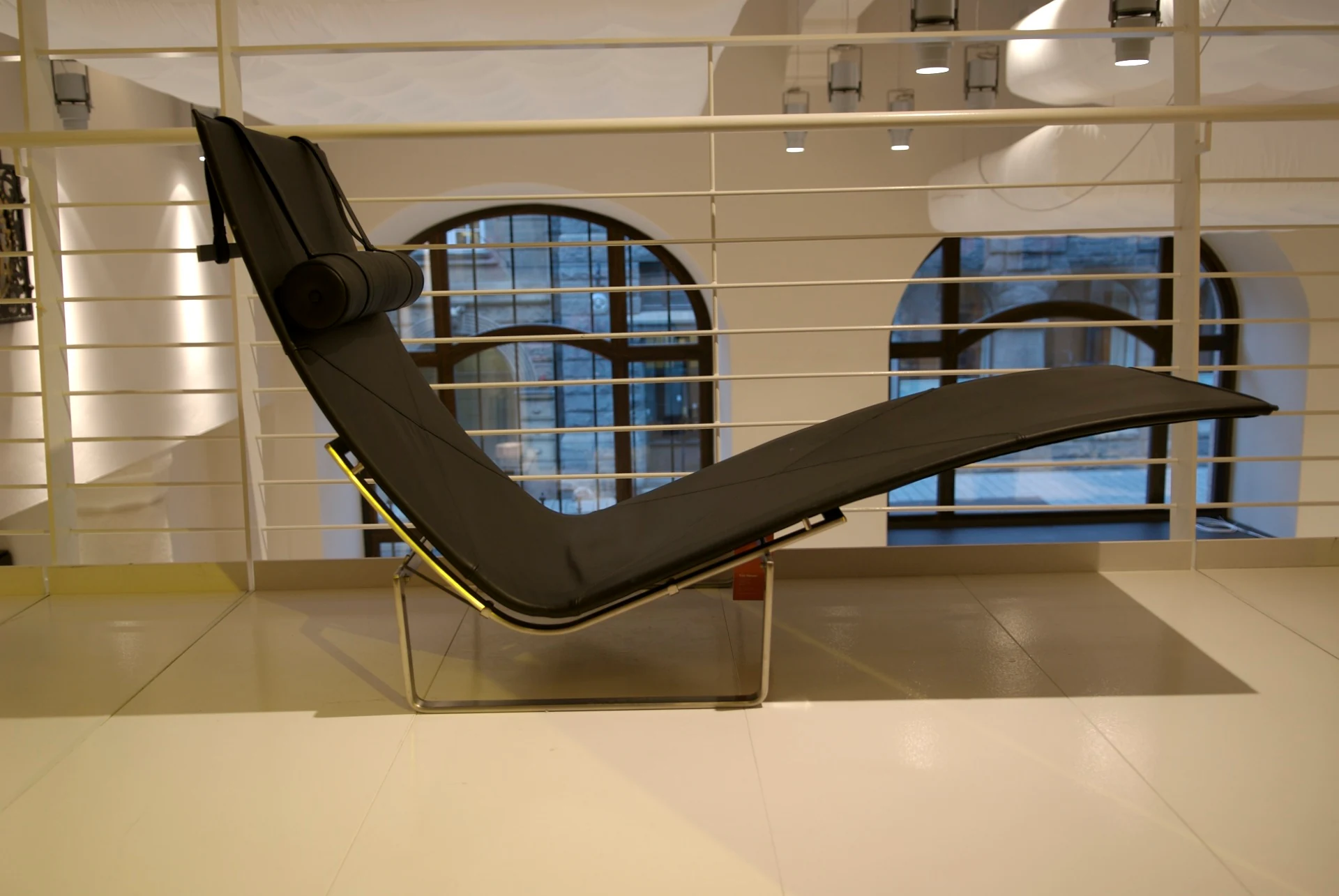
THOR's 2007 photograph shows a later black leather-covered example in strict profile. The image is not a production drawing, yet it makes the visual separation unusually clear: one dark, flowing contour carries the imagined body, while a bright steel rectangle negotiates with the floor. Between them is no bulky platform to explain away the encounter.4
That difference in geometry matters. The upper part bends continuously from a raised back through a deep hollow and towards the feet. The base prefers horizontal and vertical lines. Organic curve and right angle do not blend into a tasteful average; they remain articulate neighbours. The chair looks complete because each does one job and neither borrows the other's accent.
The smallest contact carries the story
Dansk Møbelkunst's record for a cane PK24 calls the design an example of what can be achieved with a few calculated components. It describes Kjærholm's “equilibrium principle”: a freely curving plane held by a minimal base, with the transition conveyed through a thin steel friction strip. 2
The useful word is not floating but equilibrium. Floating is an appearance; equilibrium is a relationship among shape, contact and weight. The curve still needs support, and the base still carries load, but the visual junction has been reduced until the viewer begins to notice forces rather than fasteners.
That is also why the empty space beneath the chaise is so active. A solid plinth would make the curve look displayed. Four ordinary legs would divide it into familiar furniture. The narrow base instead draws a quiet datum at floor level and lets the dark body hover above it. Gravity, normally furniture's most invisible subcontractor, finally receives a speaking part.
This is an interpretation of a documented design, not an instruction to lift, slide or re-seat another chair. A vintage PK24's contacts, finishes and condition need object-specific assessment. The photograph proves a silhouette; it does not prove that an unseen junction is complete or safe.
A hammock without the campsite
PK24's long profile invites a hammock comparison without turning the chaise into outdoor equipment. A hammock supports the body along a suspended sweep between higher points. PK24 gives that bodily idea a much more disciplined architectural setting: the surface sags visually, but the polished base remains exact.
The analogy is most convincing around the middle. A conventional upholstered seat often establishes a reasonably level platform before adding a separate back at an angle. PK24's profile refuses that break. Back, seat and leg support belong to one changing line, so reclining is present before anyone sits down.
The cylindrical headrest interrupts the line without destroying it. In the photograph it reads as a separate, compact volume crossing the raised end. The large curve carries the posture; the small roll marks where a head might meet it. A whole lounge chair has been reduced to something close to a diagram of rest, only considerably better dressed than most diagrams.
One design, more than one material record
MoMA catalogues PK24 object 557.2010 as a 1965 design by Poul Kjærholm, manufactured by E. Kold Christensen in Copenhagen. Its medium is stainless steel, leather and cane, and its recorded dimensions are 87 by 155 by 67 centimetres.1
Dansk Møbelkunst likewise documents a cane example with a stainless-steel base and vegetable-tanned leather, but THOR's photograph shows a dark leather-covered main surface. Those records should not be blended into a single imaginary chair. They demonstrate that the design identity can persist while visible surface treatment changes; they do not establish the original material, manufacture date or present condition of another PK24.
There is a further archival wrinkle worth leaving visible. Wikimedia Commons identifies and categorises the photographed design as PK24, while the linked Flickr title contains “PK22”. The shape shown is consistent with the long PK24 chaise rather than the compact PK22 lounge chair, but this page uses the image only to read visible construction. Its file label is not provenance, and it certainly cannot authenticate a chair encountered elsewhere.
The distinction improves the story. Cane would let light and air participate in the curved plane; black leather makes the same plane look denser and more graphic. PK24 is not memorable because one photograph supplies a definitive finish. It is memorable because a changing surface still has to negotiate the same modest base.
A cabinetmaker gives steel its own manners
Fritz Hansen's account of Kjærholm explains why the meeting feels precise rather than merely sparse. He trained as a cabinetmaker, became fascinated by construction materials beyond wood and argued that steel deserved the same artistic respect. The company dates his close collaboration with Ejvind Kold Christensen from 1955 and says the Kjærholm estate entrusted the wider collection to Fritz Hansen two years after the designer's death in 1980. 3
That biography should not tempt us to call every steel detail “craftsmanship” and move on. The more specific lesson is that materials are allowed different manners. Steel does not imitate a timber rail; it draws the orthogonal base with thin, reflective edges. The curved surface does not pretend to be a structural metal ribbon; it remains the broad, body-facing field. Their contact is carefully staged precisely because their characters remain apart.
Kjærholm's PK91 folding stool makes the comparison useful. PK91 lets steel ribbons cross, pivot and even carry a dovetail from the cabinetmaker's vocabulary. PK24 is quieter. Instead of turning a joint into the visible event, it reduces the event until balance itself becomes visible.
Gravity is part of the composition
PK24 can look luxurious, severe or almost impossibly calm depending on its surface and setting. Those impressions are real but secondary. The durable idea is structural theatre on a very small stage: a powerful continuous curve, a reticent right-angled base and the tiny region where one trusts the other.
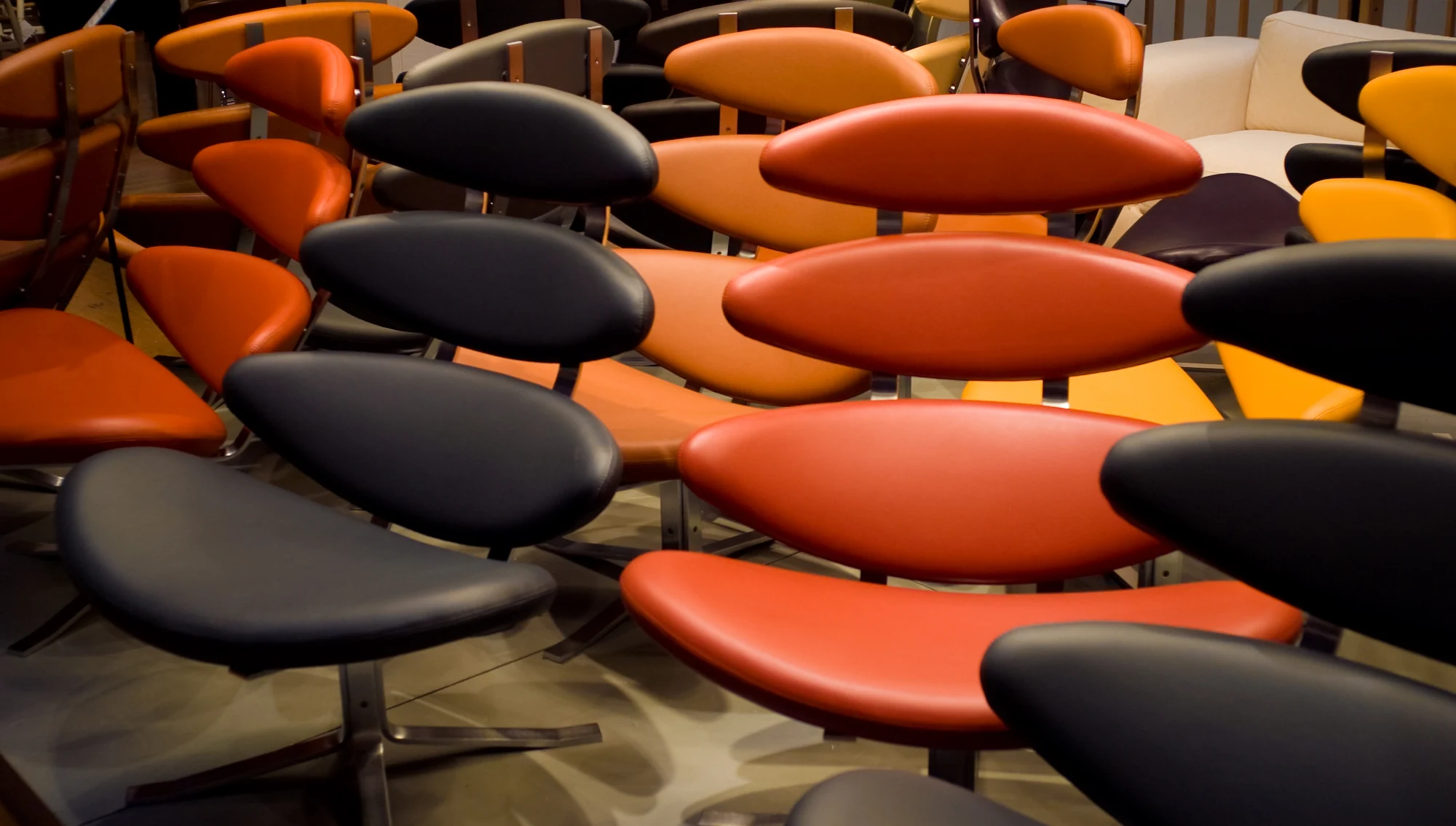
Poul M. Volther's Corona Chair, the other half of this editorial pair, asks the opposite question. PK24 connects the reclining body with one continuous sweep; Corona breaks support into separate upholstered islands. No reviewed source proposes a historical link between them. Placed together, however, they show why “Danish lounge chair” is not a single recipe for tasteful comfort.
PK24's final trick is not that structure disappears. Look long enough and the structure becomes the whole subject. Steel establishes a calm reference, friction concentrates the meeting, the curve anticipates the body and gravity keeps everyone at the table. Or, in this case, elegantly near the floor.