The old X was never obsolete
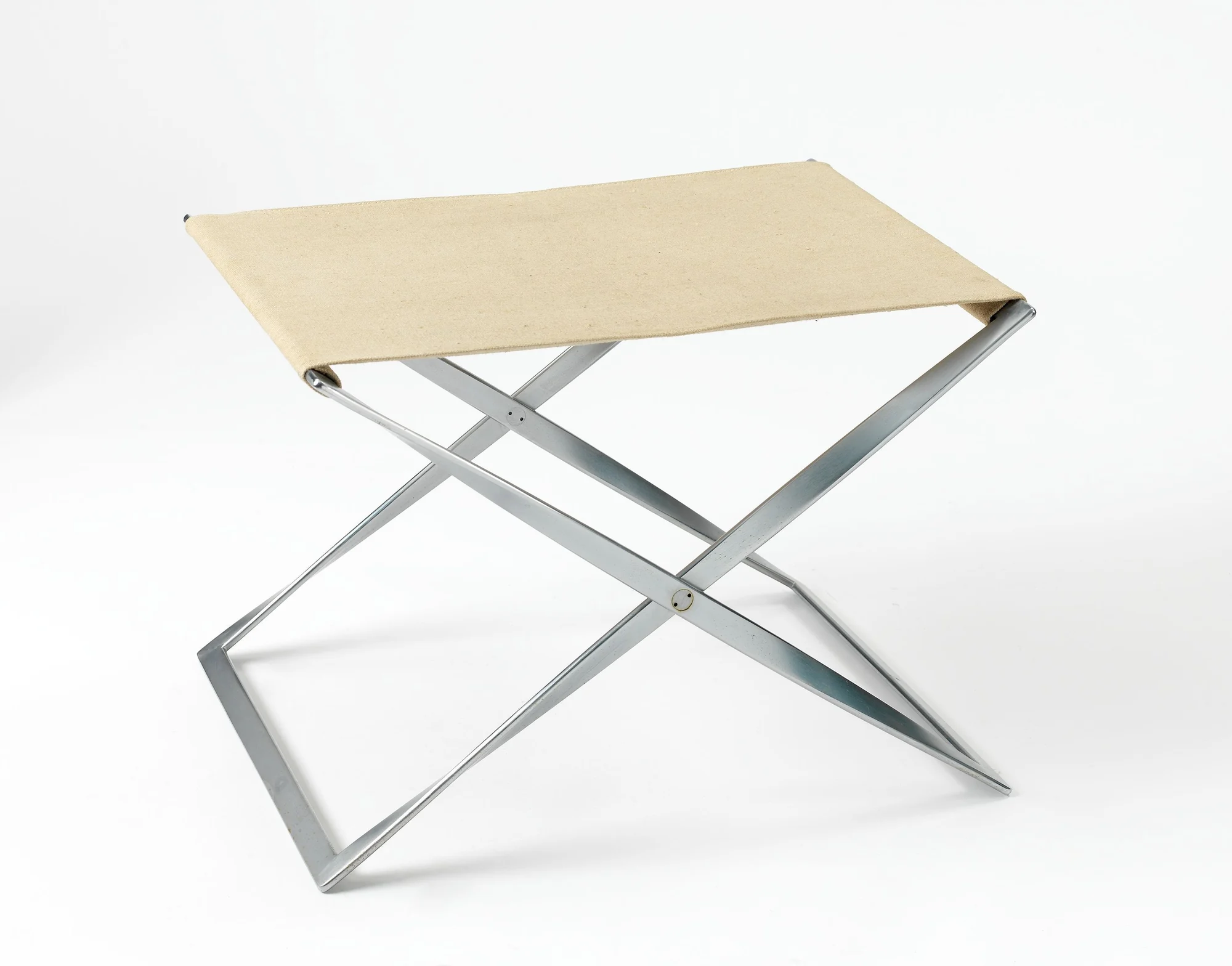
Viewed from across a room, PK91 is almost a diagram: two X-shaped side frames, a rectangle of canvas and nothing pretending to be a backrest. Poul Kjærholm designed it in 1961, but its organising idea was already very old.
The Metropolitan Museum of Art places the folding X-form in a long history that begins with examples from ancient Egypt and continues through Greek and Roman furniture. The broad arrangement survived changes in taste and material because crossing members can turn around a centre and support a seat when opened.1
That account is best read as a history of the type, not as a neat family tree leading from one named ancient stool to PK91. The museum does not identify an individual prototype that Kjærholm copied. What it establishes is more useful: he placed a visibly inherited mechanism inside the material language of post-war industry.
The stool folds, certainly, but it is not camping furniture trying to sneak into the drawing room. Movement is treated as something worth seeing.
Read from the crossing outwards
Begin with the two round pivots visible at different depths in the photograph. Each belongs to one side of the stool. The flat members cross there, then continue upwards to support the canvas and downwards towards four points on the floor.
This gives the open stool a clear visual order. The seat sits above; crossed frames occupy the middle; the legs spread below. Nothing needs a solid box, apron or upholstered shell to explain where the body is carried. Even before the stool moves, its paired Xs announce that it can.
The photograph documents only the open museum object, so it should not be turned into an operating manual for another stool. It does, however, let us follow the design's logic. A folding mechanism has not been hidden beneath a finished appearance. It is the appearance.
A dovetail where no timber remains
The most surprising detail sits away from the pivots. The Met describes the base as ribbon-like steel strips that twist and meet at the corners with dovetails, a joint traditionally associated with woodworking. 1
A dovetail is recognisable by its flared, interlocking shape. In a cabinet or drawer it makes the act of joining visible and resists the pieces simply pulling apart. PK91 carries that way of thinking into metal without giving the steel fake grain, wooden proportions or nostalgic decoration. The translation is structural rather than theatrical.
Fritz Hansen's account supplies the biographical clue. Kjærholm trained as a cabinetmaker before studying at Copenhagen's School of Arts and Crafts, and he treated steel as a material deserving the artistic attention ordinarily given to wood. The company also dates the beginning of his collaboration with manufacturer Ejvind Kold Christensen to 1955. 3
PK91 contains no timber, yet its steel was apparently still expected to pass the cabinetmaker's joinery exam. That is why the detail matters: it joins two traditions without disguising either one.
Canvas finishes what the steel begins
Nasjonalmuseet catalogues its PK91, inventory OK-1978-0210, in matt chrome-plated steel and canvas. It names Poul Kjærholm and records E. Kold Christensen as manufacturer, with a creation range between the 1961 design date and 1976.2
In Frode Larsen's photograph, the pale canvas wraps around the upper supports and spans the space between the two sides. It is neither a loose cushion placed on a completed base nor upholstery concealing a frame. The textile supplies the broad contact surface that the thin steel members deliberately do not.
Its slight give also changes the character of the geometry. Below, reflective edges and hard corners draw precise lines. Above, the canvas settles into a shallow, imperfect plane. The stool needs both: steel makes the moving order legible, while textile turns that order into somewhere a body can pause.
One PK91 is not every PK91
The two museum records describe the same design but not one universal object. The Met's stool, object 2001.405.1, is listed in stainless steel and canvas and measures 40.6 by 58.4 by 45.1 centimetres. Nasjonalmuseet's object is recorded in matt chrome-plated steel and canvas at 42 by 57.7 by 45.2 centimetres. 1 2
Those differences are not a nuisance to smooth away. They are a reminder to keep design date, object date, material record and manufacturer attribution in their proper places. Nasjonalmuseet documents E. Kold Christensen for its stool. The Met's public record names Kjærholm as designer but does not add the same manufacturer field. Neither catalogue authenticates a PK91 encountered somewhere else.
The same discipline applies to current production history. Fritz Hansen says Kjærholm's trustees entrusted the company with production and sales of the wider Kjærholm Collection two years after his death in 1980. That is the manufacturer's account of the collection's later stewardship, not a shortcut for dating an earlier stool.3
The joint is the argument
PK91 becomes clearer beside two other stories in the Library. The Egyptian folding stool shows an ancient X-frame carrying both a practical seat and a language of office. Kaare Klint's Safari Chair distributes a portable chair across timber members, canvas and leather that expect to separate.
These comparisons do not prove that either exact object supplied Kjærholm's model. They show why “folding” is not one visual style. An X can make movement and rank visible; a knock-down frame can organise transport; polished steel can turn an inherited action into a precise modern outline.
That is PK91's memorable trick. Its novelty does not depend on pretending the X-frame had never existed. Kjærholm kept the old movement, removed the wooden frame and then allowed his cabinetmaker's habits to reappear in the steel. The stool looks spare because the argument is concentrated: material may change, but a good joint still deserves to be seen.