Count four, not one
The easiest way to misunderstand Corona is to see only its outline. From a distance it has the familiar ingredients of a dramatic 1960s lounge chair: a wide seat, a high back, a central support and enough colour to interrupt a very serious room. Move closer and the back refuses to behave as one thing.
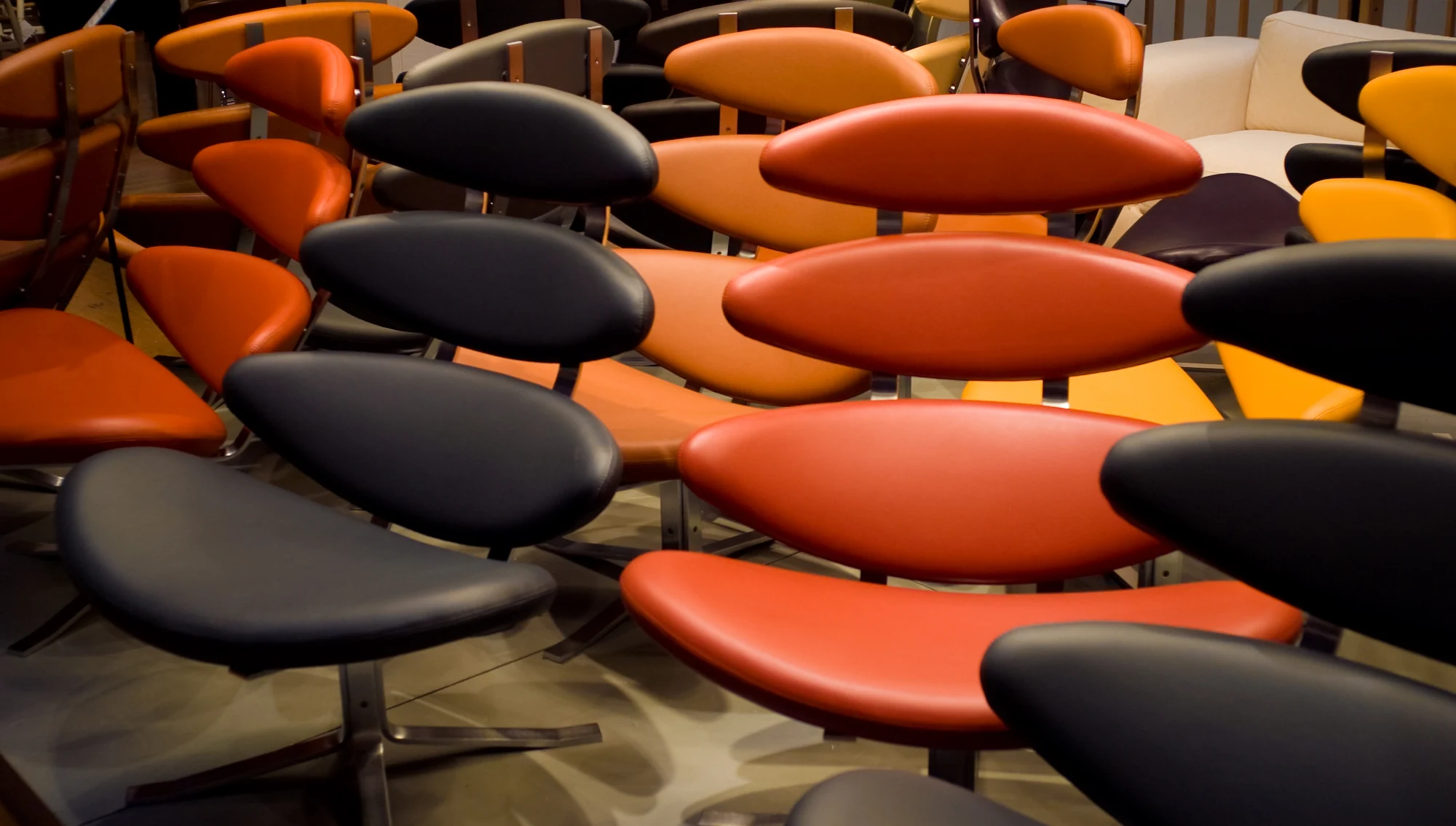
Lars Plougmann's 2007 photograph at Illums Bolighus turns that refusal into a chorus. Red, orange and black Corona chairs overlap across the frame. In the clearest examples, a broad seat is followed by three upholstered ellipses, each separated from the next by a strip of visible background. Repetition makes the rule easier to see: four pads, three pauses, one place to recline. 4
Those pauses are the thesis. Corona does not model the body by wrapping it in a single shell. It proposes several contact zones along a shared axis, then allows the eye to reconstruct the person they might support. The chair looks as though upholstery has discovered paragraph breaks.
The gaps are doing work
Fredericia's current Model 5000 specification describes a swivel lounge chair whose seat and back comprise four separately moulded, fully upholstered foam pads on a spring-steel frame.2
That is a present product record, not a universal x-ray of every Corona ever made. It does, however, name the parts that the photograph lets us read. The seat supports the lower body; successive pads rise behind the torso and head; the frame provides the line that holds the sequence together. The intervals keep one soft component from visually swallowing the next.
The gaps also admit the room. In Plougmann's crowded display, fragments of other chairs appear between the pads, making each Corona slightly porous even though its individual cushions look substantial. A continuous upholstered back of the same height would be a wall. Corona behaves more like a stack of signs: emphatic enough to be recognised, open enough to reveal the syntax.
This visual openness should not be confused with evidence about comfort, flexibility or hidden construction in another example. A photograph cannot tell us whether vintage foam has hardened, upholstery has been replaced or a frame remains sound. It can only show that absence was designed into the silhouette.
Before the ellipses, a pyramid
Fredericia traces Corona back to Poul M. Volther's post-war experiments with foam and material-saving construction. Its account identifies the 1953 Pyramid Chair as an earlier step: a wooden frame, a back divided into three parts and a claimed fabric requirement of only two metres. The chair did not become a broad commercial success, but the manufacturer presents it as the foundation for Corona.1
That lineage changes how the later chair reads. Separated cushions can look like exuberant Space Age styling when encountered without context. In the manufacturer's chronology, division began as a rational question: can support be placed where it is needed without covering every interval in cloth?
The later design is far more sculptural, but the old economy remains visible. Each ellipse earns its area. Between them, no upholstered material is asked to pretend it supports the body. The result is visually extravagant and conceptually parsimonious — a useful reminder that a chair may save material without volunteering to look austere.
Steel turns the stack into a spine
Fredericia says Volther began working with furniture producer Erik Jørgensen in the early 1960s to refine the idea. By 1964, its account continues, the collaboration had produced the sleeker version named Corona with a matte-chromed spring-steel frame.1
The change from a wooden outline to a narrow metal support is decisive. In the photograph, steel does not surround every pad like a picture frame. It appears in the intervals and below the seat, so the ellipses seem threaded onto one vertical route. That route is visually close to a spine, although the analogy is descriptive rather than anatomical engineering.
Below, the support opens into a low swivel base. Above, it disappears behind and reappears between the upholstered elements. Structure therefore alternates with softness instead of being either fully exposed or fully concealed. The chair is not a cushion collection balanced by optimism; one disciplined line keeps the sequence readable.
Fredericia's current materials and frame description help identify that logic, but they must remain current specifications. They do not establish the alloy, finish, foam recipe or upholstery history of an earlier chair. Corona's visual idea is repeatable; an individual object's facts still need their own record.
1961 and 1964 are different kinds of clue
The Musashino Art University Museum & Library collection search labels its Corona Chair by Poul M. Volther with 1961. Fredericia, by contrast, calls the 1964 result of Volther's collaboration with Jørgensen the refined version that received the Corona name.3
Those dates need not be forced into a winner-and-loser contest. The museum's brief public record does not explain whether 1961 refers to conception, a prototype or the particular design milestone it catalogues. Fredericia's longer history clearly uses 1964 for the completed named version after early development. Without a source that reconciles the fields, the responsible choice is to preserve both descriptions and say what each one actually does.
This page therefore uses 1964 for the graph's design date while keeping the museum's 1961 label in view. That is a publication decision about evidence, not a claim that work began on New Year's Day 1964. Furniture often arrives through drawings, prototypes, revisions, exhibitions and production; one year can become misleading when asked to impersonate the whole sequence.
The eclipse is not the whole show
Fredericia recounts that the Corona name was inspired by the glowing halo visible during a solar eclipse and connects the increasing ellipses to that image. It is a memorable origin story, and the chair's silhouette certainly knows how to pose for it.1
Yet the celestial nickname is less useful than the terrestrial construction. What makes Corona worth a second look is not that its cushions can resemble a halo. It is that Volther split a reclining surface into a bodily sequence, placed visible air between the parts and gave the sequence a steel line to follow.
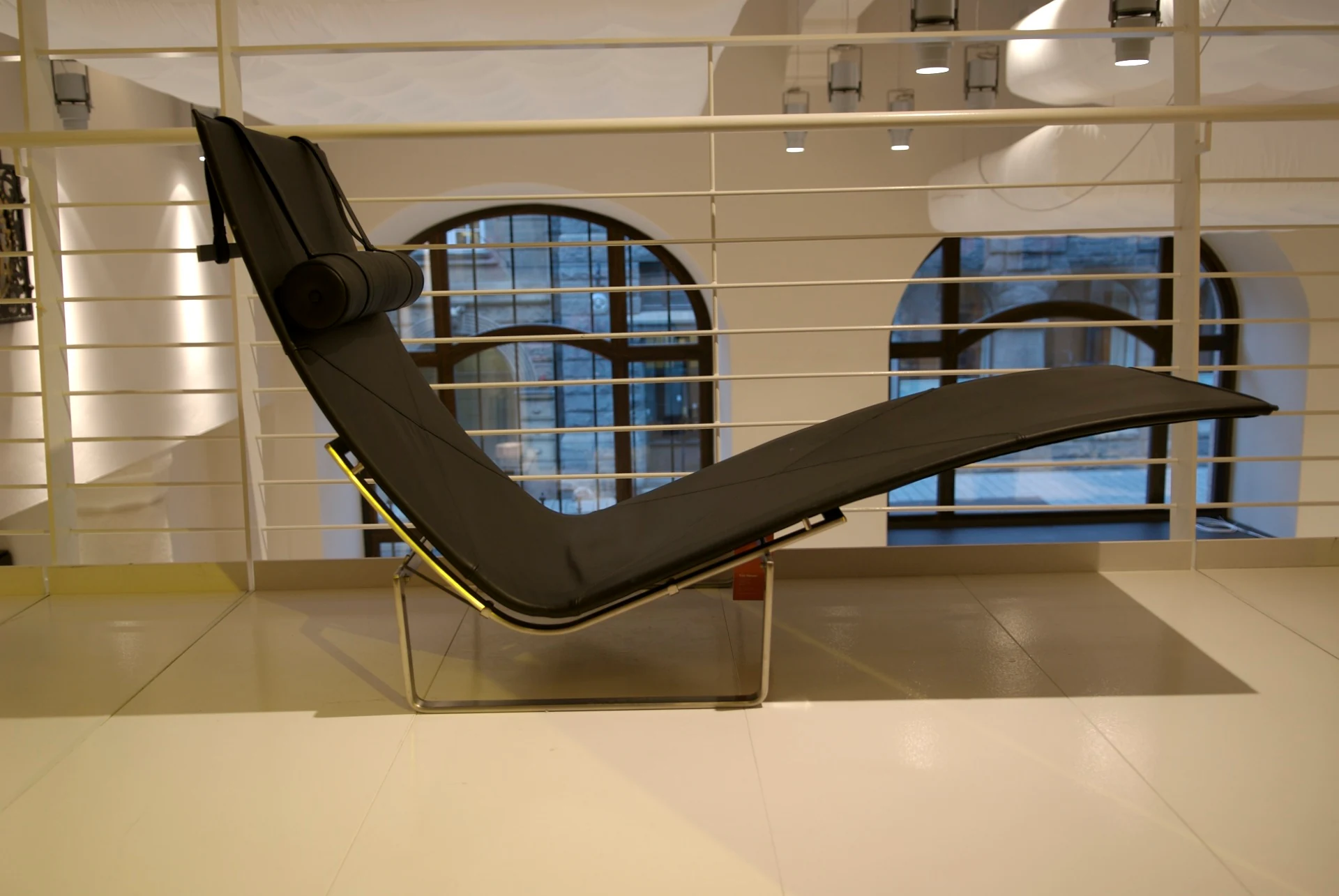
Poul Kjærholm's PK24 offers a revealing editorial opposite. PK24 carries the body on one uninterrupted curve poised over a separate base; Corona interrupts the curve and lets a central frame appear through the pauses. No reviewed source establishes an influence between the two. Their company here is simply a good reading test: one body, two Danish answers, and not a continuous backrest between them.
Corona's four pads finally behave less like pieces missing from a shell than words chosen for a short sentence. The gaps are not where the design stops. They are where we learn how to read it.